'Vasant' comes from the word 'spring' as this festival
(Vasant/Basant Panchami, also: Shree Panchami or Sarasvati Puja) heralds the
beginning of the spring season. New leaves and blossoms appear in the trees...
with the promise of new life (rejuvenation) and hope. ['Naba
Anande Jaago': link.] ~ Vasant Panchami also
announces the arrival of another big springtime event - Holi, the festival of
colours.
'Holi' comes from the word 'hola', meaning to offer
oblation or prayer to the Almighty as Thanksgiving for good harvest.
~ Holi, amongst the most distinct festivals of
India, evokes the buoyant spirit of the spring season. Well known for its
exuberant and colourful celebrations, Holi in India stirs up excitement among
people. Falling in the month of March/April, Holi celebrates the spring season
and renewal. ... Coming forth with the full flush of life, the invigorating air
of Holi festivities spreads into the lives of people. ~ Celebrated with energy
and revelry, the fervour of Holi pervades everyone - the young and the
young-at-heart alike. The essence of Holi festival is acknowledging and
celebration of the spirit of oneness (cohesion), of unadulterated joy ~ to
reset and renew... shunning/submerging all negativism, conflict and ill-will. ~
Holi has a special musical flavour. Traditional dishes include malpoa,
kheer sandesh, basanti sandesh, chaler payesh (rice pudding) etc. |
Holi 2014: March 17/18.
Here
are a few Tagorean compositions celebrating Basanta Utsab (spring festival). ~ The beauty and depth of Rabindra-sangeet (Tagore's magnificent music) is beyond description:
'Ananter
Baani Tumi': link.
'Phagun
Haowaay Haowaay': link.
'Phaguner
Nabin Anande': link.
'Ore Bhai
Phagun Legechhe' (composed with Raag Basant): link.
'Basante
Phool Ganthlo': link.
'Aaji
Basanta Jagrata Dvarey': link.
'Ore
Grihabashi Khol Dvar Khol': link.
'Neel
Digante Oi Phuler Agun Laglo': link.
'Aji
Jhara Jhara Mukharo Badoro Diney': link.
'Mor Bhabonare Ki Haowaay Matalo': link
... and the delectable 'Aji Dakhino Duar Khola': link.
~ As we know, Shamsundar Krishn is the personification of the king of seasons
- Rituraj Basant.
BG 10.35: || ṛtūnāḿ kusumākaraḥ || ~ "and of
seasons I am spring."
~ Heralding the onset of spring, Basant Panchami
celebrates nature as beautiful flowers and greenery starts to blossom in all
its glory. | Vasant Panchami is celebrated on the first day of spring, the fifth day (Panchami) of Shukla
Paksha (the fortnight of the waxing moon) of Magh Masa (month) - January-February. ... Vasanta Panchami, which marks the end of winter and heralds in spring, is dedicated to Goddess Sarasvati - the goddess of speech and learning, who blesses the world with vach (words) and the wealth of knowledge. This day is also commemorated by praying to Lord Krishna. | ~ It is the festival/celebration of the king of all
seasons: Spring/Basant. ~ It commences from spring season and carries up to
Panchami of Krishna Paksha of Falgun month, i.e. it begins with Makarasankranti and ends with Mahashivratri. [Holi is celebrated at the approach of vernal
equinox, on the Phalgun Purnima (Full Moon) ~ on the last full moon day of the
lunar month, Phalgun.]
Vasant or Basant is especially considered
significant for lovers of art and education (wisdom and intellectual pursuits,
not merely text-bookish knowledge or classroom schooling).
The day of Vasant/Basant
Panchami is considered to be the beginning of new life. Spring season is the
season of rebirth and bloom. Fields of yellow mustard charm the heart. Wheat
crop starts swaying like gold. Colourful flowers start blossoming. ... The day of
Basanta Utsab is (thus) celebrated as the welcoming of colours and happiness.
'Aanandadhaara Bohichhe Bhubane': link.
'Aami Ki Gaan Gaabo Je': link.
Here is: 'Esho Shyamala Sundara':
link.
... Coming
before us as personified spring is Shyamsundar Krishn ~ full of colour, joy,
and ecstasy and dressed as a daring dramatic dancer. Krishn means "all-attractive" (shyAmaH or kRiShNa means black - kaalah [all-absorbing/Ghanshyam.] Black does not reflect light. In the case of black, all the colours making up white light are absorbed which makes that object appear black).
| Krishn is "all-attractive" - at his charming and captivating best - with a
magical power to hold us spellbound. He looks like the full moon surrounded by its entourage of stars. His effulgent white turban appears especially splendid
sitting obliquely on his head. It is decorated with bunches of flowers,
sprinkled with fragrant reddish powder (pollen or "gulaal", or maybe
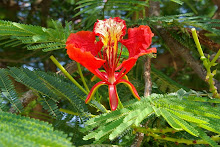
even the flaming-red Gulmohar, also known as "Krishnachura" or 'crown
of Krishna'), and surrounded by butterflies shaking his peacock feathered-crest.
His curly dark blue hair is tied back, and he wears glittering yellow garments
(Peetabasa; pitaH or HaridrabhaH = yellow in Sanskrit) just suitable for the spring season. A sachet of camphor is tucked
in his gem-studded belt. ... While listening to the vasanta raga (i.e. the
melody and the ecstasy of spring), Krishn holds a flute in his left hand and a
ball of red powder (gulaal) in his right hand. Overjoyed at the sight of
Krishna, the forest creepers display ecstatic dance. The gentle breezes from
the Malayan Hills appear as a guru to teach them how to dance. The
beautiful mango groves with their blossoming flowers appear like exuberant
laughter... and illuminate the grove with pleasant effulgence. Bumblebees,
cuckoos, and other exotic birds hum and warble pleasingly. The creepers dance
along according to the instructions of the wind. The spring season arrives in
the form of a playful lion cub showing his teeth as the stamens of the flowers.
The southern breezes force the chills of winter to depart. It appears as if
the nostrils of personified time has now opened and started breathing in and
out. ['Aanandadhvani Jaagao Gagane': link.] ~
The juncture of winter and spring seem like the period between childhood and
adolescence. Creepers explode with new buds. There are abundant colours all
around. The cuckoos sing a sweet melody. ... It seems as if the buds, birds, and
breezes all awaited the departure of the winter season. With the disappearance
of winter, the forests and trees beam with delight... and welcome the spring season
with plentiful colours and the sweet fragrances of fresh flowers. The camari
deer prepared the stage by clearing the forest floor with their bushy tails.
Wandering kasturi deer scented the air with the heady fragrance of
musk. ~ The creepers appear to be smeared with rich aromas. Even humans lose
their lethargy and feel a new energy flowing through them. Delighted, they
submerge in an ocean of joy and gaiety. There is gulaal, flying of
colourful (and even innovatively designed) kites, sumptuous feast and unlimited
happiness during the Holi festival. A new zeal of life can be seen coming in
all around. Colourful flowers decorate the earth. Swarms of butterflies dance in
mid-air and waltz among the flowering creepers.
~ Krishn
(personified spring) - the epitome of cool, the ocean of elegance, appears like
a dramatic artist dressed in colourful garments.
Hopeful,
festive, fresh flavour, evergreen, vibrant - a raag that is suitable for
singing in the evenings, a raag that ushers in the festive spirit and
one that dispels pessimism and instills hope - it's the raag Vasant. | "Vasant"
means springtime, and this raag has been suitably named since all that
is associated with it is hope and positivity. Vasant is a lively raag
and the happiness it exudes is endearing and irresistible.
Shyamsundar, whose joyous
nature spreads in all directions, fills the horizon with the reflection of his
enchanting *blue complexion. ~ Whose mind participating in this flourishing
festival of spring will not elate?
... All this is of course
allegorical. The spring season is described ~ with Krishn as personified
spring.
~ The dance is the
Divine Dance - the fascinating picturesque dance of colours - between Purusha (Cosmic Energy or Primal Creative Energy - unmanifested Purusha + its embodiment or manifestation) and Prakriti
(Manifested Nature). ~ Between the Creator and Created. Between the Infinite and finite.
Between the Eternal and the evanescent.
Krishn is Hari (haritaH or PalashaH means green in Sanskrit) ~ and
so, is also depicted as wrapped in cool cyan - bluish green). neelaH = blue. ~ He is Kshiteeshah:
The Partner (allegorically speaking) of the earth/nature.
HA= sky
RA= fire
I= energy
HARI = effulgent omnipresent omnipotent omniconscient cosmic energy.
Rudra Gayatri Mantra: ||
yo rudro agnau yo apsu ya oṣadhīṣu yo rudro viśvā bhuvanā viveśa tasmai
rudrāya namo astu || ~ "To the Rudra who is fire, who is in water, who
is in trees and plants, who has entered into the entire Universe, to that Rudra
let our salutations go." | Rudra-Siva's depiction is allegorical (refer link1)
but the face is feminine.
[The Milky Way galaxy itself was seen as the path of Aryaman (the noble one) or the Ganges
(the name etymologically related to going) of the sky (akash-ganga). ~ Here
is 'Taba
Charana Nimney': link. | Tagore's
'Suneel Saagorer Shyamal Kinaarey': link. | ~ Songs
by Rajanikanta Sen is known as "Rajanikanter Gaan". Tagore's compositions are called "Rabindrasangeet" - Tagore's magnificent music.]
'Ayi Bhuban Mano Mohini': link. [~ This
song is Tagore's celebration of nature during springtime. The sublime verses
also celebrate Goddess Sarasvati and Goddess Parvati as Rudra-Siva. ~
This song should also help us understand just who the Mohini-avatar is. |
Mohini = rare, uncommon. ~ The Krishn-avatar, a
male, is also known as "Mohan". Therefore, "Mohini" is
simply the feminine of "Mohan"... and is indicative of a female. The
'Sudarshan Chakra' - the combination of Ajna chakra (the 6th chakra)
and Sahasrara (the 7th chakra or crown chakra - the highest chakra) is associated
with this avatar. 'Heye Khaniker Atithi': link. ('Ogo akoruun (wily one), ki maya (guile/brilliant manoeuvres) jano, milanchhaley biraha aano'.) ~ The Mohini-avatar acquired the (metaphoric/allegoric) pot of
'ambrosia' from the malevolent entities ~ via diplomacy and ample use of guile, then returned it
to the
positive forces, thereby enabling the latter to regain their mojo or pre-eminence. Thus, the machinations of the malevolent or negative
entities came to a naught.
(~ The positive entities of course had to perform their collaborative,
sustained
and tangible karm-yog - to regain that pre-eminence.) ... This tale too
can well be
an allegorical tale, applicable to all eras/yugs.] | The Indus seal depicting a Tiger Lady or Tiger
Goddess is (very likely) the depiction of Rudra-Siva. The glyphs also show a
trishul. ~ The tiger probably
indicates Rudra-Siva's valiant nature. [shoorah-veerah
(the valiant); vikramee (the most daring).] ~ Trishul
could be a reference to a group of three Himalayan mountain peaks. Or it could
be an allegory for the three rivers: Ganga, Yamuna and the mythic Sarasvati. Or
both. [The confluence of the Ganga, Yamuna and the Sarasvati is known as
Triveni Sangam or Prayag. Triveni and Trishul; tri = three. | Some poets assert that while sangam is a popular word
for a confluence of rivers, this particular confluence was called Sangayam, to
represent the meeting of Sarasvati (sa), Ganga (ga) and Yamuna (yam). Sangayam could mean, to flow together.] | ~ Rivers and cows are often poetically correlated in the
Rig Veda. (~ Cows emerging out of mountains - is a reference to various rivers; in the Arya or noble 'way of life' rivers
and water-bodies were not polluted). | This should also help us
understand what 'cows' are associated with Krishn. | Gopa = ruler, king or
monarch. ~ BG 10.27: || narāṇāḿ
ca narādhipam || ~ "and among humans I am the monarch"
(Cakravartin - a sagacious and sensible consensus-builder, someone with a broader outlook/vision, an able leader and administrator + guardian [protector/preserver and guide].)
BG 10.24:
|| sarasam asmi sagarah || ~ "and
of bodies of water I am the ocean." | ~ It is a reference to the mighty
River Indus, perhaps the largest of all rivers in the world after the Nile -
Sanskrit: Nilah or Neel. | Sarasam also indicates saras - meaning:
gracefully flowing. Saras or Sarasa means spring, pool or fountain. Saras or Sarasa can also indicate SarasvatI. ~ The Sarasvati River is an important river
goddess in the Rig Veda. The Sanskrit name means, "having many
pools". The Sanskrit name for the River Indus is Sindhu. "Sindhu" means river,
stream or ocean in Sanskrit.]
~ The Sindhu and SarasvatI are mentioned repeatedly, respectfully and glowingly in the Rig Veda. The region between the Sindhu and Sarasvati rivers
were regarded by the Rig Vedic people as the holiest of holy grounds - Brahmadesa. The two rivers nourished tall majestic trees, plants and flowers. The SarasvatI River is an important river goddess
in the Rig Ved ~ whose banks served as fertile soil for the growth of ancient
Vedic culture. ~ The spectacular scenery and the might of Indus had
inspired the composition of hymns on Sindhu (Sanskrit name for the River Indus). Thousands of years ago the might of the Sindhu and Sarasvati had given
birth to the oldest and largest civilization of the ancient world - the Arya Civilization (also known as the Indus-Sarasvati Civilization or 'Aryavarsha'). | "The Rivers have come forward triply, seven and seven. Sindhu in might surpasses all the streams that flow." Its power is praised as mighty and unrestrained, of independent
glory, roaring as it runs. Other
rivers roar into the Sindhu. [BG 10.24: || sarasam asmi sagarah || ~ "and of bodies of water I am the ocean." | Sindhu" means river,
stream or ocean in Sanskrit.] As
a warrior-king leads other warriors, so does Sindhu lead other rivers. The Indus, considered sacred, is further described as
the lord and leader of the moving floods, active as a dappled mare, mighty as a
bellowing bull, kind as a mother to her calves, rich in gold, rich in ample
wealth ~ for whom Varuṇa, the water god, cut the channels for its forward course. ~ "His
roar is lifted up to heaven above the earth: he puts forth endless vigour with
a flash of light. Like floods of rain that fall in thunder from the cloud, so Sindhu rushes on bellowing like a bull. ... Sindhu, unto thee the roaring rivers run. Thou leadest as a warrior king thine army's wings what time thou comest in the van of these swift streams. Most active of the active, Sindhu unrestrained, like to a dappled mare, beautiful, fair to see. Rich in good steeds is Sindhu, rich in robes, rich in gold, nobly-fashioned, rich in ample wealth. Blest Silamavati and young Urnavati invest themselves with raiment rich in store of sweets. Sindhu hath yoked her car, light-rolling, drawn by steeds, and with that car shall she win..." [BG 10.27: || uccaiḥśravasam aśvānāḿ
viddhi mām || ~ "Of horses know Me to be Uccaiḥśravā."] | A masculine river is called "Nad", a feminine one
"Nadi". ~ Of all the Vedic
rivers, the Sindhu is both masculine and feminine.
[Note: The SarasvatI is (also) called "she with seven
sisters" (saptasvasā). ~ The 'Sapta Sindhu'
("seven rivers" - Vedic Sapta Sindhavaḥ; "Sindhu" means river,
stream or ocean in Sanskrit) refers to the
rivers SuturI (Sutlej), VipASa (Beas), AsiknI (Chenab), ParuSNI (Ravi), VitastA (Jhelum), Sindhu (Indus) and
probably KubhA. | 'Snow White and the Seven Dwarfs' ~ does this fairy tale allude to SarasvatI
and the seven rivers - "she with seven sisters" (saptasvasā)? ~ The story may have
undergone several variations and/or may have been largely unrelated.]
Devi Sarasvati represent the divine forces in play in the
growth, expansion and evolution of the Universe. This aspect of the growth of
the Universe is thus steeped with the knowledge of all that has transpired
since the moment of Creation and continues to drive the further evolution of
the Universe. This driving force of knowledge is called as the divinity Sarasvati
as it is a knowledge that continues to flow through the expanse of the cosmos
gracefully and incessantly like waves. [Saras means gracefully flowing.]
~ This knowledge power forms the root for all forms of knowledge, speech (vak),
skill, arts, fine arts, craft etc. ~ Sarasvati is therefore the divinity
that promotes the development of all of these capabilities in mankind, society
and civilization. | Goddess Sarasvati is (thus) Vishva Nath - Sovereign or Monarch (Nath) of the Universe
and Lord of Creation. ~ She is Mahat - Higher Soul or Guiding Spirit. (Mahat means literally the Great One, and is also interpreted as meaning
universal mind or cosmic intelligence). Goddess Sarasvati is Ishvari - the Cosmic Entity (~ Cosmic Ruler and Cosmic
Teacher/Steward-mentor - the Primordial or Primal Being). She is the motive
power and guiding spirit (Mahat) behind the mathematically precise universes. She is the supreme power/authority of the universe/cosmos - adhaataa (above whom there is
no other). | Goddess Sarasvati is
also the manifestation of the impersonal, unmanifested 'Primal Creative Energy' (~ known as 'Aadi Shakti' or 'Brahm-jyotih' - the Absolute OM - the impersonal (nirguna), unmanifested or avyaktah, Niraakar
Brahmn - Cosmic Light or
Light Divine. In other words: divine effulgence). | Aadi = Primal or Primordial;
Shakti = Creative Energy; Aadi Shakti = Primal Creative Energy. | Goddess Sarasvati is thus the highest possible conception of the impersonal (nirguna), unmanifested or avyaktah, Niraakar
Brahmn (the Absolute OM - Cosmic Light or
Light Divine or divine effulgence - Brahm-jyotih or 'Aadi Shakti' - Primal Creative Energy). | Goddess Sarasvati is (thus) manifested Brahmn - vyaktah, saguna, Saakar Brahmn. She is therefore, Omswaroop - manifestation of the Absolute OM - Cosmic Light or Light Divine (~ 'Brahm-jyotih' or 'Aadi Shakti' - Divine Effulgence). Hence, She is also known as Brahm-putri. [Here, 'putri' =
manifestation, personification or embodiment.]
Thus, it is said: The seen
(manifested - vyaktah, Saakar, saguna Brahmn) and the unseen (impersonal, unmanifested
- nirguna, avyaktah, Niraakar Brahmn) are both one. | Thus the Absolute OM ('Brahm-Jyotih' or 'Aadi Shakti') and Mahat (Higher Soul or Guiding Spirit - universal mind, cosmic intelligence) or Ishvari (the Cosmic Entity - Cosmic Ruler and Cosmic
Teacher/Steward-mentor - the Primordial or Primal Being) are both one.
The Devi Mahatmyam ('The Magnanimity of the Goddess', also known as the
Sri Sri chandipATh) celebrates both the aspects (manifested and unmanifested OM).
~ Here
is 'Pratham Aadi Taba Shakti': link.
'Tumi Aadikabi, Kabiguru tumi heye' ~ Maharshi Valmiki is known as "Aadikavi". | Tagore says that Valmiki
overcame his negative karma (prarabda karma) and compiled the Ramayana ('The
Exertions of Sri Ram') - due to Goddess Sarasvati's
blessings. | Tagore himself is called
"Bishwa-Kabi", which means the poet of the world (universal bard), he
is sometimes also called "Kabiguru", which means the guru of poets.
His genius enriched whatever it touched. ~ In this composition Tagore hints at
his source of inspiration; he also credits the Goddess for his multifaceted talent
and vast oeuvre.
........................................................................
The impersonal (nirguna - without qualities) and unmanifested (avyaktah, niraakar - without form) Brahmn (~ the Absolute OM - 'Brahm-jyotih' or 'Aadi Shakti' - Primal Creative Energy - Divine Effulgence or Cosmic Light) is defined as the one self-existent impersonal spirit - the
Divine Essence, from which all things emanate, by which they are sustained, and
to which they return. | The impersonal Absolute OM is beyond all thought. | Primal Creative Energy ('Brahm-jyotih' or 'Aadi Shakti') does not mean feminine energy. Energy has no form or gender. ~ Primal Cosmic Energy is Purusha - Cosmic Energy or Supreme Cosmic Spirit. | The Cosmic Entity or Primal Being is Purushottama (Supreme Being) or Purushottama Satya - Supreme Godhead. | The impersonal Absolute OM is Omprakash (Cosmic Light or Light Divine). The Almighty is Omswaroop - manifestation of the impersonal, unmanifested Absolute OM.
BG 11.12: || divi surya-sahasrasya
bhaved yugapad utthita yadi bhah sadrisi sa syad bhasas tasya mahatmanah || ~ "If the radiance of a thousand suns
were to suddenly come forth in the sky, that would be like the light of the (impersonal,
unmanifested - nirguna, avyaktah, niraakar) Brahmn - the Absolute OM." | [Mahatmanah = Supreme Cosmic
Energy. | Krishn is referring to the
impersonal, unmanifested Brahmn (the Absolute OM - Primal Creative Energy) - 'Brahm-jyotih' or 'Aadi Shakti' (i.e. Cosmic Light
or Light Divine - divine effulgence).
The impersonal (nirguna - without qualities), unmanifested or avyaktah, Niraakar
Brahmn (the Absolute OM - Cosmic Light or
Light Divine or divine effulgence - 'Brahm-jyotih' or 'Aadi Shakti') is the light (divine
effulgence) that impersonalists perceive in the Nirguna (without qualities) or unmanifested (avyaktah, Niraakar - formless) mode of God/Almighty.
All creation-related work is the work of Fire (i.e. Cosmic
Fire - Cosmic Light, Light Divine - Brahm-jyotih or the impersonal, unmanifested 'Aadi Shakti' - Primal Creative Energy.) ... The impersonal, unmanifested
Brahmn (the Absolute OM) is thus revered as the Supreme Creator
(Srashtaa).
~ This is the basis of Advaita
(monism).
Goddess Sarasvati is Omswaroop - manifestation of the Absolute OM (~ impersonal, unmanifested 'Brahm-jyotih' / 'Brahma-jyotih' or 'Aadi Shakti' - Primal Creative Energy). ~ She is therefore, Brahm-putri or Brahma-putri - manifestation or
personification of the impersonal, unmanifested Absolute OM (~ Cosmic Light or Light Divine or Divine Effulgence - impersonal 'Brahm-jyotih' or 'Aadi Shakti').
... Thus, Goddess
Sarasvati is the Cosmic Entity... and can also be called the saguna, vyaktah, saakar Goddess Aadi Shakti. | The impersonal, unmanifested Absolute OM and the manifested OM (the Almighty - Cosmic Entity) together possesses the Power of the three cosmic phenomenons of Srsstti-Sthiti-Vinaashaanaam - i.e. the Power of Creation,
Maintenance/Preservation and Dissolution
(~ distinguished by
the names: Brahma-Vishnu-Shivah/Rudra).
~ This is the basis of Dvaita
(dualism or duality).
~ Brahma-Vishnu-Shivah is simply the names of the
three aspects of the cosmic phenomenon of Creation,
Maintenance/Preservation and Dissolution, respectively.
Keshavah - one who is the three. | Keshavah = kah Brahma, ah Vishnu and Isa Shiva ~ indicating
the power of Creation, Maintenance/Preservation and Dissolution
(i.e. the three aspects of the cosmic phenomenon of
Creation, Maintenance/Preservation and Dissolution). | If we comprehend the Advaita and the Dvaita aspects we can then understand what the Cosmic Trimurti of 'Shiva-Brahma-Vishnu' and 'Parvati-Sarasvati-Lakshmi' indicates. ~ The first Trimurti indicates the impersonal, unmanifested Absolute OM. The second Trimurti represents the manifested OM - the Almighty. | The impersonal, unmanifested Absolute OM/Brahmn is the Supreme Cosmic Spirit - Primal Creative Energy. ~ The manifested Brahmn/OM or the Almighty - Universal Consciousness or universal mind or cosmic intelligence is the manifestation of the impersonal Absolute OM/Brahmn... and is therefore, the Higher Self or Supersoul - Atman or Param-atma. ... Thus, the latent spiritual energy within humans - kundalini energy - is associated with the Almighty.
~ The
Cosmic Entity or Ishvari is asankhyeyah (with countless names and forms). She is also known as Narayan or Narayani. | Narayan or Narayani does not indicate gender; it means: refuge of all living entities. ~ Even Ishvar or Ishvari does not indicate gender; both mean: Cosmic Entity or Almighty. | The Cosmic Entity is also kartaa: The doer, maargah: The path,
and neyah: The guide. [This is indicative of Her role as the Cosmic Ruler/Monarch + Cosmic Teacher and Steward-mentor.] ~ Thus, She is Sarasvati (the Creator) - and is, therefore, depicted along with the impersonal, unmanifested cosmic Brahma (the Supreme Creator
or Srashtaa aspect of the Absolute OM). Goddess Sarasvati/Narayani is also the Stabilizer/Preserver/Maintainer - of all the worlds; thus She is depicted as Lakshmi alongside the impersonal, unmanifested cosmic Vishnu (the Sustainer/Maintainer or Preserver aspect of the Absolute OM). Goddess Sarasvati is also the manifestation of the impersonal, unmanifested 'Brahm-jyotih' or 'Aadi Shakti' - Primal Creative Energy, the Absolute OM - and hence, She is (also) depicted as Shakti/Parvati alongside the impersonal, unmanifested cosmic Shiva (the dissolution aspect of the Absolute OM). ~ This should perhaps explain why Shiva and Rudra too have a syncretic form. The manifested, saguna Trimurti of 'Sarasvati-Lakshmi-Parvati' is the manifested Rudra. | The impersonal, unmanifested 'Aadi Shakti' or Absolute OM, as Brahma (the Supreme Creator
or Srashtaa) has
created fourteen planetary systems; the impersonal, unmanifested 'Aadi Shakti' or Absolute OM sustains, maintains and preserves
the universe as Vishnu (the Stabilizer/Preserver/Maintainer of the cosmos)
and dissolves the universe at the end of maha-kalpa as Shiva or Rudra. | If we understand this, we will fully comprehend what 'Shiva-Brahma-Vishnu' and 'Parvati-Sarasvati-Lakshmi' indicate, i.e. what the holy
Trimurti is all about. | If we understand the concept of Rudra-Shakti (the syncretic form ~ to create brahma-ranhdra, the transcendence of both) - all the aspects of the holy trimurti can be understood.
And then, we can also fully comprehend the following verses:
|| eko vai nārāyaṇa
āsīn na brahmā na īśāno nāpo nāgni-samau neme dyāv-āp ṛthivī na nakṣatrāṇi na sūryaḥ || ~ "In the
beginning of the creation there was only the Primal/Primeval Being Nārāyaṇa.
There was no Brahmā, no Śiva, no water, no fire, no moon, no stars in the sky,
no sun."
|| nārāyaṇaḥ paro devas tasmāj jātaś
caturmukhaḥ tasmād rudro 'bhavad devaḥ sa ca sarva-jñatāḿ gataḥ || ~
"Nārāyaṇa is the Supreme/Primordial/Primeval Being ~ from whom Brahmā was born,
from whom Śiva was born."
BG 15.12: || yadaadityagatam
tejo jagad bhaasayate'khilam yacchandramasi yacchaagnau tattejo viddhi
maamakam || ~ "That light which, residing in the sun, illumines the
whole world, that which is in the moon and in the fire - know that light
as Mine."
"You shine, all living things emerge. You
disappear, they go to rest. Recognizing our innocence, O golden-haired Sun,
arise; let each day be better than the last." ~ the Rig Veda.
BG 10.33: || dhātāhaḿ viśvato-mukhaḥ
|| ~ "and of creators I am Brahmā."
BG 10.23: || rudranam sankaras casmi || ~ "Of all the
Rudras I am Sankara" [Rudra-Śiva].
BG 10.33: || aham evākṣayaḥ kālo || ~ "I am also inexhaustible time."
And, BG 10.34: || mṛtyuḥ
sarva-haraś cāham udbhavaś ca bhaviṣyatām || ~ "I am all-consuming time,
and I am the generating principle/cause/energy of all that is yet to be."
(~ Alternatively: "I am all-consuming time, and I am too the birth of all
that shall come into being.")
... And then, we will also understand why unlike the rigorous
monism (Advaita) of the Upanishads, the Srimad Bhagavad-Gita also integrates
dualism or duality (Dvaita) and theism (āstika).
The Upanishads: || As is the human body, so is the cosmic body
As is the human mind, so is the cosmic mind.
As is the microcosm, so is the macrocosm.
As is the atom, so is the universe ||
~ After a cycle
of universal dissolution (when the manifest cosmos is completely dissolved), the Absolute OM recreates the cosmos. ~ The rest of the above verse possibly is indicative of some aspects of what the Large Hadron Collider is endeavouring to achieve.
Maybe: After a cycle of universal dissolution (when the manifest cosmos is completely dissolved), the Absolute OM decides (in a manner of speaking) to recreate the cosmos so that we jiva-souls (individual souls or mere Self) can experience
worlds of shape and solidity. ~ Maybe: very subtle atoms begin to combine, eventually
generating a cosmic wind that blows heavier and heavier atoms together. ~ Maybe: Jiva-souls,
depending on their (cumulative) karma - earned in previous world systems, spontaneously draw
to themselves atoms that coalesce into an appropriate body.
On a side note: This cumulative karma (including carried over prarabda karma or
negative karma) probably also affects or impacts their lives ~ thereby
shaping the societal or world conditions. ~ The resultant actions (including weakness
of attitude, crudity - lack of refinement of thought, or misguided actions
driven by base emotions such as avarice, malice etc) impact society. ~ It is human
follies and frailties, failings, mindless acts, prejudices and so on that shape the societal and world conditions. ["Weakness
of attitude becomes weakness of character." | "Any
intelligent fool can make things bigger, more complex, and more violent. It
takes a touch of genius - and a lot of courage - to move in the opposite
direction." | "Great spirits have often encountered violent opposition
from weak minds." ~ Albert Einstein.] | Human failings and follies cannot
be ascribed to the Almighty or to destiny. [It is part of human prarabda karma or negative karma.] God is sublime. God is subtle. God integrates empirically.
God does not play dice. | "What destiny had in store" (meant in a negative or retrogressive connotation) - is part
of a long list of callous and shallow idioms and colloquial sayings. It merely
reflects the ignorance of those responsible for the coinage and perpetuation
of such phraseology. | Various ailments and
disorders too can be traced to health and hygiene issues, lifestyle issues,
heredity, stress, environmental factors, chemical content, pollution, and so
on. | "Two things are infinite: the universe and human stupidity; and
I'm not sure about the universe." ~ Albert Einstein. | E.g. 'test by fire' is
indicative of hardships or the vicissitudes of life. But mindless/negative/retrogressive
thinking (by humans) can turn it into something else. Similarly, 'nose-cut' indicates hurt ego or pride or affront arising
out of perceived slights. ~ And yet, mindless/negative/retrogressive thinking (by
humans) can give it a totally different connotation.
Sri Ram and his siblings were born due to advanced IVF therapy; their
deeds benefited society, and so, humans born due to IVF therapy were accepted
(while Dvapar rejected genetically engineered and cloned humans). This would have helped childless couples. | Due to the efforts of Sri Ram and his associates, Treta also accepted
certain groups of humans (such as the vaan-nar or forest (vaan)-dwelling human
(nar) - adivasi or vaan-vasi, as well as the 'tritiya prakriti') as
full-fledged humans, with a distinct 'way of life'. ~ Hanuman-ji is depicted
with a tail, this is allegorical - perhaps an allusion that prior to Sri Ram's
efforts to mainstream them, these groups of humans were not considered as
full-fledged humans. Maybe, they were considered as sub-humans or part of the
animal world. [~ Hanuman-ji, Sugreeva, Angad, Riksharaj Jambavan, Nishadaraj Guhaka or
Guha, etc were forest-dwellers. Vaan-nar Sena was an army peopled with forest dwellers.] | 'Lakshman Rekha' is a Tulsidas terminology. | 'Golden deer' is a reference
to destiny (Goddess Sarasvati - Varadey Kaamarupinee [kamadhenu] - the fulfiller of wishes ~ provided one is deserving and makes the required effort). ['Maayabanobiharini Harini': link.] ~ Mandodari - Ravana's queen - was Sita's mother; both were so
alike that even Hanuman-ji was confused. It is unlikely that Ravana attended Sita's Svayamvara. It probably came about courtesy later re-telling, folk theatre, and the like. ~ Tulsidas was also instrumental in starting the
folk event/folk theatre (village costume drama) known as Ram-lila. | Ravana, an Arya, succumbed to his excessive ego (hubris) and
vaulted self-image, besides he was probably misled by his over-achingly
ambitious son - Meghnaad. [Ravana's ten heads alludes to his excessive vanity and exaggerated self-image - his temperament flaws; it also represents ten kingdoms. Despite this, Ravana was not a Cakravartin-raja. ~ Top-heavy - 'too many cooks spoil the broth'.] ~ After the fall of Ravana, and the dismantling of
various destructive weaponry (including gigantic humanoid-robots fitted with an assortment of weaponry ['Kumbhakarna'], nuclear weapons - euphemistically referred to as 'Shiva-dhanush' and potent nerve agents)
- the sagacious Vibhisana (Ravana's younger brother) was crowned king by Sri Ram. ... And yet, we have been burning Vibhisana's effigy with
gusto ~ possibly a legacy of post Gupta era stage-plays and folk theatre. [~ The Ramayana ('The Exertions of Sri Ram') has over 3,000 re-telling and/or versions,
not to mention the numerous poems and colloquial sayings based on it.] | In all likelihood, Hanuman-ji was fair complexioned, the colour of vajra
(thunder). Hanu = jaw in Sanskrit, probably indicative of a large jaw. ~ Hanuman-ji
could not have set fire to Lanka with his tail - he was not a monkey; he was
human. This too (probably) is a result of later dramatics, folk theatre, and the like. Also, indulging in plunder and pillage was most un-Arya-like (ignoble); it
is unlikely that Sri Ram, one of the finest of Aryas, ever indulged in such
activities. Besides, Vibhishana (an ally of Sri Ram) succeeded Ravana. What
would he have governed over then? | Maharshi Valmiki and Sri Ram were not
contemporaries. Sri Ram had nothing to do with the concept of "race" either. | As
for Lakshman and Urmila: they remained apart for 14 years - owing to Lakshman's
dedication and a sense of duty towards bringing about certain positive societal change.
~ Maybe, it was a mutual decision to not involve her; Sita's presence, on the
other hand, was required - to fructify the larger goals and objectives.
Maybe, Urmila had some other role (pertaining to administrative functions). We don't quite know. ~ However, Lakshman and
Urmila remained committed to each other - throughout those 14 long years. It's a personal thing. ~ There have been several great humans who have ventured beyond their personal comforts and happiness... to work for the larger good; the world is a better place due to their efforts and contributions. | Sri
Hanuman probably was a highly skilled pilot, and flew a variety of aircraft
(vimana). This (perhaps) has been mistranslated as 'Hanuman-ji carried Ram and
Lakshman on his shoulders'. 'Pavan-putra' = Airman. | Also, Sri Ram could look
beyond the mundane. And so, when Shabari - a rustic lady, offered him some wild
berries - after personally tasting them (to determine their sweetness), he
unhesitatingly accepted them. He saw the thought behind the (apparently unsophisticated) gesture; most
people would have considered it as an affront. He did not sit on a pedestal either. Therefore, paintings and
iconography depicting Sri Hanuman kneeling in front of Sri Ram with folded
hands, is a result of post Gupta era art (~ and may have given rise to certain
perceptions and cultural schisms). ~ BG 9.26: || patram
pushpam phalam toyam yo me bhaktya prayacchati tad aham bhakty-upahritam asnami
prayatatmanah ||
~ "Whoever offers Me a leaf, a flower, a fruit or water - with love, devotion
or a clear/pure consciousness (prayatatmanah), I will accept it." ~ He is
essentially saying that he sees, appreciates and values the thought behind the gesture. Not
the offering itself. | Sri Ram's actions not only helped create a better/progressive society
but also gave him the required gravitas and goodwill... once he ascended the
throne; he (probably) deferred the coronation, Kaikeyi and Manthara aided him. ~ His 14-years-long exile was
(very likely) a voluntary one; in his absence, (Kaikeyi's son) Bharata -
younger to Ram but older than (Sumitra's twins) Lakshman and Shatrughna - was
an acceptable alternative. [He may not have acquiesced on his own, though; 'coz
even in Ram's absence he chose to sit next to the throne.] ~ Raja Dasarath was
suffering from an assortment of old age-related ailments, and was (thus) keen on
arranging the coronation. Sri Ram, however, (probably) was keen to defer
it, 'coz as Dasarath's heir he wouldn't have had the required gravitas to bring
about (i.e. implement) perception and mindset change - leading to sustainable (organic) social reform (~ 'coz no
amount of royal decree would have achieved it; mere platitudes and/or text will not change or curb deep-seated
retrogressive perceptions, mindset and conditioning; there is no other way to implement measures leading to positive social change - especially if it involves attitudinal change, etc - except through steadfast/dedicated karm-yog - sustained actions); besides,
kingly duties, etc would have straitjacketed him. ~ BG 10.31: || pavanaḥ pavatām asmi rāmaḥ śastra-bhṛtām
aham || ~ "I am the wind among the purifiers, and Sri Ram
among the warriors" ~ i.e. warrior against moribund aspects, retrogressive mindset, worldview,
and the like. | The person of action (karm yogi) does not
withdraw, but cheerfully embraces struggle and toil as the
ideal in life. (~ Sri Ram accepted
continuous struggle and toil as being intrinsic to bringing about positive
societal change; change in firmly held/ingrained mindset, viewpoints,
conditioning, perceptions and so on. 'Coz it also involves course correction, including resetting/redirection of
humanity/society's inner compass... and so, cannot be sustained by ephemeral whims of the moment. Besides, mere classroom teaching or textbook knowledge does not ensure a progressive outlook). For a nishkam karm yogi, selflessness consists of
the renunciation of personal desire (a carefree life, personal glory, praise,
accolades, and the like), not of action itself.
The Ramayana War did not happen over riches or territories. The major reasons for the
Ramayana War was to destroy/dismantle dangerous weaponry (including nuclear
weapons, gigantic humanoid-robots like "Kumbhakarna" and potent nerve
agents) + to bring about mindset and attitudinal change (via-a-vis
certain groups of humans, like the vaan-nars - forest-dwelling (vaan) human (nar), the
"tritiya prakriti" + humans born out of advanced IVF therapy). Sri Ram 'breaking the Shiva-dhanush' =
dismantling of the "Shiva-dhanush" or Pinaka - euphemism for the most
destructive nuclear weapons - after an all-round agreement/general consensus
(though it is unlikely to have happened during Sita's Svayamvara, although Sita-ji too knew how to dismantle the "Shiva-dhanush"). | "Jal-samadhi" could be an allusion to the "Byomkesh" metaphor, since
unlike the Krishna-avatar, the Ram-avatar is depicted with a jata. [Note: Byomkesh is derived from byom/vyom
(sky or air) and kesh (hair). ~ Lord Shiva received into his
dredlocks (jata) the Ganga - to minimize the immense impact
(devastation) of her fall. It is a reference to the metaphoric or allegoric tide/torrent of the
Ganga that Lord Shiva is supposed to have held in his jata (dredlocks)
and (thus) become Byomkesh. (This
Ganga is a metaphor; it is not a reference to any river per se.) ~
Perhaps it is an allegory to indicate that his actions saved/protected
humanity/society from great misery and/or mitigated (in force or intensity) the
long-term damage. Maybe, it brought about a turnaround - a positive change of course, and helped lay the foundation for a new and better society to emerge.] | Jatayu (and his brother Sampati) were not birds
but humans belonging to the Shakuna clan (~ an ancient group or clan that
displayed a vulture-totem or insignia). Therefore, Raavan could not have
slashed Jatayu's wings. Also, Sita could not have lamented, cried and shouted
for help theatrically, then thrown down her jewelry from an aircraft (vimana);
none can open windows of a vimana up in the sky. ~ These are probably later
additions (very likely post Gupta era) - courtesy folk theatre, re-telling,
village/stage plays, etc. Raavan also especially deputed Vibhishana's
wife, Sarama, to look after Sita during the latter's period of
"captivity" at Ashoka-Vatika. However, even after his vanity had got the better
of him, and despite all that Meghnaad was up to, it was none other than
Vibhishana who assured Ram...
that Ravana will never let any harm come to Sita. (Vibhisana had by then come over to Ram's side. ~ But even then, i.e. even after
Vibhishana joining forces with Ram, his wife, Sarama, continued to stay in
Lanka, and continued to look after Sita; Ravana never harassed her).
~ And, this is not surprising. It was a different era, when Arya Dharma was prevalent, hence Treta is regarded as the "Silver Age". The Aryas
followed certain ethics even when they fought wars. ~ They did not indulge in pillage; they did not harm the trees or livestock, nor pollute the water-bodies. They also did not cause any harm to the elderly, children and the womenfolk, rather it would have been unthinkable for an Arya man to take revenge on
even his staunchest rival... via the latter's womenfolk. It would not only have
been most un-Arya-like (ignoble), but also considered as the
height of cowardice. (~ Such behaviour was befitting of Yavanas and
Mlechchas). ... Misbehaviour with or abuse of women was considered as the lowest of
the lowest of 'paap' (sin) that anyone could ever commit; such actions were believed to condemn the perpetrator eternally to the lowest of the Hellish Planets. [~ A shocked Hanuman-ji said as much
to Meghnaad... when the latter beat and beheaded a humanoid of Sita on
the battlefield... in a bid to break the morale of the Vaan-nar Sena.] | Meghnaad resorting to 'illusion' indicates the
usage of various technologies, which the later translators were unable to comprehend. Besides, Meghnaad may have been a name that Ravan's son (eventually)
came to be identified with. [Megh = cloud; Naad = sound, roar.] It could be
that his vimana/aircraft broke
the sound barrier (thus, Meghnaad). As for Meghnaad 'disappearing behind a cloud' -
perhaps, his vimana left a trail of smoke. ~
Kumbhakarna was not Raavan's younger "brother", but a gigantic
humanoid-robot equipped with a variety of weaponry; it was probably capable of inflicting enormous damage in the battlefield.
~ Maybe our ancients called such a humanoid-robot (Yantra), 'brhma-daitya'. Brhma comes from 'Brh', which means: to grow or to expand. Daitya = in this
case: gigantic-sized. ... And this (probably) got mistranslated to 'a
brāhmaṇa ghost' or 'the ghosts of brahmans, living in the fig trees, the pipal
(ficus religiosa), or the banyan (ficus indica), awaiting liberation (mukti or salvation) or
reincarnation (rebirth ~ i.e. continuation in the cycle of samsara)'. [~ Ghatotkacha was a 'Kumbhakarna'-equivalent in Dvapar. | Ghatam indicates: laboratory. Utkoch or utkaca =
reward, product, outcome, gift, present.] He was a highly
advanced humanoid robot, very human-like in appearance (android - male), but
with robot or machine-like strength, flexibility and assorted abilities. And so,
he could increase in size and turn himself into a
gigantic figure.]
~ Bheeshma, Dronacharya, Dhritarashtra, Pandu,
Vidur, Karna, the Kauravas and the Pandavas, Draupadi and her brother,
Drishtadumna, Ghatotkach, etc - were all 'born' or begotten through various
medical and scientific procedures (including advanced genetic engineering and cloning
technology). They were unnatural humans (human-like humanoids and/or humanoid-robots); they could not procreate naturally.
| Bheeshma refused to get himself cloned. ~ He was the outcome of genetic material taken from
multiple sources - 'born' after seven unsuccessful attempts. The metaphor of 'shara-sajya' or 'bed of arrows' has been
used to indicate his humanoid-ness. Besides, it is also indicative of karma catching up with him (the Krishn-avatar is Rudra-Siva and is associated with arrows. [Rudra is called "the archer"
(Sanskrit: Śarva) and the arrow is an essential
attribute of Rudra. The names Dhanvin ("bowman") and Bāṇahasta
(baanahasta = "archer", literally: "Armed with arrows in hands"/ Bāṇa = arrow, hasta = hand) also refer to archery - the
archer. Rudra is described as armed with a bow and fast-flying arrows (baan/bāṇa).] ~ Bheeshma chose silence, and preferred to remain a mere spectator - over doing his duty as an influential elder - when Duryodhan and Dushyasana were attempting to fructify certain negative actions. | Draupadi's five sons (one by each of the Pandavas): Prativindhya,
Sutasoma, Srutakirti, Satanika and Srutakarma are said to have been spitting
images of their respective fathers - the 5 Pandavas. This again points towards
cloning. ~ Therefore, 'the Pandavas announcing to Kunti their arrival with
excellent "alms", and a supposedly busy Kunti replying without turning
to look at Draupadi (the supposed "alms") and advising/ordering the
brothers to share the "alms" equally amongst the five of them' ~ is a
later-day re-telling, courtesy translators - who, unable to understand
technology, etc incorporated their own thinking. | There was no renunciation or sacrifice from Bheeshma (Devavrat)... to pave the way for Santanu-Satyavati's progeny to ascend the throne. Maharaj
Shantanu never had a consort/queen by the name "Ganga"; here Ganga = a laboratory. ['Ganga-putra' = laboratory-born, or
of 'virgin-birth'. ~ It is an euphemism for humans 'born' out of a laboratory process via
highly advanced medical technology... where even the gestation happened outside the human body in pitcher-shaped incubators that acted as the surrogate womb.] ~ Maharaj Shantanu probably fully understood
the consequences of unnatural humans (human-like humanoids) populating the earth, and hence was
keen to have human progeny. Once he found Satyavati, she became the queen of Hastinapura. ~ It
is possible that Devavrat too understood the outcome of unnatural
humans roaming the earth and its effect on civilization, and so,
took a firm decision (euphemistically mentioned as: undertook an unwavering vow or kathor vrat) - to not clone or replicate himself - ever. ... This probably is the reason behind
his other more famous name (sobriquet): Bheeshm or Bhishma (meaning, unwavering - a reference to his unwavering decision). | As for Dronacharya: Droṇa implies that he too was gestated in a droṇa
(vessel) - an incubator (drona) that acted as the surrogate womb. Jarasandha (literally
meaning "joined by Jara") too was a
product of stem cell technology (gone wrong). Alternatively: he may have been a conjoined
baby. ~ Jara (or Barmata - an adivasi
vyadh/doctor) either: #1. separated the underdeveloped-stillborn twin (via a surgical
procedure) or #2. stitched up gaping wounds, perhaps even gangrene, or maybe 'completed'
an 'incomplete' or ill-developed/underdeveloped human body - with the help of material taken from other
sources (including the stillborn twin). Thus Jarasandha lived. ~ However, Krishn's choice of the mighty Bheem to grapple (wrestle) with Jarasandha is allegorical; Krishna's gesture of breaking a twig and throwing both the parts in opposite direction has been mistranslated as instructing Bheem to tear up Jarasandha's body. | Balaram, was transferred from Devaki's womb to Rohini's womb (via embryo
transfer). Here 'Rohini' is a reference to an incubator - that acted as a surrogate
womb, just like 'Ganga' is a reference/metaphor for a lab. Vasuki was the king/chieftain of the Nag clan - that displayed a serpent totem or insignia. As for Krishna's sister Subhadra, she too was born of 'Rohini' - an incubator - that acted
as a surrogate womb. | Dhritarashtra,
Pandu and Vidur were 'born' due to advanced medical technology... courtesy Maharshi
Vedavyas (original name: Krishna Dwaipayana ~ he was conceived in a secluded place when visibility was low due to the presence of heavy mist or thick fog - localized fog. ~ Veda Vyas growing up instantly after birth = he was an exceptionally prodigious child). | ~ Perhaps the technique was yet to be perfected; and so, none of
them were 'born' completely healthy. E.g., Dhritarashtra was
visually challenged, while Pandu was anemic (pandu = pale) and probably had other ailments too. Neither could procreate naturally. Hence Gandhari, Kunti and Madri had to take the
help of advanced medical technology - in order to beget progeny. | The Kauravas were born as a result of a
'test-tube' process, wherein even their gestation happened in pitcher-shaped
incubators, outside their mother's womb. ... And given that Gandhari "gave
birth to a hard piece of lifeless flesh" after "two years" of
remaining "pregnant", one cannot rule out the involvement of stem
cells and cloning technology either. Advanced 'Parthenogenesis'
is a
possibility as well. | Draupadi (original name: Krishna) was 'fire-born', meaning: she was of 'virgin-birth' - 'born' out of a laboratory process... with no human
involvement
whatsoever; hence her gestation too happened in incubators, which acted
as the surrogate womb. The same is applicable for Dhristadyumna. | Note: 'Homa' = a technological procedure. 'Brahma' = a
reference to whoever possesses the know-how or is the chief scientist.
'Brahma's boon' = a reference to knowledge transfer and/or a successful
experiment/process/procedure. 'Yagna' =
a metaphor used to indicate a laboratory and/or a technological process per
se. 'Yagya-gaar' = the laboratory or place where the research or process/procedure is being conducted.
(Gaar = room, here it is indicative of a laboratory where a technological process is
underway.) 'Yagnakunda' = a metaphor to indicate the 'specifics' of any laboratory or
technological process. In other words: the 'instruments' or the 'method' used in any laboratory or technological process. 'Agni' = a metaphor to indicate the 'outcome' of a
laboratory/scientific/technological or medical process.] | Therefore, we can only wonder as to how different this planet has been and how different the humans had been. | The Krishna-avatar put a halt to all experiments directed at
creating unnatural humans (human-like humanoids) ~ thereby helping the human species and
civilization on earth to progress naturally and peacefully; he also helped
restore the gender balance.
Even the Mahabharata ('The Great History of the Bharatas' | Bharatas
refers to the Puruvansh or clan/lineage - refer link1) is a completely different story. ~ Its
scale, sweep and grandeur are immensely fascinating. | The people of ancient
civilizations not only possessed the most vaulting imaginations but also
extremely advanced technology - that the modern world is as yet unaware of. ~
They had much more knowledge and sophisticated technology at their disposal
than most of us moderns (given our linear view of history) - are willing to
give them credit for. | Dvapar saw highly advanced technology (including advanced genetic
engineering and cloning technology) - and yet, none of the versions of the 'Mahabharata'
(the outcome of numerous retelling) refer to the scientific and/or technological
aspects. ~ This great history has instead been reduced to a family feud ~
possibly, an indicator of the post Gupta era flounder - i.e. decline in civilizational values + intellectual decline... when the cradle of
knowledge (science included) was forced into a quagmire - courtesy extreme myopia, selfish and unifocal world-view, cynicism and so on (~ the proverbial "dreary desert sand of dead habit"). ~ It proved to be detrimental, counterproductive and self-defeating. | In fact, it wasn't quite a nation
either, but numerous squabbling principalities, satrapies, and the like. | An
objective assessment (however) indicates that colonization, despite its excesses, was part of the solution. ... After all, the colonizers did leave us
with various scientific innovations and a ready infrastructure, a link language,
an education system, an electoral system, other institutions and frameworks, and so on. ~ All of which was indeed
crucial in equipping us to connect + interact + integrate with the rest of the world. We were reasonably prepared for the new world system that emerged. [Colonization also helped stem the internal stagnation and decay.] Besides, several of our popular sporting events are courtesy colonial rule... and subsequent
engagement with the wider world. |
Even Tagore,
though critical of the excesses and exploitation of colonial rule, did not
reject western civilization per se. "... I am not for thrusting off
Western civilization and becoming segregated in our independence." ~
He advised intellectual rigueur and intellectual engagement, instead of
national selfishness ("narrow domestic walls") and cynical/specious arguments (~ "where the clear stream of reason has not lost its way into the
dreary desert sand of dead habit" ~ is indicative of a civilization and/or civilizational values and ideals in decline. Stream = the River SarasvatI). ~ He recognized the importance of what
India could learn - from other nations/cultures/peoples - to/for her own
benefit and progress. ~ "If Providence wants England to be the channel of
that communication, of that deeper association, I am willing to accept it with
all humility. I have great faith in human nature, and I think the West will
find its true mission." | He also believed that the responsibility of
a great future must be "untrammelled by the grasping miserliness of a past." | Tagore's vision was to take on a more holistic attitude towards
understanding the dynamic spirit of his time (and beyond). ~ He also felt that
the West should be capable of "imparting to the East what is best in
herself, and of accepting in a right spirit the wisdom that the East has stored
for centuries." ~ This is synergy creation at its best. ~ It is (after
all) western innovation and technology that has helped build India's economic
infrastructure. | Otherwise, the ritual-heavy straitjacket known as "Brahminical
faith" (which gradually came about after the decline of the Gupta era) ~ would
have ensured a perpetual "age of retrogressiveness, stagnation and decay" for this once-glorious nation. ~ Its legacy - a complete
antithesis of the enlightened way of life (Sanaatan Dharma) - is an abiding embarrassment,
as well as a cautionary note. [Brahmana is not to be misconstrued for "Brahminical
Faith". Brahmana implies erudition; one who treads the path of knowledge,
wisdom and enlightenment (the wisdom of knowledge). E.g. Chanakya was a
Brahmana. He may very well have been a Vrishni.]
BG
9.8: || prakṛtiḿ svām avaṣṭabhya visṛjāmi punaḥ punaḥ bhūta-grāmam
imaḿ kṛtsnamavaśaḿ prakṛter vaśāt || ~ "The whole cosmic order is under
Me. Under My will it is automatically manifested again and again, and under My
will it is dissolved at the end."
BG
9.10: || mayādhyakṣeṇa prakṛtiḥ sūyate sa-carācaram hetunānena kaunteya
jagad viparivartate || ~ "This material nature (Manifested Cosmos), which
is one of My energies (a reference to the Absolute OM/Brahmn - Primal
Creative Energy or Purusha), is working under My direction, O son of
Kuntī, producing all moving and non-moving beings. Under its rule this
manifestation is created and dissolved again and again." ~ The Almighty (saguna,
saakar OM - 'Brahm-putri') is the Absolute/Eternal Truth (Sat/Satya) - the
Eternal divine person/entity ~ Puruṣa-uttama: greatest of all beings. ... While, the impersonal (nirguna -
without qualities), unmanifested (avyaktah, niraakar - without form)
Absolute OM/Brahmn is Comic Light, Light Divine or Divine Effulgence (~
impersonal 'Brahm-jyotih' or 'Aadi Shakti').
BG
9.17: || pitāham asya jagato mātā dhātā pitāmahaḥ vedyaḿ pavitram oḿkāra
|| ~ "I am the father (pitā) of this universe (jagato), the mother
(mātā), the support (dhātā) and the grandsire (pitāmahaḥ). I am the bestower
of non-transient knowledge - the wisdom of knowledge (para vidya), the
purifier (dispeller of unwanted aspects) and the syllable oḿ." | Omkara = the
praṇava or Shabda Brahmn. The Almighty is saguna,
manifested OM - Brahm-putri or Omswaroop.
BG 4.5: śrī-bhagavān uvāca (Sri Bhagavan said): || bahūni me
vyatītāni janmāni tava cārjuna tāny ahaḿ veda sarvāṇi na tvaḿ vettha
parantapa || ~ "O Arjun, many are the births I have passed through and
thou too. But I know them all, whilst thou knowest not (i.e. I can remember all of them, but you cannot)." | Parantapa = one who concentrates the most.
BG 7.26: || vedaham samatitanivartamanani carjunabhavisyani ca
bhutani mam tu veda na kascana || ~ "O Arjun, as the Supreme Godhead
(the Almighty) I know everything that has happened in the past, all that is
happening in the present, and all things that are yet to come. I also know all
living entities; but Me no one knows."
On (the cosmic phenomenon of) Creation: "None knoweth whence creation has arisen; And
whether he has or has not produced it; He who surveys it in the highest heaven, He
only knows, or haply he may know not." ~ the Rig Veda. [Note: Our ancient texts don't quite refer to the Absolute OM and/or the Almighty by gender (~ the Almighty exercises guardianship, care and governance over the universe at large). ~ "Purusha" does not mean male. Purusha = Cosmic Energy or Primal Creative Energy - the impersonal 'Brahm-jyotih' or 'Aadi Shakti'. There are two aspects to Brahmn - impersonal, unmanifested Absolute OM and the saguna, manifested Almighty - the Absolute Truth (Sat/Satya) and the eternal divine person/entity. ~ The Manifested Cosmos as well as the Manifested Nature is "Prakriti". | Primal Creative Energy ('Brahm-jyotih' or 'Aadi Shakti') does not mean
feminine energy. Energy has no form or gender. ~ Primal Cosmic Energy is Purusha - Cosmic Energy or Supreme Cosmic Spirit. | The Cosmic Entity or Primal Being is Purushottama (Supreme Being) or Purushottama Satya - Supreme Godhead.]
BG 2.22 || vāsānsi jīrNāni
yathā vihāya navāni grihNāti naro.aparāNi tathā śarīrāNi vihāya jīrNānyanyāni
sanyāti navāni dehī || ~ "Just as a human being puts on new
garments, casting off old and worn-out ones, the (human) soul (Jiva-atma or mere Self)
similarly takes up residence within new material bodies, giving up the old and
infirm ones."
... Thus, no two people are alike. Even identical twins are not
alike in character traits, etc. 'Coz their souls (jiva-atma or mere Self) are different ~ even though
they may be spitting images of each other, physically.
The soul (jiva-atma or mere Self) is part of the impersonal (nirguna -
without qualities) and unmanifested (avyaktah, niraakar - without form) Brahmn ~ the Absolute OM - 'Brahm-jyotih' or
'Aadi Shakti' - Primal Creative Energy - Divine Effulgence or
Cosmic Light. | The impersonal Absolute OM/Brahmn is defined as the one
self-existent impersonal spirit (energy) - the Divine Essence, from which all things
emanate, by which they are sustained, and to which they return. | Primal Cosmic Energy is Purusha
- Supreme Cosmic Spirit. ~ Spirit is energy. It has no form or gender. ~ Thus, the soul (jiva-atma or mere Self) too is energy; it has no form or gender; only
the outer shell (material body) differs.
And so, a 'female soul' cannot be contained within a male material body, nor a 'male soul' be contained within a female material body. ~ Our ancients were clear about three kinds of humans. The third type was known as 'tritiya prakriti'.
BG 2.17: || avinasi tu tad viddhi yena sarvam idam tatam
vinasam avyayasyasya na kascit kartum arhati || ~ "But know that which
pervades the entire body is indestructible. No one is able to destroy the
imperishable soul (jiva-atma) - individual soul or mere Self."
BG 2.18: || antavanta ime deha nityasyoktah saririnah || ~ "Only the material body (outer shell) of the indestructible, immeasurable and
eternal living entity (jiva-atma) is subject to destruction." | ... While the jiva-atma only transmigrates from one body to another body:
BG 2.20: || Na jãyate mriyate vã kadãchinnãyam bhootvã bhavitã vã na bhooyaha ajo nityaha shãshvato'yam purãno na hanyate hanyamãne shareere
|| ~ "The
individual soul (jiva-atma) never takes birth and never perishes at any time
nor does it come into being again when the body is created. The individual soul
(jiva-atma) is birthless, eternal, imperishable and timeless and is never
destroyed even when the material body (outer shell) is destroyed (perishes)."
BG 10.23: || nainaṃ chindanti
śastrāṇi nainaṃ dahati pāvakaḥ na cainaṃ kledayantyāpo na śoṣayati mārutaḥ || "Weapons cleave It
not, fire burns It not, water wets It not, wind dries It
not. This self (jiva-atma or mere Self) cannot be cut, not burnt, nor get wet, nor dried up.
It is eternal, all pervading, stable, immovable and ancient. This [self] is
said to be un-manifested, unfathomable and unchangeable." | Krishn
describes (to Arjun) the human soul (the individual soul or jiva-atma) as
something that cannot be cut by weapons, cannot be burnt by fire, cannot be
drowned in water, cannot be blown/dried by the wind.
The soul (jiva-atma or mere Self) is part of the impersonal (nirguna -
without qualities) and unmanifested (avyaktah, niraakar - without form) Brahmn ~ the Absolute OM - 'Brahm-jyotih' or
'Aadi Shakti' - Primal Creative Energy - Divine Effulgence or
Cosmic Light. | The impersonal Absolute OM/Brahmn is defined as the one
self-existent impersonal spirit (energy) - the Divine Essence, from which all things
emanate, by which they are sustained, and to which they return. | Primal Cosmic Energy is Purusha
- Supreme Cosmic Spirit. ~ Spirit is energy. It has no form or gender. ~ Thus, the soul (jiva-atma or mere Self) too is energy; it has no form or gender; only
the outer shell (material body) differs.
~ The "First Law of Thermodynamics"
(Conservation) states that energy is always conserved; it cannot be created or
destroyed. In essence, energy can be converted from one form into another. ~ 'Energy
can be changed from one form to another, but it cannot be created or destroyed.
The total amount of energy and matter in the Universe remains constant, merely
changing from one form to another.' | Soul (jiva-atma or mere Self) is energy; it has no form or gender; only the outer shell
(material body) differs. | For humans, there is no guarantee that the soul
(jiva-atma or mere Self) won't transmigrate as (e.g.) an animal, bird, and so on. It
all depends on one's karma.
The jiva-atma (individual consciousness) or mere Self = part and parcel of (i.e. created out of) the impersonal, unmanifested Absolute OM/Brahmn ~ Cosmic Light, Light Divine, Divine Effulgence - Primal Creative Energy.
The Atman or Param-atma/Para Brahmn (universal consciousness - universal mind or universal intelligence) = Cosmic Entity.
The Atman - Supersoul (Param-atma) or Higher Self or Higher Mind (Manas) - is indicative of the Cosmic Entity. | The mere Self or jiva-atma can unite, commune or confluence with the Higher Self or Param-atma (Atman) ~ only when the latent spiritual energy lying dormant at the base of the spine - kundalini energy - has been fully 'awakened'. Kundalini is not associated with rote-learning or classroom teaching. ['Aaloker Ei Jharna Dharaaye Dhuiye Dao': link.] | The jiva-atma - lower mind (manas) or mere Self = individual consciousness. The Atman - higher mind (manas) or Higher Self = Universal Consciousness.
Sat-Cit-Ananda: for
purposes of comprehension and clarity: the function of the mind and the heart are
completely different. None can think with their heart. ~ That is a colloquial
phrase taken literally. | Cit is not a reference to the heart.
Cit is a reference to the mere Self (individual consciousness - sentience). While, Sat
is a reference to the Higher Self or Universal Consciousness (Param-atma or
Supersoul). | The confluence of the Cit (mere Self or individual
consciousness) with the Sat (Higher Self or universal consciousness) is brought
about by the complete 'awakening' of the latent spiritual energy lying dormant
at the base of the spine - the kundalini energy.
BG
9.4: || mayā tatam idaḿ sarvaḿ jagad avyakta-mūrtinā mat-sthāni
sarva-bhūtāni na cāhaḿ teṣv avasthitaḥ || ~ "By Me, in My unmanifested
form, this entire universe is pervaded. All beings are in Me, but I am not in
them." | 'All things are in Me' (mat-sthāni sarva-bhūtāni) = a reference
to the impersonal, unmanifested Absolute OM/Brahmn - the one self-existent impersonal spirit (energy) - the
Divine Essence, from which all things emanate, by which they are sustained, and
to which they return. ~ The human soul (jiva-atma or mere Self) too is
part of the impersonal (nirguna - without qualities) and unmanifested (avyaktah,
niraakar - without form) Brahmn ~ the Absolute OM - 'Brahm-jyotih' or 'Aadi
Shakti' - Primal Creative Energy ~ Divine Effulgence or Cosmic Light.
| 'But I am not in them' (na cāhaḿ teṣv avasthitaḥ) is a reference to the
Higher Self or Supersoul (Atman) or Universal Consciousness (Param-atma). ~
Only through 'Self-realization' can the mere Self (individual consciousness)
connect with the Higher Self (Universal Consciousness).
~ The wonder and poetry of the hymns of the Rig Veda are unlike any commandments or cut-and-dried narratives; instead, they are a fascinating poetic testament of a people's collective reaction to the wonder and awe of existence. A
people of vigorous and childlike imagination (but deepened and
widened by the calm of meditation/introspection) awakened at the very dawn of
civilization to a sense of the inexhaustible mystery that is implicit in Life. Theirs was a simple 'way of life' that held all forms of life sacred, attributed divinity to every element and force of Nature ~ but it was a cohesive and joyous one, in which there was trust in god, in which the sense of mystery only gave enchantment to life, without weighing it down with the myriad bafflement of a rigorous faith and mechanical ritualism. It was an unburdened 'way of life' that celebrated diversity - of the objective universe. Keener spiritual longing
shifts the emphasis from the wonder of the outside universe to
the significance of the self within - to explore the infinite depths of the Soul (atman or Higher Self) in which the
central principle of creation is reflected. ~ The early authors were childlike in their reaction, less brooding, and (hence) fascinated
by what they beheld (~ perhaps they also sought to understand it through their own hopes and day-to-day lives). But as when children grow they gather an
increasing awareness of their selves, the later authors sought
more and more a centre of reference in their own consciousness,
a subjective counterpart to the objective majesty that had so
long held them enthralled in awe, an answer in their own being
to the cosmic mysteries of the visible or manifest universe.
Maybe: only the Almighty (Mahat or Ishvari, Para Brahmn or 'Brahma-putri') is
familiar with the cosmic architecture - about the three cosmic phenomenon of 'Creation-Maintenance-Dissolution'
(~ the three aspects of the impersonal unmanifested Absolute OM/Brahmn
as the impersonal, unmanifested Cosmic Trimurti - 'Brahma-Vishnu-Shiva').
~ And so, the Almighty (Mahat or Ishvari, Para Brahmn or 'Brahma-putri') as the saguna,
manifested Trimurti - 'Sarasvati-Lakshmi-Parvati' is also aware
of the growth and evolution of the manifest cosmos, and so on.
~ If we can understand this, we will also comprehend: what the
impersonal, unmanifested 'Narayana' is all about, and what the saguna,
manifested 'Narayani' indicates. ... And then, we can also gain clarity about which of
them is indicated in the 'Dasavatara' - the ten principal manifestations - to maintain
and stabilize the universe + to protect and preserve humanity from negativism (~
be they entities or be they negativism or ignorance of the mind) - yuge-yuge, yug/era
after yug/era - whenever and wherever the latter becomes a bane ~ as per the promised: ||
yada yada hi dharmasya glanir bhavati bharata abhyutthanam adharmasya
tadatmanam srjamy aham - BG IV-7 || ~ Whenever and wherever there is an alarming decline or discrepancy in dharmic
principles (for the greater good, and/or for humanity/society/civilization to flourish - progress and prosper); or when such an
alarming decline is perceived or becomes a bane; O Bharata (addressing Arjun, who
belonged to the Puru-vansh or Bharat-vansh lineage/clan - for Bharatas refer link1), only then, I,
manifest Myself. | The purpose is to preserve and protect ~ to provide guidance + to renew/rekindle/re-energize/revive/regenerate/reinvigorate/revitalize/rejuvenate
- dharmic principles (positive and tangible action - steadfast karm yog - individually and collectively - for the larger
good) ~ for the collective benefit of mankind/humanity ~ to help create
and sustain a progressive, prosperous, inclusive and vibrant society/civilization
('dharma-samsthapanarthaya sambhavami yuge yuge'). | Karma is not comeuppance or retribution, but an opportunity for
redemption. ~ Krishn indicates that as the Supreme Judge he delivers his judgment on prarabdha karma (negative karma) - maybe during his presence amongst humans - and/or provides an
opportunity for redemption.
The two Indus "Yogi Seals" depict a deity with three faces, seated in
yogic position on a throne, wearing bangles on both arms and an elaborate
headdress (made of bullhorns). Various Indus glyphs appear on either side of
the headdress. The glyphs show a fish (matsya - the first avatar/manifestation)
and "V" shaped alphabets. | The three faces = indicative of the
concept of the saguna, manifested Trimurti - 'Sarasvati-Lakshmi-Parvati' - also known as: Mahat, Ishvari or Brahm-putri + the
patron figure or deity of the ancient Rig Vedic people and of the
Indus-SarasvatI Civilization (also known as "Aryavarsha" - abode or land
inhabited by the Arya people. | Arya = noble or noble-natured, it is a
reference to a people and a culture/civilization; a people who followed a pattern of life
based on noble values and ideals. It was not a homogeneous or monolithic
culture, though... and yet, there were commonalities in the 'way of life'. Varsha
= continent, in Sanskrit. | Dharma (here it means: justice) is generally
symbolized in Sanaatan Dharmic thought by the bull, vrishabha. ~ Thus, the
Almighty is also known as Vrishaakritih (embodiment or personification of Dharma) or Vrishaparvaa
and Dharmadhyaksha - Lord of Dharma (Supreme Judge). ~ And so, the illustrious
God of gods is called Vṛṣabha (the Great Bull). | The 'thousand-horned great bull with a hundred
heads' does
not refer
to any creature. It is a metaphor or imagery for Supreme Judge (Dharmadhyaksha). | One of the Indus "Yogi
Seals" has a branch with three prongs or peepal leaves emerging from the center
and adorning the horned headdress. ~ BG 10.26: || aśvatthaḥ sarva-vṛkṣāṇāḿ || ~ "among trees, I am the
peepal." (ashvattha) - fig tree (it can mean: banyan tree as
well as the Peepal/aśvatthaḥ - the Bodhi Tree or Transpersonal World Tree, or maybe both). ~ The Parijaat tree (Kalpataru
or Kalpavrisha - wish-bearing tree) is very likely the peepal. It is associated
with heaven (svargaloka); parts of the ancient Himalayan kingdom too can be
associated with svarga on earth. ... Alternatively,
Parijaat could be a reference to the Magnolia champaca (Michelia Champaca,
also known as "golden champaca" or "red champaca"), commonly called yellow jade
orchid tree, a large evergreen tree best known for its fragrant yellow or white
(various shades of peach-cream) flowers. Golden Champa or Yellow Champak - a beautiful,
delightfully scented cream-yellow flower. ~ The species epithet, champaca,
comes from the Sanskrit word campaka.
(The genus Michelia is very closely related to subgenus Yulania
of genus Magnolia.) | The other alternative for Parijaat is Shiuli (Nyctanthes
arbor-tristis) - not to be confused for Juthika (Jasminum
auriculatum/molle). | ~ In the Rig
Vedic times, the SarasvatI was a mighty river flowing from the mountains to the
sea (giribhyah asamudrat). ~ The abundance and tremendous force of its water
had an enchanting impact on the minds of the poets who repeatedly described it
as: 'abounding in waters' - maho-arnah; 'flowing rapidly' -
pra-sasre; 'moving faultlessly' - akuvari; 'possessing
unlimited strength' - yasyah amah ananto; 'roaring' - charati
roruvat, and 'fierce' - ghora. ~ Thus, the realistic picture
in the Rig Veda is that of a mighty and highly glorified river named SarasvatI
descending from the Himalayas. ... The river disappeared at a place called
Vinasana (literally 'disappearance'), though many believe it still flows below
the ground. | Here is Tagore's 'Ogo Nadi Apon Bege': link. ~ 'Ogo Nadi
apon bege pagal paraa ('flowing rapidly' -
pra-sasre; 'moving faultlessly' - akuvari) path-e path-e
bahir hoye apon haara...' (Refer the relevant passages on "Sada-Shiva"
and "Bhola Nath".) | ~ Goddess
Sarasvati is said to have invented Sanskrit, known as the mother of all
languages, of scriptures and scholarship.
The Goddess is also revered as the mother of the Vedas and as the mother of the
Indian Civilization, i.e. the Indus-Sarasvati Civilization or "Aryavarsha" (~ abode of the Arya people; land of the noble ones; Arya = noble,
noble-natured or people who followed a pattern of life based on noble values and ideals.
Varsha = continent, in Sanskrit). | Goddess Sarasvati is also the eternal
divine person/entity (Absolute or Eternal Truth - Sat/Satya). She is Purusha-uttama - the greatest of all beings - the Almighty (Brahm-putri, Para Brahmn, Mahat or Ishvari). She is Sanaatan Purusha - the eternal divine person/entity. ... Sanaatan Dharma (the eternal [sanaatan] path or 'way of
life' [dharma] emanates from Her. Arya Dharma and Sanaatan Dharma are non-different. | 'Taba Charana Nimney': link
(~ 'Arja garima keerti-kahini mugdho jagatey bohiya, hanshichhe dib balika,
kanthhe bijoy malika...') | Arja = Arya. Garima = grace, dignity. Keerti-kahini
= great, glorious and inspirational deeds. Dib = divya, divine). | Goddess SarasvatI is 'Destiny' and 'Providence' Herself. [And so, destiny and Providence are non-different.] ~ Providence:
The care, guardianship, and guidance exercised by the Almighty; divine
direction. Providence is God's fore-knowledge, beneficent care, and governance
over the universe at large and human affairs in particular. The word derives
from the Latin providentia, 'foresight'.
BG 10.35: || māsānāḿ mārga-śīrṣo 'ham ṛtūnāḿ kusumākaraḥ || ~
"Of months I am Mārgaśīrṣa [November-December], and of seasons I am spring." | Mrigashīrsha: Sanskrit mṛgaśiras (also
spelled Mārgaśīrṣa/Mṛgaśira) - the 5th nakṣatra or *lunar mansion - as
used in Vedic astronomy and astrology, is the constellation Orion (also known
as Kaalpurush, meaning: Timeless, Eternal or Ancient; kaal or kaalah = time, in Sanskrit). The Rig Veda refers to the Orion Constellation
as Mriga/Mṛga (The Deer). ~ The term Mṛgaśira is a composite of two Sanskrit words, mṛga
meaning animal (can also mean: deer - symbolizing destiny) and śira meaning head or precisely, the top of the head. [~ The Indus 'Yogi Seal' popularly known as the 'Pasupati Seal' probably has something to do with this.] | The crescent moon affixed to the jata (dredlocks) of Rudra-Siva probably represents *lunar mansion. Thus Rudra-Siva is also known as ChandrachuR or Sasidhar/Shashidhar. The jata (dredlocks) represent the Sivaliks - part of the Himalayan ranges and/or the ancient Himalayan kingdom. The gushing Ganga emerges from these mountains through the snout known as Gomukh. BG 10.31: || srotasām asmi jāhnavī || ~
"and of flowing waters I am the Ganga." [Here, Jahnavi or Ganga could be a reference to ancient India.] The tiger-skin represents Rudra-Siva's valiant nature. The smurf-blue colour - refer 'Meghavarnam'. ~ Our national anthem is 'The
Morning Song of India' ~ an ode to that Bhagya Vidhata [ed.
Lord of Destiny] - who (in Tagore's own words) "has from age after age held
steadfast the reins of India's chariot through rise and fall, through the
straight path and the curved." [Here are the complete five stanzas: link. | Goddess Sarasvati is Savitri - the goddess of dawn. Refer the passages on the Gayatri Mantra. | Thus, retrogressive idioms and proverbs involving Sati (feminine of Sat/Satya - the Erernal Truth) and Savitri (the goddess of dawn) is the outcome of the post Gupta era drift and flounder.]
"Aryavarsha" or the Indus-Sarasvati Civilization (Sabhyata)
is the only Arya Civilization (~ although some extinct civilizations too may
have followed the Arya 'way of life'). All other civilizations, including the
celebrated Greek civilization, are either Yavana or Mlechha. | "Yavana" indicates a people
who are reasonably cultured, knowledgeable, great builders and architects, and
yet... indulge in un-Arya (ignoble) behaviour like slave-taking, buying and
selling of humans in markets, plunder and pillage, misbehaviour with women, and
so on. | "Mlechcha," on the other hand, implies uncivilized or savage. | The
ancient civilizations were understood as Arya, Mlechcha and Yavana. | Alexander was a Yavana.]
The
SarasvatI is (also) called "she with seven sisters" (saptasvasā) - Uccaiḥśravā or Uchchaihshravas. ~ The 'Sapta Sindhu' ("seven rivers" - Vedic Sapta Sindhavaḥ; "Sindhu" means river,
stream or ocean in Sanskrit) - refers to the
rivers SuturI (Sutlej), VipASa (Beas), AsiknI (Chenab), ParuSNI (Ravi), VitastA (Jhelum), Sindhu (Indus) and
probably KubhA. | "Hindu" is simply a variation of "Sindhu" (River Indus) -
courtesy the ancient Persians. | Sapta-Sindhu (Vedic Sapta Sindhavaḥ) became
Hapta-Handu (Persian) - finally culminating in the word "Hindu". ~
The Avesta-speakers referred to Sapta Sindhavaḥ as Hapta-HAndu. ~ In Old
Persian, the 'S' for Sindhu/Sindhavaḥ (River Indus) becomes 'H' (due to a lack
of phonetics). Thus, Sapta Sindhu or Sapta Sindhavaḥ becomes Hapta Handu... which in turn gave way to the word "Hindu". ~ And so, "Hindu" is not the
name of any "religion" or even a set of religious beliefs whatsoever... it was simply a label for a specific landmass. | "Persia" very likely evolved
from "Parshva" (meaning: 'next door', 'neighbouring' or 'nearby').
The Rig Vedic Parsus or Parsavas has been anglicized to Persians.
So, maybe, the ancient Indus people (the Arya-s) called the people of the
first/neighbouring port by the Sanskrit word "Parshva". | Thus,
courtesy the ancient Persians... to the world beyond, the vast areas around the Indus-SarasvatI rivers and its culture came to be known as the area of
"Hindus" (thus the name "Hindustan" which literally means
the land of "Hindus". Stan = land or place in Persian. Similar
to Sthan in Sanskrit. ~ The similarity between "Stan" and
"Sthan" is again due to the ancient
Avestan Persian-Sanskrit connection which go back a
long way.) ~ This nomenclature stuck and became particularly prevalent
after the arrival of the Mughals. The Mughals (based on the earlier Persian
terminology) used the term "Hindu" to refer to the original inhabitants
of the land and this label became the way to distinguish the indigenous/ancient
culture from theirs. | When the Greeks first reached the river plains of the
Punjab, they borrowed the name of the region (Hindu) from the Persians and
simply modified it to "Indós". "Indós" later morphed into
"Indus" in Latin - by which name the river (Sindhu) is still known in
the West. [~ The ancient Greeks referred to the ancient Indians as Indói,
meaning: the people of the Indus.] The Romans began to call the whole landmass
after this river and thus the name "India" came to stay ~ which has
been the form used by Europeans over the ages. ~ Thus, "India" too is derived from the mighty
River Indus, perhaps the largest of all rivers in the world after the Nile (Sanskrit: Nilah or Neel). | BG 10.24:
|| sarasam asmi sagarah || ~ "and
of bodies of water I am the ocean." ~ It is a reference to the River Indus. Sarasam also indicates saras - meaning:
gracefully flowing. Saras or Sarasa means spring, pool or fountain. Saras or Sarasa can also indicate SarasvatI. ~ The Sarasvati river is an important river
goddess in the Rig Veda. The Sanskrit name means, "having many
pools" (also refer Ketaksha and Pushkara). ~ The Sanskrit name for the River Indus is Sindhu. "Sindhu" means river,
stream or ocean in Sanskrit. ~ If we understand this verse, we can also comprehend why this sabhyata is called Indus-Sarasvati Civilization.]
~ The greatness of
the Indus-Sarasvati Civilization can be attributed to ancient Indian genius (~
and trade was the driving force/factor.) ... Excavations (though a lot remains to be
excavated) have uncovered a civilization so vast in its extent that at its peak
it is estimated to have encompassed a staggering 1.5 million sq km - an area
larger than Western Europe. In size, it dwarfed contemporary civilizations in
the Nile Valley in Egypt and in the Tigris and Euphrates valleys in Sumer
(Sumerian Civilization - modern Iraq). | Goddess Sarasvati is a prominent figure in Buddhist iconography. She is also worshiped in Indonesia and Japan. So whether the Indus-SarasvatI Civilization stretched up to the Far East or not ~ my guess is as good as yours. | The 'Harappan' civilization is
a phase (marked by the rise, intensification, diversification and subsequent evolution of an urban process)
within the much earlier, more extensive and more durable Vedic Civilization
that still continues. ~ Across this wide swathe of land, there was no cultural homogeneity
or monolithicism, whatsoever. There was a diverse mix of population too... and
so, people of varied physical appearances peopled this civilization.
And yet, an underlying cultural affinity existed - a shared 'way of life',
history, experience, knowledge, know-how, trade, and so on. ~ Thus, our
unity in diversity go back a long way. |
The emphasis has been on acceptance and assimilation. ... There has never been any 'Aryan Invasion' whatsoever. The so-called 'Aryan
blitzkrieg' or 'Aryan Invasion theory' is fictitious. It never happened. ~ When the British archaeologist
(Wheeler) discovered a dozen skeletons, he propounded a theory
about the final massacre by 'marauding invaders' that put an end to the Indus
civilization. [~ This civilization is perennial and eternal - sanaatan; it can evolve, but not end.] ~ When an Indian scholar told him of Hariyuppa (or "Hariyupiyah") mentioned in the Rig Veda,
he took it to mean Harappa. ~ And since a fort was known as pur, and
Indra (possibly a 'title' for the king/ruler/chief of the ancient 'Deva'
people) was known as Purandhara or destroyer of forts, it all fitted
neatly. After all, weren't the Indus cities among the most fortified? ~
Archaeologists are known to stumble, but the kind of knocking that the 'Aryan
Invasion theory' has taken has few parallels. There are still many misconceptions about this
culture... that has resulted from the theoretical and cultural biases of the
earliest excavators. | As for Dravida: "Dramila" is believed to be the root of the word "Dravida" by some scholars. "Dramila"
means, "running away" or "escaping". It is possible that
this word was used (by our ancients) to refer to the people who escaped the
great deluge that swallowed up Dvarka (Dvaravati). Later, these displaced
people settled down in other parts. ~ And, perhaps with the passage of time, this
word - Dramila - underwent certain changes, and gave rise to a new word,
"Dravida". ~ It is not indicative of "race". The Indian Civilization (the Indus-Sarasvati Civilization) is 'Aryavarsha' (~ abode of the Arya
people; land of the noble ones; Arya = noble or noble-natured; a people
who followed a pattern of life based on noble values and ideals. Varsha =
continent, in Sanskrit).
~ Rabindra
Sangeet enjoys the blissful alliance of its lyrics along with music. | 'Ayi
Bhuban Mano Mohini': link. | ~ This song is Tagore's
celebration of nature during springtime. ... The sublime verses also celebrate
Goddess Sarasvati ('Destiny' and 'Providence'), Goddess Lakshmi (also symbolizing 'Good
fortune') and Goddess Parvati (popularly known as Goddess Durga - the Invincible) as Rudra-Siva. ~ This song should also
help us understand just who the Mohini-avatar is. | Mohini = rare, uncommon. ~
The Krishn-avatar, a male, is also known as "Mohan". Therefore,
"Mohini" is simply the feminine of "Mohan"... and is
indicative of a female. The 'Sudarshan Chakra' - the combination of Ajna chakra
(the 6th chakra) and Sahasrara (the 7th chakra or crown
chakra - the highest chakra) is associated with this avatar.
'Neelsindhujaladhautacharantal,
anilbikampita-shyamal-aanchal (~ this should explain Krishna as Hari, and Krishn's depiction
wrapped in cool cyan - bluish green), ambarchumbitabhalhimachal (the
Himalayas), shubhratushaarkiritini' (snow-white crown or headgear). ~ BG
10.25: || sthāvarāṇāḿ
himālayaḥ || ~ "and of immovable
things I am the Himalayas." ~ This could be a reference to the ancient
Himalayan kingdom and/or the Himalayan ranges (shubhratushaarkiritini) - indicative of:
personification of the Himalayas (thus Goddess Parvati is also known as 'Himalaya-putri'). | Putri = embodiment, personification or manifestation. ~
However, since Goddess Parvati's
father, Himavat (also known as Himavant) - the
ruler of the Himalaya kingdom of ancient
India is also considered as the
personification of the Himalayan Mountains,
here 'putri' can also mean daughter. | The saguna, saakar
Trimurti of 'Sarasvati-Lakshmi-Parvati' is non-different. (Refer the
relevant passages). The impersonal (nirguna - without qualities),
unmanifested (avyaktah, niraakar - without form) cosmic Trimurti - 'Brahma-Vishnu-Shiva' - is indicative of the Absolute OM/Brahmn - Cosmic Light
or Light Divine ~ the impersonal 'Brahm-jyotih' or 'Aadi-Shakti' - Primal Creative Energy. ~ Rather
'Brahma-Vishnu-Shiva' is indicative of the three aspects of the cosmic
phenomenon of 'Creation-Maintenance-Dissolution'. | Rudra-Siva's depiction is
allegorical, but the face is feminine (~ in other words: the facial features
belong to a female). BG 10.23: || rudranam sankaras casmi || ~ "Of all the Rudras I am Sankara" [Rudra-Śiva] ~ There
are eleven Rudras, of whom Rudra-Siva, is preeminent. | Trishul could be a
reference to a group of three Himalayan mountain peaks. Or it could be an
allegory for the three rivers: Ganga, Yamuna and the mythic Sarasvati. Or both.
[The confluence of the Ganga, Yamuna and the Sarasvati is known as Triveni
Sangam or Prayag. | Triveni and Trishul; tri = three. ... While sangam is a popular word
for a confluence of rivers, this particular confluence was called Sangayam, to
represent the meeting of Sarasvati (sa), Ganga (ga) and Yamuna (yam). Sangayam could mean, to flow together. | For Neelkanth (the allegorical 'blue-throated one' - refer relevant passages).]
'Pratham
prabhat uday taba gaganey, (the sun rises in the east; the sun is Pratyaksh-Brahmn [refer the passages
on the Gayatri Mantra and BG 10.21:
|| jyotisam ravir amsuman || ~ "of
radiance I am the radiant sun" (ravir amsuman) - i.e. personification/manifestation or embodiment [putri] of the sun, a reference to goddess Sarasvati; She is Savitri = the goddess of dawn) | Pratham
pracharita taba banbhabhaney Gyanadharma (the enlightened 'way of life' - Arya
Dharma or Sanaatan Dharma) koto Kabyakahini' (~ think of Adikavi - Maharshi
Valmiki and Maharshi Veda Vyas; due to the goddess' blessings the former
overcame his prarabda karma (negative karma) and composed the Ramayana ('The
Exertions of Sri Ram'), while the latter was assisted by the Goddess Herself
[Sarasvati and Sri Ganesh are non-different] to compile his magnum opus - the
Mahabharata ('The Great History of the Bharatas' - a reference to the Purus or Puruvansh - descendents of Raja Yayati's youngest-born, Puru). ~ Valmiki (väl-mē′kē) was a niṣāda (nishada) or vyadh (forest-dwelling hunter-gather) who
also indulged in negative activities. His original name was Ratnakara. Valmiki
means: 'one who sits in an anthill'. Maybe, it is indicative of his attaining nirvana; he was self-realized and did not have any attachment to sense objects. | 'Chirakalyanamayi tumi
dhanya, desh-bideshe bitorichho anno (indicative of Goddess Lakshmi) --
jahnabi-jamuna bigalita karuna punyapijushstanyabahini' (~ the bull is a
familiar motif in the Indus seals. Also, rivers and
cows are often poetically correlated in the Rig Veda).
Bharatavarsha
means: the continent (Sanskrit: continent = 'varsha') that is dedicated
(Sanskrit: dedicated = 'rata') to light, wisdom (Sanskrit: wisdom =
'bha'). ~ In other words: the light of wisdom or the wisdom of knowledge - enlightenment (through inner perfection - by the 'awakening' of the latent spiritual energy - kundalini - lying dormant at the base of the spine). ~ Bharatavarsha
or Bharatadesam also means, "cherished land". ~ Yet another name for ancient India is Jambudveepa or
Jambadveepa. [Jambu or Jamba = Indian blackberry.] So, maybe, there was an abundance
of this tree ~ and
hence the name. Thus, Jambudveepa = island of the Jambu or Jambul (Indian
blackberry) trees. Or perhaps, ancient India was shaped like an Indian
blackberry.
…………………………………………………………..
BG
10.28: || dhenūnām asmi kāmadhuk || ~ "among cows I am the surabhi" (also known
as kamadhenu - the "wish-fulfilling cow" ~ possibly a metaphor
for prosperity, luck, etc.) | Rivers
and cows are often poetically correlated in the Rig Veda.
~ Devi Sarasvati
is Varadey Kaamarupinee (~ the fulfiller of wishes). In other
words: Destiny or 'Lady Luck'. (Kaamarupinee = kamadhenu).
~ From
what we can gather, Lord Krishn was tall and handsome - possessing soft features, pleasant looks and an easy charm, but
his visual depiction is rather feminine. Maybe it is symbolic. Perhaps
to indicate: it is Goddess Sarasvati (Destiny) as Lord Krishn - at yet
another crucial turn of our history. ~ Soul or spirit is energy; it has no gender or form. | Our national anthem too indicates that Goddess Sarasvati and Lord Krishn are non-different. |
The trinity or trimurti of Sarasvati (also symbolizing Destiny, 'Lady luck'), Lakshmi (also symbolizing
Good fortune) and Parvati (Goddess Durga - symbolizing invincibility) are non-different. Refer the relevant passages + link1.] | If we understand the concept of the syncretic
form - indicative of the transcendence of both (the Gemini aspect) ~ we will also understand what the impersonal, unmanifested cosmic 'Shiva-Brahma-Vishnu'
and the manifested, saguna 'Parvati-Sarasvati-Lakshmi' indicates.
~ The allegoric Divine
Dance (refer the earlier passages) probably has come to be given a literal connotation ~ as
'Raas-leela'. Perhaps as a result of later-day stage plays, iconography,
poetry, verses and the like. | Krishn is associated with Prachya -
Eastern Country (Praesii or Prasioi to the Greeks - refer link1),
not Madhyadesa (Middle Country). Mathura (Megasthenes' Methora) too is part of Eastern Country. Also, he was a Shurasena Yadu (Megasthenes' Sourasenoi). ... Eastern Country (Praesii or Prasioi to the Greeks) was also referred to as Magadha. ~ Jarasandh, Chanakya, the Mauryas, the Nandas and later the Guptas were associated with this
Magadha - the one on the western parts of ancient India. ... After the great dharma-yuddha (battle of ideas,
principles, vision, inclusivity and progress - for the future of humanity, for
a prosperous and vibrant society to emerge) - this Magadha became the foremost of ancient kingdoms with
the new capital Pataliputra, a port city on the banks of the Ganges (~ this
'Ganges' could be a reference to ancient India). BG 10.31: || srotasām asmi jāhnavī || ~ "and of flowing waters I am the Ganga." [Here, 'Ganga' is a reference to India.] Did
Lothal have anything to do
with the port city? ~ The Nandas and Mauryas ruled this kingdom. And
even the Guptas. ~ The Mauryas built the celebrated Mauryan Empire that
spanned
far and wide. ~ Lord Krishn founded this city of Pataliputra (Palibothra or Palimbothra to the Greeks) - 138 generations
before the reign of Chandragupta Maurya. || Krishn was sent away to study at Maharshi
Sandeepani and Garga Muni’s ashram at a very young age. Here he would have been put through a rigorous training
regimen, spending his time reading a variety of subjects. (Ashrams or gurukul-s
were situated in isolated/remote places and the students followed a disciplined life.) So, it is quite unlikely that Krishn would have been
able to spend his time, especially his teenage years, in the company of
milkmaids (including Radha) or by playing with village boys (Sudama included).
Besides, he was not part of Madhyadesha or Middle Country region of the
Mahabharata times. | "Radha" - perhaps was originally meant to be a metaphor
for Prakriti (nature during springtime). ~ Later translators probably took it
in the literal sense. | Rivers and cows are
often poetically correlated in the Rig Veda.
(~ Cows emerging out of mountains - is a reference to various rivers; in the
Arya 'way of life' rivers and water-bodies were not polluted. ~ This should also
help us understand what 'cows' are associated with Krishn. | Gopa = ruler,
king or monarch. BG 10.27: || narāṇāḿ
ca narādhipam || ~ "and among humans I am the monarch"
(Cakravartin). | Also, there was a
large number of unnatural humans. Bheeshma, Dronacharya, Dhritarashtra, Pandu
and Vidur, Karna, the Kauravas and the Pandavas, Draupadi and her brother,
Drishtadumna, Ghatotkach, Draupadi's five sons, etc - were all 'born' or
begotten through various medical procedures (including advanced genetic
engineering and cloning technology). Therefore, it is quite unlikely that a
large number of milkmaids existed. | It is possible, though, that "Gopa"
(meaning: king, ruler or monarch) was also originally an allegory - indicative
of "heavenly shepherd" or shepherd to his flock (humanity). ~ Later, this too
may have been mis-interpreted and taken literally. | Besides, Jambavan was part of Treta. So Krishna could not
have married Jambavani in Dvapar. ~ As for his supposed 16,108 'wives' or even
700,000 'wives' and 180,000 'sons': these cannot be taken at face value. These
figures (very likely) came about courtesy the many cultic groups and movements
that came up in his name ~ especially the 'Bhakti Movement'. Members of this
movement considered themselves "married" to Sri Krishn. Yes, even the
men. | ... The 'Bhakti Movement' being a reform movement, it could be that many
of these stories were woven in order to mainstream some marginalized groups,
such as the 'tritiya prakriti', etc. ~ A multitude of retelling, paintings,
poems, songs, music, stage plays et al later... bits and pieces of these
have (probably) gradually made their way into the narrative concerning Krishn.
*Blue complexion: Wherever
there is the convergence of purity (inner perfection; Sat-cit-ānanda or the inner joy and tranquility - eternal
bliss/spiritual ecstasy or true contentment of self-realization) and depth
(boundlessness) ~ it produces the colour blue. Meghavarnam. | The
water of the seas and the sky - both are blue-hued. ~ And, since the Almighty
combines both purity (inner perfection, i.e. lack of delusion due to non-attachment to
sense objects + lack of delusion due to the transience of the material world that one inhabits) and depth or boundlessness, the Almighty too is
(allegorically) 'blue-hued'. (~ It's a
concept - indicative of divine attribute or divinity.) | Blue also stands for: meditation/introspection, peace,
tranquility (inner joy of true contentment), depth (boundlessness), stability, trust, loyalty, wisdom,
confidence, intelligence, patience, decision-making and dharma (positive,
tangible actions for the larger, collective good... leading to a prosperous,
progressive and vibrant society.)
[Note: Purity
does not refer to chastity or some such. That is mis-translation. ~ The social
conditions or world-view prior to the decline of the Gupta era was considerably
different.]
'Purity' refers to
self-realization or Param-atma (Higher Self)
realization. ~ Whosoever achieves
self-realization is a pure or perfect person (inner perfection - i.e. one who is truly enlightened; in other words: one who is non-deluded (dhirah or of steady mind) ~ it requires sense control, complete
non-attachment to sense objects).
The
process of Self-realization is a genuine spiritual transition or spiritual awakening ~
wherein humans reach a higher level of existence, by moving out of his or her
inferior manas (lower mind or lower self) and into the superior manas (higher
mind or Higher Self). | This can be achieved, for example, by working towards a higher cause - the greater, collective good and struggle
(continuous effort) - towards it without being affected by lack of instant
results or outcome. [Equanimity = to be unaffected by the transience of things, events, etc. E.g. to not feel exalted by praise, to not be deterred by barbs. To not be fickle-minded. To not give up. To not lose hope.] ~ By (symbolically) moving out of his or her lower mind or lower self (mere Self or jiva-atma) and into the
higher mind or Higher Self (Atman or Supersoul) ~ one can
(thus) become part of a higher destiny.
Self-realization is therefore
the pathway or route to inner perfection ~ one's progress as a human being... leading to Supreme Enlightenment.
~ It requires the awakening of the spiritual energy - kundalini (a latent energy that lies dormant
in the spine). Upon awakening, it rises in a sensation akin to a slithering
reptile, up the spinal column (Meru-danda, also represented by the [allegoric]
Mt Meru [Mandar Parvat] in the story. | BG 10.23: || meruh sikharinam
aham || ~ "and of mountains I am Meru." (~ Here Mt Meru is also an
allegory for Sahasrara Chakra - the 7th chakra, also known as the crown
chakra - the highest chakra). | BG 10.28: || sarpāṇām asmi
vāsukiḥ || ~ "and of serpents I am Vāsuki." ~ Here Vasuki is an allegory
for the latent spiritual energy - kundalini - that lies dormant at the base of the spine. | If we look at the human brain: there is the left hemisphere
(side 1) and the right hemisphere (side 2) ~ the area in the middle is
(allegorically) occupied by a 'serpent'. ~ Therefore, in a manner of speaking, we can say: kundalini is
'serpent power'. | Kunda =
"to coil or to spiral". | The
power of kundalini can be allegorically termed as 'serpent power'. ~ It
may be that our ancients termed the awakening/rousing of the kundalini
power as 'a serpent's crown jewel' or 'the priceless jewel found inside
the head
of serpents'. ~ 'Coz in the final state of the Kundalini 'Fire' - when kundalini passes through the top of the head, at the fontanel
area, when the kundalini reaches the Sahasrara (the 7th chakra or crown chakra - the highest chakra) it (allegorically) shines forth like a diamond disc/chakra. | If we can understand this, we can also comprehend what Tagore brilliantly conveyed through the sublime verses of 'Nirjarer Swapnabhango' ('Awakening/Rousing of the
Fountain'). ~ Fountain = spring, sarasa. | Note how brilliantly he has combined Goddess Sarasvati and kundalini ~ as
if two rivers rushed to greet each other; and as they met, sprays of water rose
high in the air - and then the waters of the two 'rivers' (mere Self and Higher Self) joined together and in
their immensity flowed as one single river. To Tagore, time moves in slow, majestic waves, rising
up and sinking down again into the sea/ocean.
~ In the sacrum bone (a large, triangular bone) at
the base of the spine there exists a subtle and dormant coil of spiritual
energy known as the kundalini. (Goddess Adi Shakti is associated with Kundalini). ~ The process of spiritual awakening (Enlightenment, or in other words,
Self-realization) involves the gentle awakening/rousing of this living and conscious
energy, so that it pervades an individual's entire being. Once
this occurs, a person or
individual is no longer disconnected from the universe around him or her -
i.e. he or she is no longer confined inside his or her own head (courtesy: inflated ego, arrogance, confusion, delusion,
selfish considerations, vainglory, etc) - but becomes a connected part of the greater
cosmos (~ the mind is lit up, in a manner of speaking; in other words:
the metaphoric dimaag ki batti is lit up - possibly depicted by the "halo" - symbolizing enlightenment or complete wisdom); it brings about self-knowledge (atma-vidya - self-reflection or knowledge of the Self) and inner joy or contentment
- leading to Sat-cit-ānanda, the eternal bliss or spiritual ecstasy (total contentment) of "self-realization".
Sat-cit-ananda: Sat describes an essence that is pure (perfect or inner perfection - i.e. non-deluded by the transient nature of the material or manifest world due to non-attachment to sense objects) and timeless (eternal -
non-evanescent or non-transient); cit is consciousness (~ the complete awakening of the spiritual energy, kundalini - resulting in awareness, sentience - self-reflection, cognizance,
insight and accurate interpretation - perception and internal wisdom); ananda is absolute bliss or spiritual ecstasy/true
contentment - inner joy, peace and tranquility of self-realization. | Sat-cit-ananda essentially
means to connect or commune with the Higher Self (sat). ~ The complete awakening of the spiritual energy - kundalini - unites the individual
consciousness (mere Self) with the Universal Consciousness (Higher Self) ~ the jiva-atma (mere Self) or finite to the Atman or Infinite. This results in sat-cit-ananda - the eternal bliss or spiritual ecstasy (inner joy and tranquility or true contentment) of self-realization. | ~ One who has experienced Sat-cit-ananda - is a pure or perfect person (inner perfection). ~ Kundalini
awakening connects a human (mere Self) to his or her Atman (Supersoul or Higher Self) - which is the source
of all things. This Atman is the eternal aspect of an individual's personality;
when an individual become totally connected with it, such a person becomes a
Buddha (the Enlightened One - the state of complete wisdom - para vidya). ~ Such a person is non-deluded by attachment to sense objects or by the transient nature of the material or manifest world that he or she inhabits; such a person gains or is filled with eternal (pure/perfect) or timeless (non-transient) knowledge - para
vidya. [~ Also refer to the passages on kundalini.]
BG 10.22: || indriyanam manas casmi bhutanam asmi cetana ||
~ "Of the senses (indriyanam) I am the mind (manas); and in living beings
(bhutanam) I am the living force (cit or consciousness - sentience)" | If we can understand this, we will also understand what has been meant by Karna's 'chariot wheel sank deep
into the ground'. [Literally: Karna = ears. Kundal = ear-ring; though it
is probably derived from "kundalini" (refer the relevant passages on Kundalini and
Sahasrara or crown chakra).] | As per the narrative, Karna's 'chariot wheel sank deep
into the ground' at a crucial time; he was, thus, unable to
recollect the 'mantra'
for unleashing certain weaponry (~ this is indicative of cognitive dulling; the dulling of Karna's memory). ~ Wheel = cakra or chakra, and (very likely) refers
to
Karna's mind chakra or Manasa Chakra, which is connected with most of
the head
(especially the brain), is a combination of sensing and intellect.
[Maybe, only by weakening of Karna's "kundal"... could this unnatural
human,
('son' of Lord Surya, a higher being, and Kunti - begotten through advanced genetic engineering) be rendered inactive; otherwise nothing
else
could affect him (~ as indicated by the "kavacha" - that was part of
his genetic makeup.) ~ Hence, Karna could never have donated either his
"kaavacha" or his "kundaal".
Living force (cit - sentience) i.e. cetana or consciousness = life force or vital energy is a reference to sentience. It is also a reference to kundalini energy. | Consciousness
and conscience are two different things; consciousness
[cit - cetana, life force] is awareness, sentience - self-reflection, cognizance, insight and accurate interpretation... resulting in perception and internal wisdom (insight). It is the ability to feel, think, perceive,
comprehend or to experience. It is necessary for deeper insight. | Krishn is referring to the awakening of the kundalini energy - to the ajna chakra (6th chakra) and the Sahasrara (the crown chakra - the 7th chakra) ~ also allegorically represented by the syncretic form of Shiva-Shakti. 'Shiva' represents the 6th chakra or the third eye chakra. 'Shakti' represents the 7th chakra (crown chakra, Sahasrara or the highest chakra ~ depicted with an OM). [~ Also refer the passages about sat-cit-ananda, kundalini, Sahasrara and the sixth chakra ~ to understand what 'lotus petals open and enlightenment takes place' and 'opening of the third eye' mean.]
The sixth chakra, the third eye chakra, is
located in the center of the forehead above the eyebrows. The orientation
is self-reflection and the main function is seeing, cognizance and accurate interpretation. In this chakra, an individual aims to open his or her internal
wisdom and see at a deeper, more perceptive level. One can do this though the third eye center
which is located between the eyes and is the organ for inner
perception. Opening the third eye allows an individual to see the big
picture, transcend egocentricity, and find the deeper meaning inherent in
all things (para vidya). As inner sight develops, illusions disappear, clarity begins, and consciousness (cit) extends yet
another step beyond what was available through the lower five chakras alone. As an individual makes his or her way up from the root chakra and
out the crown of the head (sahasrara), he or she is gaining insight and delving deeper into his or her
internal wisdom. And so, a person's actions become not only significant and purposeful,
but also thoughtful. This road to thoughtful action is cognizance and accurate interpretation, insight - it guides an individual towards responding and
acting appropriately (~ the path of "dharma" and "nishkam karm-yog").
~ Chakras are centers of
Prāṇa, life-force, or vital energy. Chakras correspond to vital points in the
physical body i.e. major plexuses of arteries, veins and nerves. The 7 Chakras
are the energy centers in our body in which energy flows through. ~ Kundalini
is vital for all the 7 Chakras (centers of Prāṇa, life-force, or vital energy)
to be fully 'awakened'. ~ And this happens when kundalini reaches the 7th
chakra - the Sahasrara or the crown chakra (the highest chakra). ~ This is the chakra of (symbolic) one thousand petals. | Sahasrara is unique in many ways. All other chakras feature (symbolic) upward,
pointing lotuses. In the Sahasrara, the lotuses point downward, symbolizing
freedom from the mundane (inner perfection - i.e. self-realization - non-deluded by the transient nature of the material or manifest world that one inhabits due to non-attachment to sense objects - the state of complete wisdom/enlightenment - the state of a Buddha), and divine rain from
its petals. ~ The Sahasrara (the 7th chakra) was not considered an in-body chakra;
(earlier) it was pictured as lying atop the head. The Saharsara is considered
beyond most symbolic representations, although the chakra is usually perceived
as white. ~ The Sahasrara is considered beyond senses, sense organs, and vital
breath (prana or life-force). As such, it is often described without a seed syllable, although some
sources depict it with an OM. | The 7th chakra
or Crown Chakra (Sahasrara) is the chakra that integrates all the chakras with their respective
qualities. ~ It is the last milestone of the evolution of human awareness. This
happens when kundalini passes through the top of the head, at the fontanel
area. ~ When the kundalini reaches the Sahasrara, the (symbolic) 'lotus petals' open and
enlightenment takes place. ~ The kundalini (then) unites our individual
consciousness (mere Self) with the Universal Consciousness (Higher Self) ~ the jiva-atma or finite to the Atman or Infinite. This results in sat-cit-ananda - the eternal bliss or spiritual ecstasy of self-realization. (Aham Brahmasmi - ah-HUM
brah-MAHS-mee) | Aham = I, Brahmasmi = am Brahmn. | Meaning: I
Am Brahmn. ~ This state is also said to be the state of complete
wisdom or enlightenment (~ the state of a Buddha).
~ Tagore's brilliantly composed 'Nirjarer Swapnabhango' ('Awakening or Rousing of
the Fountain') - conveying the awakening of his mere Self or individual self's
ego-consciousness in the Higher Self; his journey of self-realization - of realizing the Infinite
'I' within the finite 'I', his journey of transcending the narrow or
self-centred philosophy to the philosophy of life, the philosophy of the greater whole (in other
words: self-realization) was penned at the age of twenty.
Tagore's path to
self-realization was through his considerable oeuvre; as a renaissance poet,
thought leader, educationist, humanitarian, and as one of the finest
ambassadors of Indian/Eastern thought and philosophy to the rest of the world. | He credits several
illuminating experiences from his childhood with shaping his life and
establishing its creative direction. When he was learning to read at about the
age of six, disconnected words suddenly came together as he encountered the
rhyming phrase "jal parey/pata narey" (the water falls/the
leaf trembles) in his spelling book. The rhythm of the words connected him for
the first time with a harmonious creative dimension. ~ "I was no longer a
mere student with his mind muffled by spelling lessons," he writes.
"The rhythmic picture of the tremulous leaves beaten by the rain opened
before my mind the world which does not merely carry information, but a harmony
with my being. The unmeaning fragments lost their individual isolation and my mind
reveled in the unity of a vision." ~ Tagore wrote poetry as an
eight-year-old. At age sixteen, he released his first substantial poems... and the next sixty-four
years were marked by the emergence and torrential flow of creativity in manifold forms.
~ Swami Vivekananda too
imbibed and conveyed this essence succinctly: || Bohu-rupe sammukhe tomar aami, kotha khunjichho Ishvar?
Jibe prem kare jei jan, Shei jan shebichhe Ishvar || ~ Service to mankind (not restricted to humanity
alone) is service to God. That is true worship.
~ This, to Vivekananda, was his path to
self-realization (or Param-atma realization); it was his path to uniting or connecting his individual consciousness or mere Self (the finite 'I') with the Higher Self (the Infinite 'I'). | Vivekananda means: 'one who derives
happiness (ananda) through one's consciousness (cit)' or one who has achieved eternal (sat) bliss or spiritual ecstasy of true contentment i.e. inner joy and tranquility of self-realization ~ Sat-cit-ānanda (pronounced as: sach-chid-ānanda). | Sat describes an essence that is pure (perfect or inner perfection - i.e. non-deluded by the transient nature of the material or manifest world due to non-attachment to sense objects) and timeless (eternal -
non-evanescent or non-transient); cit is consciousness (~ the complete awakening of the spiritual energy - kundalini - resulting in awareness, sentience - self-reflection, cognizance,
insight and accurate interpretation... leading to perception and internal wisdom); ananda is absolute bliss or spiritual ecstasy/true
contentment ~ inner joy, peace and tranquility of self-realization. | Sat-cit-ananda essentially
means to connect or commune with the Higher Self (Supersoul or Atman). ~ The complete awakening of the spiritual energy - kundalini - unites the individual
consciousness (mere Self) with the Universal Consciousness (Higher Self) ~ the jiva-atma (mere Self) or finite to the Atman or Infinite. This results in sat-cit-ananda - the eternal bliss or spiritual ecstasy (inner joy or true contentment) of self-realization.
Only when humans gain enlightenment - the state of complete wisdom, the state of a Buddha, the Sahasrara or the 7th Chakra - the (symbolic) 'thousand-petaled lotus' opens up fully ~ symbolizing that the kundalini power has been fully
awakened.
BG 10.33: || akṣarāṇām
a-kāro 'smi || ~ "Of letters I am the letter 'A'." | Krishn is also referring to kundalini.
~ The sound 'A' is the foremost of the sounds.
All the alphabets begin with the letter 'A', thus is number 1. Before number
one it can only be zero (shunya). ~ Zero (shunya) is the potential Creation,
the Cosmic Egg, which would manifest in due course of time, and Fire (Cosmic
Fire/Light Divine/Divine Effulgence or the impersonal, unmanifested 'Brahm-jyotih' / 'Aadi Shakti' - Primal Creative Energy) is the basis for such manifestation. | All the planes of
existence are the result of the work of Agni (Cosmic Light or Light Divine - the impersonal, unmanifested Absolute OM). Agni transforms; transforms that
which is subtle to gross and also transforms the gross to subtle. In the
beginning it is from subtle to gross and later from gross to subtle. The
evolution and involution is the work of Agni. ~ The whole creation-related work
commences from Agni, and Agni is the one who emerges from the unfamiliar to the
known as the Cosmic Bang - indicative of the commencement of the cosmic phenomenon of "Creation". ~ Thus, it is probably said: Brahma emerged from the Cosmic Egg due to the Cosmic Bang. | The dynamism in us is also Fire. ~ The Kundalini
'Fire' causes enlightenment of the brain cells. But enflaming the Kundalini
'Fire' requires service to the fellow beings, to the society (steadfast, selfless/nishkam
service or action... that contributes towards a better society.) One has to dedicate
oneself to nishkam karm - without which the Kundalini 'Fire' is not ignited. |
Agni: exists as Cosmic Fire, Solar Fire and as Frictional Fire. | In the sacrum bone (a large, triangular bone) at
the base of the spine there exists a subtle and dormant coil of spiritual
energy known as the kundalini. | The Kundalini
Fire is Frictional Fire, when it is below the diaphragm. When it is above the
diaphragm, it is already Solar Fire, and when it reaches the brain, it is
Electric Fire (brilliant white). As one progresses regularly (in nishkam karm),
the brilliance of the 'Golden disc' (Solar Fire) grows. Just as the morning Sun who is
Golden in colour grows to brilliant white, the 'Golden disc/chakra' visualized
at the eyebrow centre (ajna chakra - the 6th chakra) rises to Ajnea
center/chakra and shines forth like a diamond disc/chakra. ... This is the final
state of the Kundalini 'Fire'. ~ When this 'chakra' opens, it is deemed as the
opening of the (symbolic) Third Eye.
This phenomenon is perhaps also indicated by the syncretic form of Shiva and Shakti. ~ The Shiva and the Shakti join within
Sahasrara (the crown chakra or 7th chakra - the highest chakra) to create brahma-ranhdra, the transcendence of both. ~ Within this chakra, the
individual personality dissolves into the essence of the all (~ i.e. the realization of the Infinite
'I' within the finite 'I'; the union of the jiva-atma or mere Self (individual consciousness) with the Universal Consciousness - Atman or Higher Self.)
The third-eye chakra: This is where the state of thoughtless (tranquil, non-deluded) awareness or
Nirvikalpa Samadhi happens. ~ In this state one can
actually feel the beautiful Silence, the Stillness, which is at the heart of
creation. The primary quality of this chakra is forgiveness and magnanimity; high-mindedness, nobility of spirit: the ability to rise above selfish considerations. There is freedom from inflated ego, hubris, arrogance, contempt, and the like.
~ If we can understand this, we can also understand why Rudra-Siva is also known as 'Sada-Shiva' and 'Bhola Nath'. ~ "Shiva" means: the kindly, auspicious one, one who is eternally pure. Pure = perfect person i.e. inner perfection - one who has achieved sense control, is non-selfish (nishkam) or non-deluded by transient aspects, including the transient nature of the material world. | Rudra-Siva's state is eternal perfection ('Sada-Shiva') and eternal tranquility (sat-cit-ananda). [Sada = always, constant, eternal.] Rudra-Siva possesses the ability to rise above selfish (sakama) considerations. ~ The sobrequets, 'Sada-Siva' and 'Bhola Nath' indicates all of this. | Bhola = non-selfish or nishkam + dhirah - one who is non-deluded by transient aspects and is not attached to sense objects - the state of a Buddha (the Enlightened One). Nath = monarch or guardian. | Rudra-Siva is non-deluded and possesses complete sense control, and hence is the foremost of karm-yogi-s (~ not to be misconstrued for renunciation).
If we can comprehend this, we can also understand what 'path-e path-e bahir hoye apan haara...' or 'Aakash bojhe ananda taar, bojhe nishar nirab tara' - in Tagore's 'Ogo Nadi Apon Bege' (link) means. [~ Here tara (star) is a reference to the Pole Star or Lode Star (Dhruva
Tara or Shuktara - the Morning Star. Also known as the Guiding star). ~ Our national anthem is 'The
Morning Song of India' ~ an ode to that Bhagya Vidhata [ed.
Lord of Destiny] - who (in Tagore's own words) "has from age after age held
steadfast the reins of India's chariot through rise and fall, through the
straight path and the curved." [Here are the complete five stanzas: link. | The Hindu and Buddhist alike regard Mt Meru (the central 'mountain' of the world) as
the location of the fabled Buddhist
land or mythical kingdom of Shambhala.
[Mt Meru: is
taken as the true centre of the planet and the world's spiritual powerhouse; it
is the heartbeat of whole universe, the base of spiritual consciousness, heart
of divinity; it is the center of the
cosmos. Its summit is believed to align to the wheeling constellation of Ursa
Major, the Seven Stars that circle the Pole.] | BG
10.23: || meruh sikharinam aham || ~ "and of mountains I
am Meru." ~ Mt. Meru is very likely an allegorical mountain. The
Dasavatara depicts Sri Vishnu (i.e. the stabilizing/preserving/maintainer aspect
of the impersonal Absolute OM/Brahmn) as supporting Mt. Meru ~ as the Kurma
Avatar. [Maybe, it has something to do with the cosmic architecture.] ~ If we understand the dual aspect of the Cosmic Trimurti - 'Shiva-Brahma-Vishnu' and 'Parvati-Sarasvati-Lakshmi' - we will understand this. ~ And then, we can also fully comprehend what the 'Cosmic Duality' or 'ArdhaNarishvara'/ 'ArdhaNarishvari' concept is all about. [~ Impersonal (nirguna - without qualities), unmanifested (niraakar, avyaktah - without form) Brahmn - Absolute OM/Brahmn ('Shiva-Brahma-Vishnu') + manifested (saakar, vyaktah), saguna Almighty OM/Brahm-putri or Brahmi or Brahmani - 'Parvati-Sarasvati-Lakshmi'. ~ This also explains the concepts of Advaita (monism), Dvaita (dualism or duality) and Astika (theism). | Here, 'Putri' = manifestation, embodiment or personification.]
Sarasvati Gayatri Mantra: link2.
|| OM Sarasvatyei Vidmahe,
Brahmaputriye Dhimahi, Tanno Devi Prachodayat || ~ "OM. May we meditate on the Great Goddess Sri Sarasvati,
who is the embodiment/manifestation/personification - Brahm-putri - of the (impersonal, unmanifested) Absolute OM/Brahmn - the impersonal Cosmic Trimurti of 'Shiva-Brahma-Vishnu', and who is also the embodiment/manifestation/personification of the majestic Sun-God (Pratyaksh-Brahmn - symbolizing the self-effulgent impersonal, unmanifested Absolute OM). May that effulgent Maha Sarasvati Devi
inspire and illumine our mind and understanding."
[~ Goddess Sarasvati is also known as Brahmi - manifestation of the impersonal, unmanifested cosmic Brahma - the Supreme Creator or Srashtaa. ~ She is also known known as Brahmani - manifestation of the impersonal, unmanifested cosmic Brahmn - the impersonal Absolute OM. | The majestic Sun-God (Pratyaksh-Brahmn - symbolizing the impersonal, unmanifested Brahm-jyotih) stands for an embodiment of knowledge, prosperity, spiritual light,
wisdom, intellectual illumination, and so on. ~ Goddess Sarasvati embodies or represents all of this.]
~ Self-realization is the process of genuine, inner
spiritual transformation and must be experienced to be understood, since it
lies beyond the domain of scriptural description or academic definition (terminologies, etc). This 'way of life' is performative and is (therefore) to be experienced. Thus, the central concepts of dharma and
karm-yog elude translation. | Self-realization is the essence of Sanaatan Dharma. Rather, self-realization is Sanaatan Dharma (Adi Dharma). ... Self-realization leads to Ananda (inner joy, peace, tranquility or true contentment) ~ the eternal bliss or spiritual ecstasy (true
contentment) of self-realization ~ Sat-cit-ānanda. | The union or confluence of the jiva-atma (the mere Self or individual consciousness) with the atman (Higher Self or Supersoul - the Universal Consciousness) is called Sanaatan Dharma or Adi Dharma. | Adi = foremost, most ancient; Dharma = path of illumination ~ noble 'way of life'.
Once (during his famous trip abroad), some
people drew Swami Vivekananda's attention toward a pile of books ~ sacred books of
every faith, stacked high against the wall. The Srimad Bhagavad-Gita lay at
the bottom, while the other books were piled on top of it. ~ The ones who drew
Swami-ji's attention towards this arrangement perhaps intended it as a
slight or snub ~ since he hailed from a colonized nation; probably there were
some (misguided and thoughtless) aspects arising out of colour of skin too.
However, Swami-ji (in his characteristic serene manner) smilingly responded
that it was the right arrangement, since the root is always at the bottom.
Vivekananda means: 'one who derives
happiness through one's consciousness' or one who has achieved eternal bliss of
self-realization - Sat-cit-ananda (pronounced as: sach-chid-ananda). (refer relevant passages) | Sat describes an essence
that is pure (perfect i.e. inner perfection - non-deluded by transient aspects and non-attachment to sense objects) and timeless (eternal - non-evanescent or non-transient); cit is consciousness (union of the individual consciousness with the universal consciousness - that comes about with the complete awakening of the latent spiritual energy - kundalini - lying dormant at the base of the spine); ananda is inner joy and tranquility or absolute
bliss (spiritual ecstasy or true contentment).
.............................................................
Aham Brahmasmi (ah-HUM
brah-MAHS-mee) ~ Brhadaranyaka Upanishad, 1.4.10 (of the Yajur Veda.)
~ Aham = I, Brahmasmi = am Brahmn. | Meaning: I
Am Brahmn (~ indicating the confluence of the jiva-atma (mere Self, individual consciousness or finite) with the Higher Self (Atman or Supersoul - universal consciousness - the Infinite).
The impersonal (nirguna - without qualities) and unmanifested (niraakar, avyaktah - without form) Brahmn (the Absolute OM - 'Brahm-jyotih' or 'Aadi Shakti' - Primal Creative Energy) is defined as the one self-existent impersonal spirit - the
Divine Essence, from which all things emanate, by which they are sustained, and
to which they return. | The impersonal Absolute OM is beyond all thought. | Primal Creative Energy ('Brahm-jyotih' or 'Aadi Shakti') does not mean feminine energy. Energy has no form or gender. ~ Primal Cosmic Energy is Purusha - Cosmic Energy or Supreme Cosmic Spirit. | The Cosmic Entity or Primal Being is Purushottama (Supreme Being) or Purushottama Satya - Supreme Godhead. | The impersonal Absolute OM is Omprakash (Cosmic Light or Light Divine). The Almighty is Omswaroop - manifestation of the impersonal, unmanifested Absolute OM.
~ It is the light (divine effulgence or light divine) that
impersonalists perceive in the Nirguna (impersonal, unmanifested - avyaktah,
Niraakar) mode of God/Almighty.
There are two aspects of Brahmn. | One is the Absolute OM/Brahmn. The other is Brahma-putri - the Almighty OM or God. | The Absolute OM/Brahmn is the impersonal, unmanifested or avyaktah, Niraakar Brahmn ~ Cosmic Light or Light Divine (i.e. divine effulgence - 'Brahm-jyotih' or 'Aadi Shakti') - Primal Creative Energy. | The other is Mahat (the Great One, Guiding Spirit, Higher Soul; also: universal mind, cosmic intelligence) or
Ishvari (the Almighty). Mahat is the Cosmic Entity (Cosmic Ruler
and Cosmic Teacher/Steward-mentor - the Primordial or Primal Being). ~ Mahat or
Ishvari is the motive power and guiding spirit behind the mathematically
precise universes; the supreme power/authority
of the universe/cosmos - adhaataa
(above whom there is no other). Mahat or Ishvari is Jagat-patih or
Vishva Nath - Sovereign or Monarch (Nath) of the Universe and Lord of Creation. | The Cosmic Entity (Almighty OM) is (thus) the
highest possible conception of the Absolute OM/Brahmn ('Brahm-jyotih' or 'Aadi Shakti') ~ the impersonal, unmanifested (avyaktah, Niraakar) Brahmn - Cosmic Light or Light Divine - Divine
effulgence, which is beyond all thought. | Mahat or Ishvari is (therefore) manifested
Brahmn - vyaktah, saguna, Saakar Brahmn. | As
manifested Brahmn (i.e. as vyaktah, saguna, saakar Brahmn) ~ Mahat or Ishvari
(the Cosmic Entity) is Omswaroop - manifestation of Absolute OM. | Mahat or Ishvari - the Cosmic Entity - is also kartaa: The
doer, maargah: The path, and neyah: The guide.
~ (Aham = I, Brahmasmi = am Brahmn. |
Meaning: I Am Brahmn. ~ As you think, so you
become. Think you are Brahmn; Brahmn you will become).
... Fill the mind with
Atman/Supersoul. Then the mind becomes identified with Brahmn (Higher Self or universal consciousness). In other words: the mind becomes Sattvic, immune from selfish or worldly
thoughts.
~ As you think, so you
become. Think you are Brahmn; Brahmn you will become. ~ This means: your entire being, your
karm, your thoughts... will reflect that (sattvic aspects).
When the mind is
attached to objects of the senses and to that which lies without, mental
focus and rational stability are impaired, as is concentration and
steadfastness. As a result, such attachment (of the senses) leads to
narrow selfish (sakama) thoughts, inconstancy and lack of direction. [The mind is thus weak, agitated or fickle.] But
when the mind is withdrawn from sense-objects and given dharmic
direction (i.e. doing what is for the larger good with inner
detachment; steadfast karm/effort with equanimity and equipoise - for the larger good), this fleeting
flux of attachment (or selfish thoughts) vanishes and dharmic fixity is established. ~ The
mind - having acquired an attitude of concentration and equipoise - is thus
balanced and steadfast, and (therefore) is now free to establish its
sovereignty and dharmic authority. [i.e. The mind is Sattvic -
immune from selfish or worldly thoughts.] ~ It is the state of Turyaga - the state
of a Muni/Jnani or "yogi" - a truly enlightened person; it
does not indicate renunciation, though; it means: being unaffected by sense
objects or worldly objects; it leads to (inner) "detachment" (Jeevan
Mukta) ~ allowing one to enter into thoughtless (tranquil, non-deluded) awareness or nirvikalpa samadhi to 'awaken' to
"Moksha" (liberation). | When the mind is completely absorbed in one
object of meditation, it is termed Samadhi.
Having gained the
realization of the Ultimate/Eternal Truth (Self-realization), one is never again
deluded. (~ A self-realized being possesses the mental maturity and intellectual discrimination to differentiate between the enduring and the
ephemeral/transient or trivial aspects - like the swan/hamsah.) ~ When the mind is withdrawn from the sense
objects and deep reflection sets in, the objective consciousness is 'closed' - i.e. submerging of the individual self's ego-consciousness within the universal consciousness or Higher Self; Savitarka
Samadhi commences. This is Samadhi (meditation/introspection or awareness) with reasoning. The mind here is
free from worldly thoughts; such thoughts cannot enter now. The mind is (thus) Sattvic.
(It can be called Chitta Suddhi. Chitta = Cit). | When the mind is completely absorbed
in one object of meditation, it is termed Samadhi. ~ Nishkam karm-yog
(selfless action or service to humanity) is also a kind of meditation. It
destroys the ego (negative or false pride, inflated ego, ahankara, narrow perspective, vainglory, contempt, etc). ~ Nishkam karm-yog requires
complete self-sacrifice (total devotion)... of selfless action or service to humanity. Such a yogi
is a Nishkam karm-yogi (~ possessing monk-like focus, non-deluded by transient aspects, non-selfish
and non-attachment to sense objects). ~ Such a karm-yogi is hamsah - the
swan. [~ This also explains what 'Sada-Shiva' and 'Bhola Nath' means.] | Complete self-sacrifice of selfless action or service (i.e. total devotion to a greater societal cause) = to give up a carefree life, to be prepared for myriad barbs, bile and so forth. ~ And to display equanimity - to not be affected or feel exalted by success or praise or accolades + to not feel dejected by setbacks, lack of quick or instant tangible results/outcome, barbs, and so on. | Fame, success, glory et al are transient.
~ When one enters into nirvikalpa samadhi (thoughtless or tranquil, non-selfish or non-deluded awareness),
one's heart is larger than the universe itself. One 'sees' the universe as a
tiny dot inside one's vast heart. (Aham Brahmasmi ~ I am Brahmn - represents the union or confluence of the mere Self (jiva-atma or individual consciousness) with the Higher Self (atman or Supersoul - universal consciousness). ~ One then (in a manner of speaking) reflects the light of every
being in the universe, and one's light is reflected in them. ['Aalo Aamar
Aalo': link.]
One can feel the
expansiveness of one's being... an expression of the infinite field of
intelligence and all possibilities. ~ Becoming
one with the soul is possible only in the Nirvikalpa Samadhi state -
i.e. when the mind is Sattvic - free from all worldly or narrow selfish thoughts. | Should
one hold communion with the Higher Self (Atman or Supersoul - universal consciousness),
devoid of mental attachments (to sense objects) etc, then the great bondage of the mind will
cease, all doubts will vanish, all pratibandha or vighna (impediments of the
mind and spirit) will disappear, and all (negative/prarabda) karmas will perish. ... It is
then (i.e. only after attaining the stage of Nirvikalpa Samadhi - when the mind is
Sattvic, free from all selfish, worldly thoughts, etc) that one gains Realization
of God and the Self (~ Self-realization or Param-aatma realization.) ~
It is then that Jiva-atma (the mere Self or individual consciousness) becomes
identical with the Higher Self or Supersoul (Atman or Param-atma - universal consciousness). ... In other words: to dissolve in each other in a cosmic way. [~ 'Hridayo Basanta Boney Je': link. Tagore is referring to 'Self-realization' and the inner joy, tranquility and contentment of self-realization - sat-cit-ananda.]
~ Self-realization (or
Param-aatma realization) is to fully know and understand oneself (atmavidya - self-reflection).
Before knowing God, it is important to know oneself (Ātmavidyā or "knowledge of the
Self"). If one understands oneself... only then it is possible to understand
God, i.e. only then can one gain Brahmavidyā or "knowledge of Brahmn", Manifested Cosmos, etc. [~ Here, Brahmn = Higher Self, Atman, Param-atma or Supersoul - Universal Consciousness.] With the realization of the
Universal Consciousness (Atman, Supersoul or Higher Self) come universal
compassion, love, and the awareness of the oneness of all things (higher
knowledge).
..............................................................
The hamsah (either the white swan or the bar-headed
white goose) is an important element in the symbology found in Sanaatan
Dharma - and represents: wisdom (of non-transient knowledge) and beauty (sundar = sattvic traits - auspiciousness, goodness, non-selfish and devoid of narrow perspective; in other words: inner perfection). The Hamsa
represents perfect union, balance and life. | A
constant repetition of the word "hamso" changes it to
"Soaham", which means: "That I am" or "I am He".
| Ham-sa when inverted reads as sa-ham, which in Sanskrit means: 'the
oneness of the human (finite) and the divine (Infinite)'. ~ Hence, the hamsa is often identified with the
Eternal Truth (Sat/Satya) and Sundar (auspiciousness, goodness, non-selfish and devoid of narrow perspective - sattvic
traits; inner perfection).
The Hamsa is seen as a symbol of
purity/perfection (inner perfection - non-deluded (dhirah) due to sense control, non-selfish + sat-cit-ananda),
detachment (the dharmic freedom of inner detachment or Jeevan Mukta - due to non-attachment to sense objects), divine knowledge, cosmic breath
(prana or universal consciousness, the spiritual energy - kundalini) and the highest spiritual accomplishment. It is supposed to transcend
the limitations of creation - for it can walk on the earth, fly in the sky
(air) and swim in the water. Just as the swan or hamsa lives on water
but its feathers do not get damp, similarly a Hamsan (i.e. a true yogi/ascetic
- a real karm-yogi) lives in this material or manifest world full of Maya (transience),
yet remains detached and is not impacted by its transient or evanescent nature. A hamsan
- a true yogi, a real karm-yogi - thus possesses sense control, which requires a steadfast and alert intellect.
(~ Essentially the state of a Buddha.)
'Aji
Jhara Jhara Mukharo Badoro Diney': link. ('... oi balaka-r pathakhani nitey chiney...' balaka = white goose or hamsa. | 'Meghamallar shara dinaman | baje jharonaro (spring, fountain) gaan...' is a reference to Goddess Sarasvati). ~ Tagore also hints at the source of his inspiration; he credits the Goddess for his multifaceted talent and vast oeuvre.
'Chaander Haasir Baandh Bhengechhe': link. (~ 'Neel gaganer lalatkhani chandan-e aaj makha, banibaner hamsa-mithun
melechhe aaj pakha...') | Hamsa-mithun = the Cosmic Duality (~ the dual aspects of the Trimurti - the cosmic, impersonal, unmanifested 'Shiva-Brahma-Vishnu' and the manifested, saguna 'Parvati-Sarasvati-Lakshmi' ~ refer the relevant passages. | Melechhe aaj pakha = ascent).
'Prana Bhoriye Trisha Hariye': link. [prana, the breath of life or vital energy - cit or cetana - sentience; it is a reference to the 'awakening' of the latent spiritual energy - kundalini.]
~ The hamsa is supposed to possess the
ability to separate the water from the cream (in milk). The hamsa's ability to
separate milk and water symbolizes the need to intellectually discriminate or differentiate between positive
and negative aspects (i.e. between the enduring/durable and the evanescent/ephemeral/trivia). E.g:
The English language, in a generic sense, was
the (metaphoric or proverbial) 'amrit' that arose out of a (symbolic)
'manthan' - colonization. ~ Today this language is a link
language - globally. | Tagore said: "We must recognize that it is providential that the West has come
to India. And yet some one must show the East to the West, and convince the
West that the East has her contribution to make to the history of civilization." [~ Tagore saw the need for international cooperation and
sharing. The bard advised (rather insisted) that India must learn from other nations, for
example, in science, as well as look inward. Tagore believed that India had a
message for the world, but he thought India must also incorporate others'
messages into her own cultural and intellectual repertoire. Tagore also believed that inner development or cultivation of
the self was vital, that India too must develop herself from within... instead of merely relying upon or borrowing others' ideas and innovations.]
During pranayama, which is a yogic
exercise of breath control, the inhalation is believed to sound like
"ham", while the exhalation is believed to sound like "sa".
Thus, a hamsa came to epitomize the prana, the breath of life.
Ajapa (A + Japa = No + Chant) is the primal
Mantra.
This chantless Mantra pervades the
breath going in and out, the subtle sound 'sah' going in and the subtle sound
'ham' going out. (Sa = Siva, Vishnu, Lakshmi, or Gauri; Ham
= I am; so = Parvati.) As one chants this subtle-sound Mantra 'soham', a
derivative of 'sah-ham', 'Hamsa' comes into being by inversion. Soham, Hamsa
and AUM (Pranavah) are equipotent.
OM or AUM is the sound of primal energy - Omkar.
| Bhairava - the Primordial sound (Pranava Naad or Shabda Brahmn). | This aspect is found in our national anthem too.
Soham is the unintonated sound of normal
breathing, meaning: 'I am He.' ["aham" + "sa"]
The awareness that one is inseparable from
or is a part of the divine (Brahmn) - exists only in enlightened
persons.
Tagore's 'Prana Bhoriye Trisha Hariye': link. | '... Tabo
bhubhaney tabo bhabhaney morey aaro aaro aaro dao sthan | Aaro aalo,
aaro aalo, ei nayaney prabhu (My Lord) dhalo | surey surey banshi purey tumi aaro aaro aaro dao taan.
... Mor aami (ego-consciousness) dube jak nemey sudhadharey aponare (universal
consciousness/Supersoul/Higher Self) tumi aaro aaro aaro karo daan...' ~ the infinite (boundless - universal consciousness) within the bound of the form (finite - individual consciousness).
It became the keynote of his life: the great is
to be found in the small, the infinite within the bound of the form (finite), and the
eternal freedom of the soul in universal love, collaborative reflection, compassion (humanism) and understanding. ~ That the trials of obstacles, the burning of sorrow only
deepens that joy (~ turning hardships into motivation and inspiration). He embraced human life and humanity's very existence on
earth with such exuberant ecstasy. Through varied artistic outlets, he explored the
ecstatic bliss (sat-cit-ananda) of the Universal Soul (universal consciousness or Higher Self) in the human soul (individual consciousness or mere Self).
"A human being is a part of a whole, called by us
'universe', a part limited in time and space. He experiences himself, his
thoughts and feelings as something separated from the rest... a kind of optical
delusion of his consciousness. This delusion is a kind of prison for us,
restricting us to our personal desires and to affection for a few persons
nearest to us. Our task must be to free ourselves from this prison by widening
our circle of compassion to embrace all living creatures and the whole of
nature in its beauty." ~ Albert Einstein
'Mor
aami (ego-consciousness) dube jak nemey sudhadharey aponare (universal
consciousness/Supersoul/Higher Self - universal intelligence or cosmic mind) tumi aaro aaro aaro karo daan'
~ Tagore is referring to the spiritual ecstasy - inner joy, peace and tranquility (true
contentment) of 'self-realization' (~ the confluence of the mere Self/finite
- individual consciousness with the Higher Self/Infinite - universal consciousness). | Tagore aspires for his ego-consciousness (the finite 'I') to be completely
submerged in the Higher Self - the infinite 'I' ~ so as to awaken in the
Higher Self. | He aspires to realize the Infinite 'I'
within the finite 'I' ~ i.e. he aspires to transcend the narrow or
selfish/self-centred philosophy to the philosophy of life, to the philosophy of the
greater whole - the continuum. ~ 'Aamar Ei Path
Chawoatei Ananda': link. | He does not want to be confined
inside his own head (courtesy ego, arrogance, contempt, selfishness, confusion, delusion, vainglory, etc);
instead, he wants to become a connected part of the greater cosmos (universal consciousness or universal mind). ~ He wants
the Higher Self to pervade his entire being.
He, as an individual, no longer wishes to
remain disconnected from the universe around him. ~ Instead, he aspires for inner perfection; he
aspires to be completely tuned in with the Higher Self (the Infinite 'I') - Chandra-Tara-Rabi
~ to dissolve in each other in a cosmic way.
Tagore
on progress: "You have to judge progress according to its aim. A railway train
makes its progress towards the terminus station - it is a movement. But a full
grown tree has no definite movement of that kind. Its progress is the inward
progress of life. It lives, with its aspiration towards light tingling in its
leaves and creeping in its silent sap."
~ Tagore, the great polymath, became
the first-ever Asian and the first non-European to win the Nobel Prize in Literature (in 1913). [~ The East and West did meet.] As a thought leader, renaissance poet and playwright/dramatist/lyricist he
advanced a vast canon that comprised paintings, sketches and doodles, hundreds of texts, and over two
thousand songs (Rabindrasangeet - Tagore's magnificent music). His
elegant and magical poetry is noted for their rhythmic and lyrical nature. | Tagore's
life as a peripatetic litterateur was dedicated towards cultural rapprochement; as a
humanist, universalist and internationalist, his message of Asian brotherhood and
internationalism was a cautionary note vis-a-vis the pitfalls or counterproductiveness or myopia of narrow, selfish, unifocal nationalism (~ especially in a kaleidoscopic nation like India + given the ancientness of our civilization). He also cautioned against the approach of negativism called lethargy, ignorance, moribund discourse, finger-pointing, inertia, and other members of that brood. | "Each
country of Asia will solve its own
historical problems according to its strength, nature and needs, but the lamp
they will each carry on their path to progress will converge to illuminate the common ray of knowledge." | Tagore disliked rote classroom schooling. He held
that proper teaching does not
explain things; proper teaching stokes curiosity: "[It]
knock[s] at the doors of the mind. If any boy is asked to give an account
of what is awakened in him by such knocking, he will probably say something
silly. For what happens within is much bigger than what comes out in
words. Those who pin their faith on university examinations as the test of education take no account of this." ~ He emphasized on education - knowledge and
intellectual curiosity (as opposed to learning by rote). "These
solidly complete Universities over which our country is brooding, are like hard
boiled eggs from which you cannot expect chickens to come out." | In old age, Tagore still rose long before dawn
to witness the birth of each new day, and he still wrote fluently in his own
hand. He liked to make extensive corrections; he also liked his manuscripts to
be elegant. His
artist's eye for his handwriting were revealed in the
simple artistic and rhythmic leitmotifs embellishing the scribbles, corrections, and word layouts of his manuscripts. ~ His genius enriched whatever it touched.
............................................................
Tagore's
portrayal and celebration of a higher power embedded in the fabric of the universe
and responsible for its continuing existence and operation is very fascinating,
indeed. | ~ Tagore
celebrates the Divine, the Infinite - the Anant ... and expresses a
sense of deep wonder in the universe:
~ 'Biswabinarobe Biswajon': link.
~
'Maharaj, Eki Saaje': link.
~ 'Aamar Khyala Jakhon Chhilo Tomar Shoney': link.
~ 'Saara Jiban Dilo Aalo': link.
~ 'Aakash Bhora Surjo Tara': link.
~ 'Mahabishwe Mahakaashe 1': link.
~ 'Mahabishwe Mahakaashe 2': link.
~ 'Tahare Arati Kare Chandra Tapan Deva Manava': link.
~ 'Jaage Nath Jochhonaraate': link.
Tagore was a genius in many fields - poetry, short stories, plays and novels, music, choreography, painting, science, education, social service
and statesmanship. A renaissance poet par
excellence... this minstrel-bard of numerous songs was simply in a rarest class by himself. A Sadhaka of scholarship, knowledge and the cosmic mind, he was a strikingly handsome figure with piercing eyes and intelligent cerebral looks, an intellectual luminary who possessed an inner charm... that emerges in his inspiring words and his lyrically unequaled songs. Elements of Indian classical music has been integrated in an extremely intelligent and effective manner in his magnificent songs - Rabindra-sangeet - which embodies a mesmerizing fusion of his musicianship and poetic genius. Tagore's unrivaled arena of creativity, where he
produced prodigious volumes of poems, songs, dramas, essays, novels, travelogues and short
stories with seemingly endless energy - are his everlasting gifts ~ the infinite treasures of his oeuvre. Tagore's boundless curiosity also carried him into the
realm of physical sciences, and his interest in scientific inquiry, his meetings and conversations with Albert Einstein
(among others) are quite well known, and have now become part of the Tagore lore. He never deviated from his dharma, which was poetic
creativity, contributing to the society, collaborative reflection and intellectual engagement - exchange of thoughts and ideas - to convey and bring forth a more substantive perception and analysis. ~ Absence of scholarly engagement, even informal ones, gives rise to redundant and moribund discourse. ~ He believed that at all times the beauty in life is to be found
in all pursuits of knowledge, and knowledge or development in isolation is
never complete. Hence, his emphasis on cultural, scientific and social
exchange between all peoples in all places. ~ He envisioned an India imbued with the noblest of her ancient civilizational ideals: that of acceptance, exchange and the striving for
human perfection through a loving and reverential appreciation of nature and
identification of the infinite within the finite. | To illustrate his theory of education, Tagore
enjoyed recounting the following incident: "I well remember the surprise and annoyance of an
experienced headmaster, reputed to be a successful disciplinarian, when he saw
one of the boys of my school climbing a tree and choosing a fork of the
branches for settling down to his studies. I had to say to him in explanation
that "childhood is the only period of life when a civilized man can
exercise his choice between the branches of a tree and his drawing-room chair,
and should I deprive this boy of that privilege because I, as a grown up man,
am barred from it?" What is surprising to notice is the same headmaster's
approbation of the boys' studying botany. He believes in an impersonal
knowledge of the tree because that is science, but not in a personal experience
of it." | Tagore was not narrowly national, he did not believe in intellectual regimentation either (~ "where the mind is without fear" - here, fear = intellectual regimentation, straitjacketing, cynicism, specious discourse and stagnation). He also believed in the wisdom of knowledge - 'coz knowledge in the absence of wisdom is merely mechanical regurgitation; he believed in a broader vision, a longer-term understanding of issues + dignity of labour ("and the head is held high"). His message was for
the world. And yet, he remained a passionate Indian. ... He drew inspiration from the deep wells (vast repertoire) of wisdom and
thought and culture. ~ He saw himself as an inheritor, representative and expositor of India's age-old heritage (civilizational values and ideals). His writings constitute the best commentary on his
life. These reveal him as nothing else does. ... The universal bard is to be found in his poems. ~ Tagore's vast legacy of creativity,
intellectual freedom, relentless striving towards inner perfection, harmony amongst people and
harmony of people with nature, the unbounded joy of life which has discovered
its own rich resources - these are a priceless gift to India, and
indeed, the world.
Many decades ago, Tagore encouraged the idea of
reforestation (Vriksharopan) at a time when there was no such thing as a wave of nature
conservation, climate change, Earth Hour or Earth Day. ~ On one such occasion, he celebrated nature and woodlands by planting trees during a festival he called Vanamahotsava
(Celebration of Forests). At that time, he wrote the song 'Marubijayer
Ketan Udao Shunye Heye Prabal Pran' ('Raise aloft the banner of the conquest of the
desert') - link - which carried emphatically the idea of fertile soil and the connection of
life itself to the soil and the bounty that it brings forth.
.................................................................
~ Chakras are centers of
Prāṇa, life-force, or vital energy. Chakras correspond to vital points in the
physical body i.e. major plexuses of arteries, veins and nerves. The 7 Chakras
are the energy centers in our body in which energy flows through. ~ Kundalini
is vital for all the 7 Chakras (centers of Prāṇa, life-force, or vital energy)
to be fully 'awakened'. ~ And this happens when the latent spiritual energy lying dormant at the base of the spine - kundalini - reaches the 7th
chakra - the Sahasrara or crown chakra (the highest chakra). ~ This is the chakra of (symbolic) one thousand petals. | The symbolic crown jewel.
BG 10.22: || indriyanam manas casmi bhutanam asmi cetana || ~ "Of the senses
(indriyanam) I am the mind (manas); and in living beings (bhutanam) I am the
living force (cit or consciousness - sentience)" ~ (Chakras are centers of
Prāṇa, life-force, or vital energy. The 7 Chakras
are the energy centers in our body in which energy flows through).
If we can understand this, we will also understand what has been meant by: Karna's 'chariot wheel sank deep
into the ground'. [Literally: Karna = ears. Kundal = ear-ring; though it
is probably derived from "kundalini" (refer the relevant passages on Kundalini and
Sahasrara or crown chakra).] | As per the narrative, Karna's 'chariot wheel sank deep
into the ground' at a crucial time; he was, thus, unable to
recollect the 'mantra'
for unleashing certain weaponry (~ this is indicative of cognitive dulling; the dulling of Karna's memory).
~ Wheel = cakra or chakra, and (very likely) refers
to
Karna's mind chakra or Manasa Chakra, which is connected with most of
the head
(especially the brain), is a combination of sensing and intellect.
[Maybe, only by weakening of Karna's "kundal"... could this unnatural
human,
('son' of Lord Surya, a higher being, and Kunti - begotten through
advanced genetic engineering) be rendered inactive; otherwise nothing
else
could affect him (~ as indicated by the "kavacha" - that was part of
his genetic makeup.) ~ Hence, Karna could never have donated either his
"kaavacha" or his "kundaal".
Living force (cit or sentience) = cetana or consciousness = life force or
vital energy; ~ kundalini energy... when fully awakened unites the mere Self or lower manas i.e. lower mind or individual consciousness with the Higher Self (Supersoul, Atman or higher manas - Universal Consciousness). ~ The jiva-atma to the Param-atma. | ... This is the state of complete wisdom (the wisdom of non-transient knowledge) - highest enlightenment (para vidya) - the state of a Buddha. ~ The convergence of the lower manas (lower mind/self, jiva-atma or individual consciousness) with the higher manas (higher mind/self, atman or universal consciousness) brings about sat-cit-ananda - inner joy, peace and tranquility i.e. true contentment of Self-realization or Paramatma-realization. It results in self-knowledge through self-reflection, insight, perception and internal wisdom (the wisdom of knowledge). ... Such a soul/person is dhirah - temperate (~ non-deluded by the transience of the material world that he or she inhabits + possesses inner detachment to sense objects - fame, glory, accolades and so on). | In other words: such a person achieves inner perfection.
[Sat-Cit-Ananda: for
purposes of comprehension and clarity: the function of the mind and the heart are
completely different. None can think with their heart. ~ That is a colloquial
phrase taken literally. | Cit is not a reference to the heart.
Cit (cetana - sentience) is a reference to the mere Self (individual consciousness). While, Sat
is a reference to the Higher Self or Universal Consciousness (Param-atma or
Supersoul - the eternal aspect). | The confluence of the Cit (mere Self or individual
consciousness - sentience) with the Sat (Higher Self or universal consciousness - universal intelligence or cosmic mind) is brought
about by the complete 'awakening' of the latent spiritual energy lying dormant
at the base of the spine - the kundalini energy.]
... Goddess Sarasvati represents intelligence, wisdom, consciousness (the spiritual
energy - kundalini - lying dormant at the base of the spine - but which when fully 'awakened' unites the mere Self or
individual consciousness with the Higher Self or Universal Consciousness),
cosmic knowledge, creativity, education (not merely text-bookish or transient knowledge - apara vidya),
culture, enlightenment, music, the arts, eloquence (fine speech, persuasion/ vāk) and so on. The goddess of knowledge and arts represents
the free flow of wisdom and consciousness (sentience).
~ If we understand the above, we can then fully comprehend Tagore's sublime
'Nirjarer Swapnabhango' ('Awakening/Rousing of the Fountain'). Fountain =
spring or sarasa. | He is celebrating the awakening of his latent spiritual energy -
kundalini ~ resulting in him gaining insight and delving deeper into his internal wisdom (the wisdom of knowledge); with the gradual disappearance of illusions... clarity begins - to see the big
picture, transcend egocentricity, and finding the deeper meaning inherent in
all things (para vidya - non-transient knowledge). ~ The resultant synergy took him to the pinnacle
of creativity.
~ Chakras are centers of
Prāṇa, life-force, or vital energy. Chakras correspond to vital points in the
physical body i.e. major plexuses of arteries, veins and nerves. The 7 Chakras
are the energy centers in our body in which energy flows through. ~ Kundalini
is vital for all the 7 Chakras (centers of Prāṇa, life-force, or vital energy)
to be fully 'awakened'. ~ And this happens when the latent spiritual energy lying dormant at the base of the spine - kundalini - reaches the 7th
chakra - the Sahasrara or crown chakra (the highest chakra). ~ This is the chakra of (symbolic) one thousand petals. | The symbolic crown jewel.
'Arup Tomar Bani': link.
(~ 'nityakaaler utsab taba bishwer dveepalika [Omswaroop - universal consciousness], aami shudhu taarii maatir
pradeep (earthen lamp), jvalao tahar shikha' (wick - symbolizing the 7th chakra - the Sahasrara or crown chakra; it essentially signifies the enlightenment of the brain cells). | Note how brilliantly Tagore conveys the
confluence or convergence of the finite into the Infinite. His mere Self within
the Higher Self... leading to his spiritual and intellectual awakening and evolution. ~ His journey
towards the awareness that the finite is inseparable from or is a part of the Infinite - the divine
(Param-atma or Higher Self). | In other words: self-realization. | And so, he says in 'Sheemar Majhe Ashim Tumi' - 'aamar modhye tomaar prakash tai ato madhur'.
~ 'tyemni aamar praner (individual consciousness or cetana - sentience) kendrey nishvas (universal consciousness - by the 'awakening' of the latent spiritual energy - kundalini) dao purey, shunya tahar purna
koriya dhanya koruk shurey (to emerge as his spiritual and intellectual evolution... and manifold creativity)' ~ Tagore is asking for his individual consciousness (cit - sentience) to be fully awakened ~ to experience 'sat-cit-ananda'. | He aspires to realize the Infinite 'I' (universal consciousness - Param-atma) within the finite
'I' (individual consciousness - jiva-atma) ~ Self-realization. This happens with the confluence or convergence of the individual consciousness (the mere
Self) with the universal consciousness (Atman, Higher Self or Supersoul - universal intelligence or cosmic mind).
'Sheemar Majhe Ashim Tumi': link.
| ~ 'Sheemar majhe (within finites) ashim tumi (You the Infinite) bajao apon
shur (play your own tune), aamar modhye tomaar prakash tai ato madhur'
~ The second line
is indicative of Tagore experiencing 'sat-cit-ananda' - through the confluence of his finite 'I' (mere Self or individual consciousness) with the
Infinite 'I' (Higher Self, Supersoul or universal consciousness) ~
self-realization or Param-atma realization - the realization of the Infinite
'I' within the finite 'I' - his journey towards inner perfection. Tagore also hints
at the source of his inspiration; he credits the Goddess for his multifaceted
talent and vast oeuvre.
'Mor Bina Othe': link. ('Mor bina othe kon suurey baaji kon naba
chanchala chhandey | Mama antara kampita aaji nikhiler hridayaspandey')
On a separate note: the name Vivekananda - 'one who derives happiness through one's
consciousness' or one who has achieved eternal bliss of self-realization (Sat-cit-ananda) - too conveys this essence and is indicative of the communion of the mere Self (individual consciousness) with the Higher Self (universal consciousness).
Self-realization is (therefore)
the pathway or route to inner perfection. | The
process of Self-realization is a spiritual transition or spiritual awakening ~
wherein humans reach a higher level of existence, by moving out of his or her
inferior manas (lower mind or lower self) and into the superior manas (higher
mind or Higher Self). ~ This transition or awakening must be experienced to be understood, since it
lies beyond the domain of scriptural description or academic definition (terminologies, etc). Self-realization is the essence of Sanaatan Dharma. This 'way of life' is performative and is (therefore) to be experienced. There is no one path or
hard-and-fast rule to self-realization. It depends on individuals. ~ Thus, the central concepts of dharma and
karm-yog elude translation.
The Almighty does not
discriminate.
BG 10.24: || sarasam asmi sagarah || ~ "and of bodies of water I am the ocean." ~ This conveys
boundlessness.
The Rig Veda says: || Ekam
Sat Vipraha Bahudha Vadanti || ~ Truth is one, but the wise know/call it as
many. |
In other words: God is one, but we can approach the Almighty in many ways.
Truth/Sat/Satya
= Shaashvata or
Sanaatana - Eternal. | Sat/Satya = the Eternal Truth; also, timeless essence or true
(non-transient) knowledge - enlightenment or complete wisdom - the wisdom of non-transient knowledge - para vidya. ~ The ability to see the big picture and/or to find the deeper meaning inherent in all things. The awareness that the finite is inseparable from or is a part of the Infinite - divine
(Param-atma).
Tagore envisioned a parallelism - the
parallelism of welding together (i.e. amalgamation) into one body various
peoples (~ and this is reminiscent of the Universal Form - Vishwaroop or
Viraat-roop - of the Primordial.)
A
quote from Swami Vivekananda's speech (Welcome Address - Chicago, Sept 11,
1893) ~ in response to the warm and cordial welcome he received: "As the different streams having their sources in different places all
mingle their water in the sea, so, O Lord, the different paths which men take
through different tendencies, various though they appear, crooked or straight,
all lead to Thee."
Here is 'Ketechhe Akela': link.
'Shhob
path eshey miley gyalo shheshey tomaarii duu-khani nayone...' ~ It is a reference to
Rudraksha or eye of Rudra. Sanskrit: rudrākşa =
rudra and akşa = eye. [Rudraksha and Virupaksha are non-different. Virupaksha = with oblique eyes.] | Rudra-Siva is said
to have healing remedies - as the best physician of physicians, and as
possessor of a thousand medicines. This is described in Rudra-Siva's
alternative name Vaidyanatha (Lord of Remedies). ~ Rudra-Siva and
Dhanvantari (the Supreme Druid) are non-different. | However, the eyes of Rudra
could also be a reference to two pools (sarasa) - one
at Pushkara in Rajasthan and the other - *Ketaksha - in the Salt Range. Both
are associated with Rudra-Siva. ~ The Sarasvati River is an important river
goddess in the Rig Veda. The Sanskrit name means, "having many
pools". | The Matsya kingdom of the
Mahabharata times is probably modern-day Rajasthan. Satyavati hailed from this
kingdom, and is therefore referred to as Matsya-kanya. (It does not mean
fisherwoman or daughter of a fisherman. Kanya = female). She later became the
queen of Hastinapura. | Arjun spent the final year of his vana vasa
(exile period) - on Krishn's advice - as Brihannala, teaching dance and music -
in Virata kingdom (then ruled by the Matsya king - Virata Raj). It was in his court that the Pandavas spent
a year in concealment (ajgnata vasa) during their exile period. | The thirteenth year was the period of concealment; if
discovered the Pandavas were to undergo another thirteen years of exile - as
per Duryodhan's terms (following Shakuni's advice). Alternatively, given some
of their rituals, it is also possible that the Pandavas' final year of exile - ajgnata vasa - was spent among the Kalasha people (refer link1.) | As for the Matsya kingdom: maybe their insignia
or emblem was that of a fish. Did the matsya-avatar hail from this ancient
kingdom ~ my guess is as good as yours. | Incidentally, one of the only two Kalkiḥ temples in the country is in Jaipur... quietly awaiting the coming of the final 'Preserver-Rejuvenator' - the Kalkiḥ-avatar. [The other temple is in Uttar Pradesh - probably built by Rani Ahilyabai of the Holkar dynasty.] | Sawai Jai Singh, the
founder king of Jaipur, built the temple around 1727 AD - at the time of making
the city. Of scholarly inclinations, Jai Singh was a keen student of Vedic
texts. He built the Kalkiḥ
temple right opposite the eastern entrance to the city palace [BG 10.21:
|| jyotisam ravir amsuman || ~ "of
radiance I am the radiant sun" (ravir amsuman)], which opens into
the Sireh Deori bazaar, famous for its Hawa Mahal, the palace of winds. [BG 10.31: || pavanaḥ pavatām asmi || ~ "I am the wind among the purifiers."] ~ Its
important location is indicative of the temple's significance for Jai Singh.
*However, instead of opening directly into the street, the temple was set behind
the street facades of impressive structures. Only the temple top is seen rising
into the sky from the street-scape. Facing the temple in one corner is a
canopied kiosk, which contains a fine white marble statue of a horse.
[Kalkiḥ, also referred to as Kalkin and Kalaki, is often a metaphor for "Eternity" or "Time". (Time
is Kaalah in Sanskrit.) ~ Another etymology (for "Kalkiḥ")
from Sanskrit is 'white horse'.] | Constructed in stone, the Kalkiḥ
temple conforms to the typical style of the North Indian Temple Architecture.
However, there is one architectural feature in the Kalkiḥ temple that is unique. It is the
presence of two shikhars or temple tops instead of the usual one. [BG 10.23: || meruh sikharinam aham || ~
"and of mountains I am Meru."] ~ But the
temple itself is closed. In fact, it has been closed ever since it was built.
(Though it is periodically opened for cleaning purposes). Otherwise, the Kalkiḥ temple has a
deserted look. No devotees. No prayers. No temple bells. ~ Maybe, this is so since the final 'Preserver-Rejuvenator' is stated to be a 'Sampoorna Avatar' ~ a total,
complete, all-encompassing manifestation (maha-avatar). And so, cannot be associated exclusively with any faith, nor will the Kalkiḥ-avatar be the passive preceptor of
any new faith. [~ 'Tomaar Aason Pathbo Kothaay' (composed in Mishra Basant Bahar): link. | 'Bhengechho Duaar Eshechho Jyotirmay': link (~ bhengechho duaar/the tearing down of metaphoric doors = the dispelling of inertia, slothfulness, apathy, illusion, confusion, hackneyed and stale aspects, and so on). | And, possibly: 'Tomaar Aason Shunya Aaji': link. | 'Aaloker Ei Jharna Dharaaye Dhuiye Dao': link. | 'Oi Mahamanob Aashhe' (Cometh the great one): link.]
*Instead of opening directly into the street, the temple was set behind
the street facades of impressive structures. Only the temple top is seen rising
into the sky from the street-scape. ~ BG 9.11: || avajānanti
māḿ mūḍhā mānuṣīḿ tanum āśritam paraḿ bhāvam ajānanto mama
bhūta-maheśvaram || ~ "The ignorant deride Me since my form/appearance is
human-like (i.e. since I appear to be like any other human). They do not know
(are unaware of) My transcendental nature and My supreme
dominion over all
that be (~ as the Supreme Lord
[maheśvaram] of all that be)." | avajānanti māḿ mūḍhā (The
ignorant deride Me since my form/appearance is human-like, i.e. since I appear
to be like any other human): Is this an indication that he puts on a veneer? ~ My
guess is as good as yours. | The location of this Kalkiḥ temple is very significant. Since
Ketaksha or Katas Raj - also believed to
have been Ayudhya - is nearby. ~ BG 10.31: || pavanaḥ
pavatām asmi rāmaḥ śastra-bhṛtām aham || ~ "I am the wind
among the purifiers, and Sri Ram among the warriors" ~ i.e. warrior
against moribund aspects, retrogressive mindset, worldview, and so on.
~ The rare blue lotus is
termed pushkara. It is also known as krishna kamal - signifying
the 'perfection of wisdom' - wisdom of knowledge (brought about by the complete 'awakening' of the kundalini energy - refer the relevant passages on kundalini).
[Blue Lotus signifies wisdom and knowledge, and stands for the victory over the senses. It defines a person's control over his or her mind and consciousness, to let go of materialistic aspirations in life and rise to a selfless soul. The blue lotus flower is not fully open, the bud is closed towards the centre, which is never revealed. This state of the flower (the partially-opened bud) is indicative that one should not stop attaining knowledge and wisdom in life. ~ It is associated with the Bodhisattva of wisdom, known as Manjushri (Buddha Manjushri - the Wisdom Buddha - the embodiment of the omniscient wisdom of all enlightened beings), and Prajnaparamita, the one who signifies the 'perfection of wisdom'. ~ The Buddha (Buddha Shakyamuni) is shown seated on a pale-red lotus. A full-bloomed pale-red lotus signifies enlightenment or the stage where nirvana is attained.] ~ Many say: there is no blue lotus, no such flower exists or ever has; that it
is a botanical chimera. ~ However, it could be that the blue lotus is
an allegory or imagery - a symbolic reference to the Cosmic Entity (the Almighty) and/or the Krishna-avatar (the
only Purna Avatar - one in whom divinity is manifested fully, since he
possessed all 16 divine attributes). | In other words: the rare blue lotus could
be indicative of the unicorn (symbolizing rarity). | The Indus Unicorn Seals
depict a one-horned horse. [One-horned = ekashringa. Even Sri Ganesh is
depicted with a single tusk.] It is imagery - to denote rarity or
uniqueness. The Cosmic Entity is vishama (unequaled); atulah
(incomparable); ekah (the one); naikah (the many); ekaatmaa
(the one self); asankhyeyah (with countless names and forms); shoorah-veerah
(the valiant); vikramee (the most daring); saattvikah (one who is
full of sattvic or noble traits and qualities); kartaa (the
doer); maargah (the path); neyah (the guide); Vishvaatma (Soul of the Universe - guiding spirit); aadidevah (the first devah; aadi =
foremost, primal); mahaadevah (the great devah); deveshah (the
Lord of all devas) and adhaataa (above whom there is no other).] |
However, a closer look at the unicorn seals reveals a body reminiscent of a
horse as well as that of a cow. So, the unicorn could be denoting Goddess
Sarasvati - Varadey Kaamarupinee or kamadhenu (the fulfiller of wishes,
Destiny or 'Lady Luck'). [~ The saguna, manifested Trimurti of 'Sarasvati-Lakshmi-Parvati' is non-different.] ~ Rivers and cows are often poetically correlated in
the Rig Veda. | Goddess Sarasvati (Varadey Kaamarupinee), Sri Krishn and Sri Ganesh
(Vignesh or Vighna-vinashak - the remover of obstacles or impediments in the
path of good/positive deeds) are non-different.
*Ketaksha means,
"raining eyes" (aksha = eye). ~ Perhaps it was originally meant as: spring
(sarasa) of the raining eyes. ~ However, with the passage of time and changing
phonetics, Ketaksha probably became Katas. ~ The ancient Katas Raj temple
complex is believed to date back to the Mahabharata era. [Mahabharata = the
Great history of the Bharatas. | For Bharatas - refer link1.] | It is also associated with the 'Shiv-Sati' story ~ large parts of which (very likely) describes some cosmic event. | The name "Sati" probably is derived from Sat or Satya; possibly a
feminine version of Sat or Satya. ~
However, 'Shiva wandering about in the cosmos with Sati's lifeless body on his
shoulders' - is very likely a description (in the style of story-telling) of some cosmic
event. ... Maybe, pieces of meteors and/or other celestial debris rained down on
earth - which (gradually) resulted in the many "Shakti Peeths", as well as
pools (sarasa-s or sarovaras). ~ Later translators probably took the allegorical
cosmic events in the literal sense. And with the passage of time, the story of
Parvati too converged with the narrative. ~ Rudra-Siva is Goddess Parvati
herself - simultaneously (as indicated by the syncretic form of Rudra-Shakti).
The manifested, saguna Trimurti of 'Sarasvati-Lakshmi-Parvati' are non-different. |
Goddess Parvati's consort (namesake Shiva) is very likely the Shiva of the Bhasmasura
story (refer link1.)
| (Though, perhaps, a few of the "Shakti Peeths" are in honour of some or the
other great woman. Or [maybe] both; i.e. celestial debris + a great human). | Daksha Prajapati's yagna and Sati's
'agni-pariksha': "Prajapati" is a 'title' indicative of a leader, king or
chieftain. ~ Therefore, Sati's father - Daksha - was an influential personage.
~ Daksha Prajapati's yagna and Sati's 'agni-pariksha' = Daksha initiated some
activity or process (karm-yagna) which turned out to be (his daughter) Dakshayani Sati's 'test by fire'
instead, more than his own. Thus, Sati was vulcanized via the most trying of
circumstances; it is indicative of her unmatched tenacity and resilience. [~ In 'Aamar Mukti Aloye Aloye' (link), Tagore says: 'Aamar mukti sharbajoner moner majhe dukkha-bipad tuchha kora kothhin kaaje' | My salvation is in the universal mind (sharbajoner moner majhe - in their collective consciousness), and in my exertions belittling/defying all sorrows/disappointments and perils (dukkha bipad tucchha kora), in tasks difficult (kothhin kaaje). ~ Tagore, a humanist, is referring to karm yog, nishkam (selfless) karm yog. To him, this world is the karm-bhoomi (euphemistically yagna-shala) of the World's Master. ... And, he aspires to become a karm-yogi ~ to turn his life and efforts (exertions and creativity) as an offering. Therein lay his salvation. ~ For Swami Vivekananda, service to humanity was the path to self-realization and salvation.] ~ It is possible
though that Daksha had a dim view of his somewhat rustic
son-in-law named Shiva... and considered him unworthy of his accomplished
daughter. | Dakshayani means: daughter of Daksha. The name "Sati" probably is derived from Sat or Satya; possibly a
feminine version of Sat or Satya. | Sati and Parvati (popularly known as goddess Durga) is non-different. ~ And both are Rudra-Siva.]
~ Another version of this legend involves the
death of Shiva's horse Katas (Ketaksha?) ... Ketaksha or Katas is also believed to have been Ayudhya. [~ Ayudhya probably became Ayodhya due to changing phonetics.] |
Ayudhya = invincible, unconquerable or eternal. "Ayudhya" comes from
the root word "yudh" meaning "not to be fought". | There is an Ayutha and Dvaravati in Thailand too. ~ Ancient
Ayutha or Ayutthaya - the former capital of Thailand - apparently rose from the
earlier, nearby kingdoms of Lavo and Suphannaphoom (Suvarnabhumi). The seaport
city of Ayothaya is Ayothaya Si Raam Thep Nakhon - the Angelic
City of Sri Rama. ~ The new city was known as Ayothaya, or Krung Thep
Dvaravadi Si Ayothaya. Later it became widely known as Ayutthaya,
the Invincible City. ~ It is believed that this city is associated with the Thai
national epic Ramakien, which is a southeastern version of the Ramayana ('The
Exertions of Sri Ram'). | Dvaravati was part of the Mon kingdom - and refers to both a culture and a conglomerate of ancient city-states or principalities in the lower plain (riverine region) of the Chao Phraya river. | The term Dvaravati derives from coins which were inscribed in Sanskrit with śrī dvāravatī. The Sanskrit word dvāravatī means "she with many gates" (from dvar "door gate"). Its name is probably derived from the city of Dvāraka (Dvaraka) in ancient India.
The seven greatest capital
cities of the Rama Empire/civilization were known in classical texts as 'The
Seven Rishi Cities'. Rishi (Sanskrit: ṛṣI) signifies enlightenment, wisdom and
knowledge; it was also an honorific for highly learned and knowledgeable persons. ... Maybe, these Seven Rishi Cities were knowledge hubs or thinking
hub. Priest-Kings (meaning: "Great Teachers" or "Masters")
who governed the cities were essentially Brahmana statesmen. [Brahmana implies the
light of wisdom or the wisdom of knowledge; Brahmana can also be interpreted as
sensible and enlightened persons with a broader worldview or outlook.] Some of
them belonged to the benevolent aristocracy of the Rama civilization. Today
they are generally called "Priest-Kings". They were apparently persons
whose mental powers/intellect were of a degree that would seem incredible to
most moderns. (Even Chanakya can be called a Brahmana statesman.)
Some legends also state that the very first "Shiva
Ling" was in Katas. | The Shiva Ling is very likely the
depiction of the Brhmaanda or Brahmaanda (the "Cosmic Egg"; Brh = to grow or to expand; aanda = egg) and
"Garbhodaka Ocean" that lies at the bottom of the universe. | How and when the word "ling" came to be associated with "phallus" ~ my guess is as good as yours.
~ There is a vast
'ocean' (the 'ocean of Garbha') present at the bottom of our universe
(Brhmaanda or Brahmaand - the "Cosmic Egg"). This 'ocean' is very likely a combination of
cosmic dust, energy and gas, even gas hydrates formed under conditions of high
pressures and low temperatures, and so on... and maybe, even a great amount of
suction force. Its appearance is in the form of 'concentric circles or bands' ~
though none of it is visible to the unaided eye. During "Prakritik Maha
Pralaya" ~ (i.e. when Material Universe or Manifested Cosmos is completely
dissolved - signifying the cosmic phenomenon of "dissolution") - Material Universe or
Manifested Cosmos 'dissolves' into this 'ocean of Garbha'. ~ Our ancients
visualized this 'ocean of Garbha' as the endless serpent 'Adi-Sesha' or
'Ananta-Sesha'. [Ananta = infinity, endless, eternal. Sesha = zero, shunya.] |
"Prakritik Maha Pralaya" (the cosmic phenomenon of "dissolution")
occurs when 'Ananta' becomes 'Sesha', infinity becomes zero and Yog-maya (the
ever changing and evolving [mayamayi or transient] Material Universe or
Manifested Cosmos) becomes Yog-nidra (the big sleep). Therefore, in a manner of
speaking, it is said that when Adishesa 'uncoils', time (kaal, kaalah) moves
forward and creation takes place. When Adisesha/ Śeṣanāga 'coils back', the
universe ceases to exist. ("Shesha" in Sanskrit texts, especially
those relating to mathematical calculation, also implies the
"remainder" - that which remains when all else ceases to exist.)
~ So, very likely, what
is today known as the "Shiv Ling" was actually a depiction of this
above phenomenon ~ the "Cosmic Egg" (Brhmaanda or Brahmaanda) and
"Garbhodaka Ocean" that lies at the bottom of the Brahmaand. | If we can understand this, we will also understand what the
concept of "Hiranyagarbha" means. (~ Maybe the Gupta emperors too installed the
"Shiv Ling" - to depict the cosmic phenomenon of "creation" and
"dissolution".) ... However, with the passage of time - possibly after
the decline of the Gupta era - due to various interpolations, extrapolations,
mistranslations and so on, other connotations have come about. Just like Purusha
actually means: Cosmic Energy or Primal Creative Energy, although now it has come to mean: a male. | We can only marvel at the ancients' immense knowledge and vaulting
imagination. They could - so effortlessly - simplify complex science to such an
extent ~ that even a child could easily grasp it. Amazing, indeed!
Vadavagni is a form of
Agni (fire) - depicted as a mare that breathes fire. It is believed that
it is the escape of this 'fire' (Vadavagni) from under the 'ocean' (very likely the 'ocean
of Garbha'), which will finally consume the current cycle of creation and
prepare the universe (Brhmaanda or Brahmaanda - the "Cosmic Egg") for the next cycle of
creation. | Vadavagni is (believed to be) located beneath the 'ocean' (possibly the 'ocean of Garbha') and is allegorically depicted with the face of a
mare. Apparently, mists and clouds are formed due to the activity of Vadavagni
(below the 'ocean' - the 'ocean of Garbha'). This also prevents the 'ocean'
from consuming the Material Universe or Manifested Cosmos. ~ This probably means:
Vadavagni (allegory for a tremendous force/energy and/or some kind of Cosmic
Fire?) causes the (metaphoric) 'ocean water' to 'evaporate' and turn into
'mist' ~ thus preventing the 'ocean' from ever overflowing on to the Material
Universe or Manifested Cosmos. ~ It is said that just before 'Prakritik Maha
Pralaya' (cataclysmic events - Nataraj - the symbolic dance of "dissolution" - heralding
the cosmic phenomenon of "dissolution"), Vadavagni will stop doing this,
causing the 'ocean' to expand and submerge the Universe or Manifested Cosmos. ~
At this time, Vadavagni will burst forth as (in the form of) 'volcanoes' from
under the 'ocean' and escape (~ i.e. the cosmic fire of dissolution
will [gradually] consume the whole of Material Nature or Manifested Cosmos).
BG 11.32: śrī-bhagavān
uvāca (The Blessed Lord said): || kālo 'smi loka-kṣaya-kṛt pravṛddho ||
~ "Now I am Time (kālo 'smi), the destroyer of all." | Alternatively:
"Time I am, the shatterer of worlds." ~ He is referring to the cosmic
phenomenon of "dissolution".
[Note: The first atomic bomb was detonated on July 16, 1945, in
the Trinity test in New Mexico. Oppenheimer, often called the "father of
the atomic bomb", remarked later that it brought to (his) mind words from
the Bhagavad-Gita. He interpreted it as: "Now I am become Death, the
destroyer of worlds." ~ We knew the world would not be the same. A few
people laughed, a few people cried, most people were silent. ... I suppose we
all thought that one way or another.]
Thus, BG 10.33: || aham evākṣayaḥ kālo || ~ "I am also
inexhaustible time."
And, BG 10.34: || mṛtyuḥ sarva-haraś cāham udbhavaś ca bhaviṣyatām || ~ "I am all-consuming time, and I am
the generating principle/cause/energy of all that is yet to be." (~
Alternatively: "I am all-consuming time, and I am too the birth of all
that shall come into being.")
[Note: The above verses could be a reference to the final 'Preserver-Rejuvenator' - the Kalkiḥ-avatar or Kalkiḥ Maitreya. ~ Unlike the Krishn-avatar - a 'Purna-Avatar' (~ one in whom divinity is manifested fully, indicative of all 16 divine attributes), the final 'Preserver-Rejuvenator' is addressed as 'Jagat-patih' - Sovereign/Monarch of the Cosmos or Lord of Creation. | Kalkiḥ, also referred to as Kalkin and Kalaki, is often a metaphor for "Eternity" or "Time". (Time
is Kaalah in Sanskrit.) ~ [Kaliyug is the shortest of all eras/yugs. The later part, or the end of Kaliyug, is termed as the ghor kaliyug phase - the metaphoric 'Iron Age' of stagnation, ignorance and decay.] ~ This maha-avatar will "close" Kaliyug, set the stage for the next 'Maha-Yug' to manifest... and will also be the avatar of the next 'Maha-Yug' - which will commence with the advent of a whole new era/yug - the next Sat Yug or Satya Yug (~ the metaphoric "Golden Age" of progress, positivity, fresh thinking, prosperity, vigour, rejuvenation, etc). ... There will be no further individual avatars after the coming of the final 'Preserver-Rejuvenator'. | Avatar comes from the Sanskrit 'Avatirna'. Avatar = manifestation.]
BG 10.33: || akṣarāṇām
a-kāro 'smi || ~ "Of letters I am the letter 'A'." | Krishn is also referring to the latent spiritual energy lying dormant at the base of the spine - the kundalini energy.
~ The sound 'A' is the foremost of the sounds.
All the alphabets begin with the letter 'A', thus is number 1. Before number
one it can only be zero (shunya). ~ Zero (shunya) is the potential Creation,
the Cosmic Egg, which would manifest in due course of time, and Fire (Cosmic
Fire/Light Divine/Divine Effulgence or the impersonal, unmanifested 'Brahm-jyotih' / 'Aadi Shakti' - Primal Creative Energy) is the basis for such manifestation. | All the planes of
existence are the result of the work of Agni (Cosmic Light or Light Divine - the impersonal, unmanifested
Absolute OM). Agni transforms; transforms that
which is subtle to gross and also transforms the gross to subtle. In the
beginning it is from subtle to gross and later from gross to subtle. The
evolution and involution is the work of Agni. ~ The whole
creation-related work
commences from Agni, and Agni is the one who emerges from the unfamiliar
to the
known as the Cosmic Bang - indicative of the commencement of the cosmic
phenomenon of "Creation". ~ Thus, it is probably said: Brahma emerged
from the Cosmic Egg due to the Cosmic Bang. | The dynamism in us is also Fire. ~ The Kundalini
'Fire' causes enlightenment of the brain cells. But enflaming the Kundalini
'Fire' requires service to the fellow beings, to the society (steadfast, selfless/nishkam
service or action... that contributes towards a better society.) One has to dedicate
oneself to nishkam karm - without which the Kundalini 'Fire' is not ignited. |
Agni: exists as Cosmic Fire, Solar Fire and as Frictional Fire. | In the sacrum bone (a large, triangular bone) at
the base of the spine there exists a subtle and dormant coil of spiritual
energy known as the kundalini. | The Kundalini
Fire is Frictional Fire, when it is below the diaphragm. When it is above the
diaphragm, it is already Solar Fire, and when it reaches the brain, it is
Electric Fire (brilliant white). As one progresses regularly (in nishkam karm),
the brilliance of the 'Golden disc' (Solar Fire) grows. Just as the morning Sun who is
Golden in colour grows to brilliant white, the 'Golden disc/chakra' visualized
at the eyebrow centre (ajna chakra - the 6th chakra) rises to Ajnea
center/chakra and shines forth like a diamond disc/chakra. ... This is the final
state of the Kundalini 'Fire'. ~ When this 'chakra' opens, it is deemed as the
opening of the (symbolic) Third Eye.
The
sixth chakra, the third eye chakra, is
located in the center of the forehead above the eyebrows. The
orientation
is self-reflection and the main function is seeing, cognizance and
accurate interpretation. In this chakra, an individual aims to open his
or her internal
wisdom and see at a deeper, more perceptive level. One can do this though the third eye center
which is located between the eyes and is the organ for inner
perception. Opening the third eye allows an individual to see the big
picture, transcend egocentricity, and find the deeper meaning inherent in
all things (para vidya). As inner sight develops, illusions disappear, clarity begins, and consciousness (cit) extends yet
another step beyond what was available through the lower five chakras alone. As an individual makes his or her way up from the root chakra and
out the crown of the head (sahasrara), he or she is gaining insight and delving deeper into his or her
internal wisdom. And so, a person's actions become not only significant and purposeful,
but also thoughtful. This road to thoughtful action is cognizance and accurate interpretation, insight - it guides an individual towards responding and
acting appropriately (~ the path of "dharma" and "nishkam karm-yog").
~ Chakras are centers of
Prāṇa, life-force, or vital energy. Chakras correspond to vital points in the
physical body i.e. major plexuses of arteries, veins and nerves. The 7 Chakras
are the energy centers in our body in which energy flows through. ~ Kundalini
is vital for all the 7 Chakras (centers of Prāṇa, life-force, or vital energy)
to be fully 'awakened'. ~ And this happens when the latent spiritual energy lying dormant at the base of the spine - kundalini - reaches the 7th
chakra - the Sahasrara or crown chakra (the highest chakra). ~ This is the chakra of (symbolic) one thousand petals. | The symbolic crown jewel.
............................................................
The Gayatri
Mantra,
also known as Savitr Mantra, is the greatest mantra (spiritual experience or self-reflection - to
connect with the Higher Self (universal consciousness); not ritualistic or mechanical chant). | A
24-syllable hymn from the Rig Veda, it is one of the most auspicious and oldest
of mantras. | The auspicious Gayatri Mantra is considered one of the most
universal mantra, invoking the impersonal (nirguna - without qualities), unmanifested (avyaktah, nirakaar - without form) Absolute OM/Brahmn
(~ Cosmic Light, Light Divine or Divine Effulgence - the impersonal Brahm-jyotih or 'Aadi
Shakti') as the principle of knowledge and the illumination of the primordial
sun.
This auspicious mantra also invokes the saguna, vyaktah, sakaar (manifested + with qualities) 'Brahm-putri' - the Almighty. [Putri = manifestation, embodiment, personification.]
~ BG 10.35: || gāyatrī chandasām aham || ~ "I am Gayatri mantra among the Vedic mantras."
Primordial Sun = Impersonal (nirguna - without qualities), unmanifested (niraakar,
avyaktah - without form) Absolute OM or Absolute Brahmn.
Savitr = the Sun-god (Surya-dev) - the majestic effulgent Sun-god (Sūrya,
Aaditya). ~ In other words: Pratyaksh-Brahmn.
Pratyaksh = embodiment.
Pratyaksh-Brahmn: since the impersonal, unmanifested Absolute OM (Brahmn)
is Cosmic Light or Light Divine - Divine Effulgence - it cannot be seen with mortal eyes. | And so, the Sun-god or Surya-dev is considered to be its embodiment. | In other words: through the majestic, effulgent Sun-god
(Surya-dev) we can (in a manner of speaking) 'see' the otherwise impersonal (nirguna - without qualities) and unmanifested
(avyaktah, narakaar - without form) Absolute Brahmn ~ Cosmic Light, Light Divine or Divine Effulgence - Brahm-jyotih
or 'Aadi Shakti' - Primal Creative Energy.
~ Thus, the majestic Sun-god symbolizes the one self-effulgent
impersonal, unmanifested Absolute OM or Absolute Brahmn (~ Cosmic Light, Light Divine, Divine
Effulgence - Brahm-jyotih or 'Aadi Shakti'). | The Sun-god also stands for an
embodiment of knowledge, prosperity, spiritual light, wisdom, intellectual
illumination, culture, creativity, and so on.
BG 15.12: || yadaadityagatam
tejo jagad bhaasayate'khilam yacchandramasi yacchaagnau tattejo viddhi
maamakam || ~ "That
light which, residing in the sun, illumines the whole world, that which is in
the moon and in the fire - know that light as Mine."
"You shine, all living things emerge. You disappear, they go to
rest. Recognizing our innocence, O golden-haired Sun, arise; let each day be
better than the last." ~ the Rig Veda.
~ Technically speaking, what promotes life is the energy of the sun. The
rays from the sun not only support life, but the rays of the sun are indeed the
source of life itself. It enhances the efficacy of the life principles,
including one's body, mind and soul. ~ When one prays to or
meditates upon the sun, one is also visualizing the sun's rays
streaming forth into one's body, mind and soul... guiding him or her
through the path of illumination (sūrya-dvāreṇa).
The Gayatri Mantra: || AUM Bhur Bhuvah Svaha Tat Savitur Varenyam
Bhargo Devasya Dhimahi Dhiyoyonah Prachodayat ||
Pronounced: ||
OHM BUR BOO-VAH SVA-HA TAHT SAH-VEE-TOOR VAHR-EHN-YUM BHAHR-GO DEH-VAHS-YAH
DEE-MAH-HEE DEE-YOH YOHN-AH PRAH-CHOD-DAH-YAHT ||
Meaning: AUM. Let the light of Savitri (the goddess of dawn and embodiment of the sun - the path of illumination (sūrya-dvāreṇa) = Universal Consciousness or Higher Self) enter into My Spirit and illumine My mind and enrich My Spirit (individual consciousness or mere Self).
~ This, in a nutshell, explains 'Self-realization' or Paramatma-realization
~ the realization of the Infinite 'I' within the finite 'I' ~ the
confluence or convergence of the individual consciousness (mere Self or
jiva-atma) with the Universal Consciousness (Higher Self or Supersoul/Atman - the
Param-atma) ~ leading
to an individual's spiritual and intellectual awakening and evolution - one's
progress as a human being. ~ In other words: the
journey towards inner perfection and Supreme Enlightenment. | Tagore expressed it as: 'aamar
modhye tomaar prakash tai ato madhur'. ['Aanandamayi Chaitanyamayi': link.]
~ BG 10.35: || gāyatrī chandasām aham || ~ "I am Gayatri mantra among the Vedic mantras."
This is because Goddess Sarasvati is the manifestation of the
impersonal, unmanifested Absolute OM or Absolute Brahmn.
She, as the manifested OM/Brahmn ~ Para Brahmn - the Almighty (~ Cosmic Entity - Mahat or
Ishvari) is thus, Brahma-putri. ['Putri' = manifestation, embodiment or
personification.] ~ She is the Absolute Truth (Sat/Satya) - the eternal divine person/entity.
Devi Sarasvati is the deity (manifestation, personification or embodiment) of
Gayatri (refer the above passages); the fountain of fine arts and science. She is also Savitri - the goddess of dawn -
who dispels the fog of ignorance and confusion... and lights the diya or
lamp of Eternal Knowledge (non-transient knowledge) - i.e. the wisdom of knowledge or the light of wisdom - enlightenment - para vidya ~ the ability to see the big picture, transcend egocentricity, and find the deeper meaning inherent in all things. ['Mere Mann Ke... Var de Var de': link.] ~ This happens as inner sight develops; then illusions disappear, clarity begins, and consciousness (individual consciousness/sentience - the mere Self) extends yet
another step beyond what was available through the lower five chakras alone. [Rajanikanta Sen's 'Tumi
Nirmala Karo': link.] ~ As one makes his or her way up from the root chakra and
out the crown of the head, he or she is gaining insight and delving deeper into his or her
internal wisdom. Then actions become not only significant and
purposeful, but also thoughtful. This road to thoughtful action, is insight (seeing the larger picture): which guides an individual towards
responding and acting appropriately. It also adds meaning and depth to his or her lives. [The Sanskrit word sara
means essence and sva means self. Thus, Sarasvati denotes the
essence of the self. ~ Possibly indicative of Atman - the Higher Self.]
Goddess Sarasvati is intrinsically associated with flowing water in her
role as a goddess of knowledge (not merely text-bookish or transient knowledge -
apara vidya) - hence she holds a lotus - the symbol of true (non-transient) or eternal knowledge
- para
vidya. [Maybe the lotus
symbolizes the Sahasrara - refer relevant passages.] ~ Goddess Sarasvati is
wisdom personified. | In the Rig Ved, SarasvatI is a river as well as its
personification as a goddess. [Veda = The Book of Knowledge/The Book of
Enlightenment. Veda (meaning wisdom, knowledge) comes from the root
"vid" - to know. Veda has in turn given rise to "Vidya",
which also means: knowledge.]
Goddess Sarasvati is depicted as extremely fair-complexioned and clad in *pristine white attire. ~ This could be indicative of the highly revered Puṇḍarīka (Pundarika) or Pankaja/Svetakamala/DhavalaH
kamala or Shubhra Kamala - "pure white
lotus". [Dhavala is pronounced as DA wahl.] | Pure white symbolizes pristine - purity of mind (supreme or highest enlightenment or the stage where nirvana is attained), calmness, serenity and spiritual perfection + embodiment of true (non-transient) eternal knowledge (Para
Vidya). It also signifies tranquility. | Pure white lotus could also be a
reference to the final state of kundalini energy - when it reaches the Sahasrara - the 7th chakra or crown chakra - the highest chakra, signifying the light of wisdom = Surya-Kotti
Samaprabha; as radiant as a million Suns.
*White reflects all the colours of the visible light spectrum to the eyes. The sum of all the colours of light add up to white. Thus, white is the blending of all colours. [White light is made up primarily of red, blue and green.] ~ Light appears colorless or white. Sunlight is white light that is
composed of all the colours of the spectrum. A rainbow is proof. We
can't see the colours of sunlight except when atmospheric conditions bend
the light rays and create a rainbow. One can also use a prism to
demonstrate this. Thus, white is a combination of all colours, i.e. white
reflects all colours. White objects, tend to reflect all types of light equally well, and tend to
reflect most of the light falling on it. ~ An object we call 'white' reflects all
wavelengths of visible light and therefore could be considered all-coloured. White light contains light of all frequencies. In that sense, white is a
combination of all colours. [~ Rainbow is called Meghdhanush, Ramdhanu or Indra-dhanuSha in Sanskrit. It symbolizes hope. | Indra-dhanuSha = bow of Lord Indra, king of the gods (Devas - Higher Beings). The Almighty is Mahendra - Lord of Indra.]
Sarasvati Mantra, 'Pranam mantra' or Sanskrit prayer: || OM Sarasvati
Mahabhagey, Vidye Kamalalochaney | Viswarupey Vishalakshi, Vidyam Dehi
Namohastutey || Jaya Jaya Devi, Charachara Sharey, Kuchayuga Shobhita, Mukta
Haarey | Veena Ranjita, Pustaka Hastey, Bhagavati Bharati, Devi Namohastutey || ~ O, the great Goddess
Sarasvati, the lotus-eyed personified knowledge... O, large-eyed Goddess,
taking the form of the whole universe (~ large-eyed in the Vishwaroop or Viraat-roop - the Universal Form, or [maybe] the Primal Form), thou shower us with all the powers and
glories of all knowledge that exist. | Salutations to the Goddess who is wisdom
personified, who is the Goddess of knowledge and arts, whose essence is
all-pervading; who is serene and adorned in radiant white attire (embellished with white flowers and white pearls); who is bearer
of the musical instrument (veena) and a book (pustak); O wise and benevolent
Goddess Sarasvati (Bharati - the Goddess of fine speech/persuasive powers/
vāk or vāc), we pay our respectful obeisance unto you. May you bless
and guide us.
The 'Sarasvati Vandana Mantra' (for guidance and the wisdom of knowledge, or the light of wisdom: link) || "May Goddess
Sarasvati, who is fair like the jasmine-coloured moon, and whose pure white
garland shines like (i.e is as bright as) frosted dew drops [dew is the purest form
of water]; who is adorned in radiant white attire, on whose beautiful arm rests
the veena, and whose throne is a pure white lotus blooming in a wide stretch of water (neluhini); who is surrounded and
respected by the Gods, bless us. May the goddess fully remove our lethargy,
sluggishness, and ignorance." || ~ It is believed that Goddess Sarasvati endows humans with the powers of
fine speech/vāk (persuasive powers) and the wisdom of knowledge (~ the ability to discriminate between the enduring or the essentials and evanescent/trivial or between positive and negative aspects - like the swan). Her symbolic four hands represent four aspects of human personality in
learning: mind, intellect, alertness and self. She plays the music of
compassion, wisdom, assimilation, universal love and life on a string instrument called
the veena. | The goddess is not associated with transient or trivial aspects - thus the imagery of a swan.
The light of wisdom = Surya-Kotti
Samaprabha; as radiant as a million Suns. | Shri Ganesh represents a set of qualities: great retention power or
vast intelligence (as symbolized by the elephant head - implying elephant's
memory). The elephant-head: represents calm disposition, intelligence,
perceptiveness, knowledge and wisdom as well as the wisdom of knowledge. [The light of wisdom = Surya-Kotti
Samaprabha; as radiant as a million Suns.] | The big head = think big.
~ Talent, steadfast effort or endeavour (towards a positive deed, such as: contributing to the society) aught to be nurtured, appreciated and acknowledged. These make the world a better place. ~ It is also important to develop a broader vision or to take a holistic view... so as to not miss out on the enduring or essential aspects. ~ However, if the mind is focused on the ephemeral, then the mind lacks the
mental maturity and intellectual discrimination (of the swan) to distinguish
between the positive and negative aspects as well as between the eternal
(enduring or essential) and the evanescent (unimportant, superficial or trivial). Being enthralled in superficial nitpicking and/or mixing up two entities that are not similar or are completely different = inability to understand the bigger picture. ~ This in turn reflects on society and civilization (i.e. on societal or civilizational values and ideals). ~ Excessive focus on unimportant or transient aspects cloud the mind and intellect; one then tends to overlook the enduring i.e. not perceive, understand or experience the larger picture (~ as symbolized by the swan metaphor).
BG 10.27: || airāvataḿ gajendrāṇāḿ || ~ "Of lordly elephants I am Airavata". ~ This could be a reference to Sri Ganesh. [~ Sri Ganesh represents a set of qualities.]
~ The small eyes
= concentration. The small mouth and the bent trunk (Vakra-Tunndda) = less noise,
more efficiency (complete opposite of 'empty vessels makes the most noise'). The bent
trunk indicates: one who is not given to boasting or talking unnecessarily; in
other words: non-ignorant. The big elephant ears = great listening
ability ('listening', and not merely 'hearing'). The single tusk = retaining the good and discarding the rest. Also: non-extravagant. The big body (Maha-Kaaya) = immense strength: to stop all
obstacles - in the path of good deeds or actions. The large stomach = not constricted; digests or accepts everything (all that life has to offer) without being affected. The swift mooshika-vahana
(the 'mooshika' or the mouse as 'vehicle') - represents: swiftness
(obviously), but a mooshika finds its way through all kinds of terrains
and tears down all sorts of obstacles (vighn) - with its sharp teeth. ~ And, since the mooshika
is his 'vaahan' or vehicle - the latter remains under control and
cannot take Sri Ganesh for a ride. In other words: lack of negative
greed or avoidable desire. The parasu or axe = to strike down all obstacles in the path of good (positive) deeds. The
rope + lotus = to pull an individual closer to the goal + to pull him or her away from
negative aspects, negative thinking, and the like. [*A lotus grows in muddy water
yet remains untouched by it.] The palm in abhaya mudra = blessings + reassurance. The tasty Modakas = the rewards/fruition of one's single-minded efforts [karm-yog.] All that Sri Ganesh
symbolizes can achieve any goal or purpose: Nirvighnam Kuru Me Deva Sarva-Kaaryessu Sarvadaa. | When
one prays to Sri Ganesh, one is essentially praying to be bestowed with all
these traits or qualities so as to be able to surmount all odds and impediments... and complete a good deed
or task successfully always (Sarvadaa). Hence, Sri Ganesh is worshiped before the commencement of
any auspicious task. | Gan + esh = Ganesh. ~ 'Gan' can indicate people (gana) or even good traits (guna). 'Esh' = the best of or the master of. | Note: Lord Buddha is depicted with large ears, while the similarity between Sri Ganesh and the Laughing Buddha is remarkable. Goddess Sarasvati is also a prominent figure in Buddhist iconography.]
*The lotus in muddy water is not to be misconstrued as: a lotus flower
blooms brightly if more mud is poured on it. | The roots of a lotus are in the mud (muddy water), the stem
grows up through the (muddy) water, and the heavily scented
flower lies pristine above the water, basking in the sunlight. ~ The
lotus remains Nirmal (pristine), even though rooted in the muddiest
waters. ~ This pattern of growth signifies the progress of the soul from the primeval mud of materialism (attachment
to sense objects - glory, fame, accolades, etc), through the waters of experience,
and into the bright sunshine of enlightenment (the wisdom of knowledge). ~ The lotus represents a self-realized soul (one who has achieved inner perfection);
the muddy water represents sense objects. The lotus remaining Nirmal
(pristine), even though rooted in the muddiest waters - represents
non-attachment to sense objects and the dharmic freedom of inner detachment (Jeevan Mukta).
~ It is the mark of an enlightened, higher soul (mahatmanah). The spirit of
such persons is pristine (Nirmal). And so, the concept of
caraṇa-ambujam/caraṇa-ambhojam or "lotus feet" and kara-puṣkara or
"lotus-palm" has come about. | The goals and objectives is important ~ so long there is non-attachment to sense objects (personal accolades, fame, etc) and so
long the means (ingenuity, etc) is a step towards the greater cause - the
larger or collective good ~ e.g. working towards creating a better (progressive and vibrant) society. | The lotus flower and the swan (hamsah) are (thus) embodiments of nishkam karm and inner detachment
(Jeevan Mukta - the dharmic freedom of inner detachment) and exemplify a
true yogi - a real ascetic (hamsan) or sanyaasi (~ it indicates inner detachment or jeevan mukt - not
renunciation). ~ Such a one is a true yogi - a nishkam karm-yogi. Such a yogi is called hamsah - the swan. | Krishn is also known as Hamsah - the swan; his was the highest dharmic mission. Humanity was faced with bigger and mightier
odds/challenges/impediments in Dvapar than in Treta, but this did not deter
him. He was clear-eyed (non-deluded) and steered the course through tortuous events ~ to put things on firmer ground (upward trajectory or a positive turnaround). | The lotus is an aquatic perennial plant. The lotus flower is considered divine and represents the purity of the mind (highest enlightenment) and consciousness (inner perfection). Lotus is the embodiment of spiritual perfection. It defines the capacity of
the soul to expand and embrace the beauty of life with a clear
conscience. ~ This magnificent flower emerges from the muddy waters
of a pond or lake, but still remains unstained by the mud
surrounding it in the pond or lake. This unique quality of the flower is
believed to represent a higher soul (mahatmanah), beauty (sundar = sattvic traits - auspiciousness, goodness, non-selfish and devoid of narrow perspective; in other words: inner perfection) and transcendence. The quality of the lotus flower to remain unblemished by the water
and mud of the pond, where it grows, is compared with the quality of a
wise and spiritually enlightened person, who performs his or her duty without
any material desire. This quality of detachment enables
one to remain unaffected by all worldly pleasures and gain, and achieve
spiritual perfection. The lotus bud is compared with a folded soul, which has the ability to blossom or awaken to realize the divine
truth. ~ This symbolizes the journey from the darkness of ignorance to the
light or spiritual illumination. (Asato maa Sat-gamaya | Tamaso maa Jyotir-gamaya ~ From delusion or illusion lead us to the Truth [eternal/non-transient knowledge or highest enlightenment - para vidya) | From darkness/ignorance or confusion lead us towards light and wisdom...)
Airavata is said to have been white in colour.
Modern
Burma (also: Burmah, now Myanmar) was actually Brahm Desha or the 'Land of
Brahm'. | The region between the
Sindhu and SarasvatI rivers too were regarded by the Rig Vedic people as the
holiest of holy grounds - Brahmadesa. | Sri Hayagriva or the Hayagriva-avatar is the male equivalent of Devi
Sarasvati. [Putra or Putri indicates manifestation, personification or
embodiment.]
... The
major river in Burma has now been anglicized to Irrawaddy, but is pronounced very
differently in the Burmese tongue as Ayeyarawati. This is because: it is
derived from the Sanskrit name Airavata (~ maybe it issued forth from a
mountain snout or rock shaped like the mouth of an elephant). | Besides, the Acirvati
was an ancient river flowing through what are now Nepal and the northern
portion of Uttar Pradesh. The Aciravati was also known as the Ajiravati or the
Airavati. The Chinese pilgrim Yuan Chwang knew it as A-chi-lo. Jain texts
mention it as Eravai. ~ The ancient city of Sravasti stood on the western bank of
the Aciravati. It was one of the five great rivers that constituted the Ganges
group of rivers. It was one of the sacred rivers of the Buddhist midland. [This
system of five rivers too probably issued from a mountain snout or rock shaped
like the mouth of an elephant.]
~ In
Thailand whitish-gray elephants are found. Elephants are considered special in
Thailand, and white-hued elephants in particular are regarded as sacred and
lucky because they are associated with the birth of the Buddha. Legend holds
that the more white-hued elephants found during a king's reign, the more
glorious and prosperous his reign will be. Today, they are commonly thought to
bring good luck. Most white-hued elephants are not truly white or albino, but are
paler in colour than other elephants.
...........................................................
BG 10.21: || jyotisam ravir amsuman || ~ "of radiance I am the radiant
sun" (ravir amsuman). ~ It is a reference to the majestic Sun-god
[Pratyaksh-Brahmn] as well as to the impersonal (nirguna - without qualities), unmanifested (avyaktah, niraakar - without form) Brahmn-jyoti. (Refer the passages on the Gayatri Mantra). ~ Goddess Sarasvati is the manifestation of both - the majestic Sun-god
[Pratyaksh-Brahmn] + the impersonal (nirguna - without qualities), unmanifested (avyaktah, niraakar - without form) Brahm-jyoti (Absolute OM). | In this verse, Krishn is also referring to the Summer Solstice (Sanskrit: Dakshinayana -
June 21 or 22.) ~ On this day even Druids celebrate. | Sudarshan Vasudev Dhanvantari - the Supreme
Druid - arrives to stem the societal 'churn'/manthan whenever it
becomes too great, i.e. whenever it becomes a bane. ~ Dhanvantari, the
Supreme Druid, stabilizes and re-energizes by administering aoushata (cure, remedy) - so that
human society can (gradually) regain its health and vigour. [Rudra-Siva (Vaidyanatha - Lord of Remedies) and
Dhanvantari (the Supreme Druid) are non-different.] | ~ This verse is essentially indicative of Goddess Sarasvati. The saguna, unmanifested Trimurti of 'Sarasvati-Lakshmi-Parvati' (Rudra-Siva) is non-different. 'Ogo Nadi Apon Bege': link. ~ 'Ogo Nadi
apon bege pagal paraa ('flowing rapidly' -
pra-sasre; 'moving faultlessly' - akuvari) path-e path-e
bahir hoye apon haara (Rudra-Siva, Sadasiva or Bhola Nath...)'
**Dakshinayana or Pitrayana is referred to as Karka Sankraman or
Karkataka Sankranti. On this day, Sun enters into Karka rashi (Cancer) [Tropic
of Cancer]. Dakshinayana or Karka Sankraman is a time for performing Pitru tarpan - to
pay respect to Pitr Devatas (ancestors), it is also a time for performing
charitable deeds, worshipping Lord Vishnu (the impersonal, unmanifested
cosmic Vishnu - the Sustainer/Maintainer or Preserver aspect of
the impersonal, unmanifested Absolute OM); chanting
Vishnusahasranama stotram ("the thousand names of Vishnu"), chanting Lalita
Sahasranama stotram ("the thousand names of Goddess Lalita" - the saguna,
manifested Goddess Aadi Shakti; in other words: Goddess Sarasvati); worshipping
Lord Varaha (the 3rd avatar of the Dasavatara, the supreme form of *Goddess Narayani
- the manifested saguna Vishnu/Narayan - Goddess Sarasvati.) ~ Incidentally,
the current kalpa is known as "Svhetavaraha Kalpa". (Svheta = white.
Varaha = the one-tusked great boar.) | *Goddess
Sarasvati/Narayani is also the Stabilizer/Preserver/Maintainer of all the worlds;
thus She is depicted as Lakshmi alongside the impersonal, unmanifested
cosmic Vishnu - the Sustainer/Maintainer or Preserver aspect of
the impersonal (nirguna - without qualities), unmanifested (avyaktah,
niraakar - without form) Absolute OM - Cosmic Light or Light Divine. | In Sanskrit, sahasra means "a thousand" and nāma
(nominative, the stem is nāman) means, "name". Nāman = to pay obeisance to.
BG 10.27: || uccaiḥśravasam aśvānāḿ
viddhi mām amṛtodbhavam airāvataḿ gajendrāṇāḿ narāṇāḿ ca narādhipam || ~ "Of horses know Me to be
Uccaiḥśravā, of lordly elephants I am Airāvata, and among humans I am the
monarch." (Cakravartin)
|| uccaiḥśravasam aśvānāḿ viddhi mām
amṛtodbhavam || ~ Uccaiḥśravā (Uchchaihshravas): the snow-white and seven-headed flying horse, considered
the best of horses and king of horses, produced/created during the churning of
the ocean ('samudra-manthan' or 'sagar-manthan' i.e. kshira-sagara manthan - for
'amrit').
Flying horse: peacock + swan imagery. ['Ogo
Kajal Nayona Harini': link. | Tagore's 'Aji
Jhara Jhara Mukharo Badoro Diney': link. ('... oi balaka-r pathakhani nitey chiney...' balaka = white goose or hamsa. | 'Meghamallar shara dinaman | baje jharonaro (spring, fountain) gaan...' is a reference to Goddess Sarasvati).]
Here 'amrit' is a metaphor. It refers to new,
fresh or positive aspects that emerge or evolve out of societal churn (~ the proverbial 'samudra-manthan' or 'sagar-manthan' - kṣīroda, kṣīradhi or Ksheera Sagara manthan). |
Lord Rudra-Siva (as 'Neelkanth' - the allegorical 'blue-throated one') accepts the 'toxic aspects' or negativism resulting out of 'societal manthan/churn' - for the good of
humanity/mankind ~ to allow it to evolve, so that a better and vibrant society emerges. |
Negativism (referred to as halahala or kaalkoot) = the metaphoric 'toxic aspects' (such as: barbs, bile, confusion, ignorance, delusion, illusion, hopelessness, retrogressiveness, vanity, hubris, pettiness, inertia, apathy or indifference, narrow-mindedness, triviality, selfish concerns, and so on) which - if allowed to accumulate - would lead to stagnation and societal degeneration (i.e. degeneration or decline in civilizational values and ideals). ~ Lord Rudra-Siva's actions helps to curb these negative aspects... thereby laying the foundations for a rejuvenated and vibrant society to emerge.
The River SarasvatI is (also) called "she with seven
sisters" (saptasvasā). | The 'Sapta Sindhu'
("seven rivers" - Vedic Sapta Sindhavaḥ; "Sindhu" means river,
stream or ocean in Sanskrit) refers to the
rivers SuturI (Sutlej), VipASa (Beas), AsiknI (Chenab), ParuSNI (Ravi), VitastA (Jhelum), Sindhu (Indus) and
probably KubhA. | ~ And this should probably explain 'the snow-white
and seven-headed flying horse', considered the best of horses and king of horses
(unicorn - the one-horned horse - symbolizing rarity and uniqueness). | [One-horned = ekashringa. Even Sri Ganesh is
depicted with a single tusk.] It is imagery - to denote rarity or
uniqueness (~ being the only one of its kind, i.e. unparalleled or extraordinary). | On a side note: 'Snow White and the Seven Dwarfs' ~ maybe, this fairy tale alludes to
SarasvatI and the seven rivers - "she with seven sisters"
(saptasvasa). ~ The story, though, may have undergone several variations and/or is largely unrelated.
|| narāṇāḿ ca narādhipam || ~ "and among humans I am the monarch." (Cakravartin) | Cakravartin = a sagacious and sensible consensus-builder, someone with stature and a broader
outlook/vision, an able leader and administrator + guardian
(protector/preserver and guide) ~ kartaa (the
doer), maargah (the path), and neyah (the guide).
**The month of Śrāvaṇa (Shravan) begins with the Sun's entry into Leo. | During Dakshinayana or Pitrayana (the Summer Solstice - June 21st or 22nd) the
Sun enters into Karkataka (Karka) rashi (Cancer). [Tropic of Cancer.] Hence, Dakshinayanam or
Pitrayana is also referred to as Karka Sankraman or Karkataka Sankranti. [Sankranti means transition; transmigration of the Sun from one Rāshi
(constellation of the zodiac in Indian astronomy) to the next.] | Śrāvaṇa is the fifth month of the Hindu year, beginning in
late July and ending in the third week of August. Śrāvaṇa begins with the Sun's
entry into Leo. [Dates of
Janmashtami are decided by the star constellations Ashtami and Rohini.] | In the traditional lunar calendars,
Śrāvaṇa begins on the new moon and is the fifth month of the year. ~ The
Shravan masa vratam is the most auspicious of all vrata-s. ~ Shravan masa (the
month of Shravan) is the best time to worship Lord Vishnu (~ the impersonal, unmanifested
cosmic Vishnu - the Sustainer/Maintainer or Preserver aspect of
the impersonal, unmanifested Absolute OM/Brahmn). ~ People observing this vratam take meals once a day (eka bhukta bhojan) or Naktha Vratam (keeping fast during daytime
and taking prasad or fruits or a light meal at night). Besides Lord Vishnu, Goddess Lakshmi is also worshiped. [~ Goddess Sarasvati/Narayani is also the
Stabilizer/Preserver/Maintainer of all the worlds; thus She is depicted as
Lakshmi alongside the impersonal, unmanifested cosmic Vishnu
(the Sustainer/Maintainer or Preserver aspect of the Absolute OM/Brahmn).] Goddess Lakshmi represents not only
material wealth, but also the wealth of grains, courage, valour, wisdom, success, prosperity, well-being and eternal bliss or spiritual contentment of self-realization: sat-cit-ananda. [Though it is mentioned as grains (and unhusked rice is kept near
the idol), it means nutrition, healthy and balanced nutrition.] People generally abstain from non-vegetarian
food. ~ This is essentially done keeping the season and change of weather in mind. ~ Fruits, milk,
etc enhance one's immunity. In the coastal areas... it is thought that most
fish spawn during this period and so, abstaining from fishing during Śrāvaṇa (Shravan) will
lead to increased availability of fish throughout the year.
BG 10.31: || jhaṣāṇāḿ makaraś
cāsmi || ~ "I am the crocodile among the fishes". ~ A crocodile can be associated with patience
and precision, but crocodile is makara in Sanskrit. It is
associated with Makara Sankranti or Uttarayan (also known as: Pongal) - the most important Sankranti and one of the
most auspicious occasions, signifying renewal or re-energizing (~ it is, therefore,
regarded as the beginning of an auspicious phase). Sankranti means transition; i.e. transmigration of the Sun from one Rāshi
(constellation of the zodiac in Indian astronomy) to the next. ~ Makara Sankranti marks the transition of the Sun into Makara rasi (Capricorn). Scientifically, this day
marks the beginning of warmer and longer days compared to the nights; thus the chill of winter in on decline. In other
words, Sankranti marks the termination or closure of winter season and beginning of a new
harvest or spring season. ~ It is perhaps the only festival or occasion whose date
always falls on the same day every year: 14 January, with some exceptions, when
the festival is celebrated on 13 January or 15 January (in a leap year). ~ Makara
Sankranti marks the arrival of spring in India. ... And the spring season is
associated with Krishn; he is the personification of spring. BG 10.35: || ṛtūnāḿ kusumākaraḥ || ~ "and of seasons I am spring". ~ Shyamsundar Krishn is the personification of spring. The spring season also (symbolically) indicates a new
beginning. | Makara Sankranti (or Pongal) marks the beginning of Uttarayan. [This time
of year is generally associated with Goddess Sarasvati and Lord Vishnu. | Uttarayan begins from
the day of Makara Sankranti - heralding the arrival of
spring and marking the beginning of Vasant Panchami (~ also known as Shree
Panchami or Sarasvati Puja) - to pay our respect for knowledge and
learning (~ non-transient knowledge). | Uttarayan is a combination of two Sanskrit words, 'uttar'
meaning northward and 'ayan' meaning movement towards. It celebrates the
Sun-god's northward movement. | Makara
Sankranti is the day when the majestic Sun-god (Suryadev or Pratyaksh-Brahmn) begins his movement towards the northern
hemisphere, and thus it signifies: 'Tamaso mā jyotir gamaya' - may you
go higher and higher, towards more and more Light (knowledge, prosperity,
spiritual light, wisdom, intellectual illumination, and so on). It
is the time to shun negative thinking (downward slide, hopelessness, cynicism, moribund aspects, and so on); positive
thinking is re-energizing. ~ The Sun-god stands for an embodiment of
knowledge, prosperity, spiritual light,
the wisdom of knowledge, intellectual illumination, etc.
~ Makara Sankranti signifies renewal or new life: to turn away from (symbolic) negativism - confusion, delusion, ignorance, pessimism, and the like... and to begin to create a new life with bright light (within
us) - to shine brighter (i.e. inner progress).
It is a festival/occasion celebrated all over the country with great fervour, gaiety and kite-flying. [Note: Shankhachil or "Brahminy Kite" is distinctive and
contrastingly coloured, with chestnut plumage except for the white head and chest
and black wing tips. In India, the noble-natured Brahminy Kite (Haliastur indus)
is considered as the contemporary representation of Garuda. ~ The Brahminy Kite (often referred to as the Singapore Bald
Eagle) is also called Shankhachil, since the white plumage of this bird is similar to
the white of a conch-shell. ~ Brahminy is derived from Brhm (non-transient knowledge or para vidya leading to the wisdom of knowledge - enlightenment).] | Post-Makara Sankranti, when the earth begins to get closer to
the sun, the cold winter begins to yield to delightful spring. ~ Vasant Panchami
marks the beginning of Vasant or spring, when it is time for every tree, branch
and bower to spring to new life with blooms and bursts of colour and fragrance,
vibrant in festive display. ~ The flower (kusumā) is a beautiful symbol of life and
regeneration. ... Hence, the spring season is Kusumakar (kusumākaraḥ) or
Rituraj, the king of all seasons. [BG 10.35: || ṛtūnāḿ kusumākaraḥ || ~ "and of seasons I am spring".]
..........................................................
BG 2.47: || karmaṇy evādhikāras te mā
phaleṣu kadācana mā karma-phala-hetur bhūr mā
te sańgo 'stv akarmaṇi || ~ Do your duty (i.e.
imbibe the spirit of dharma - steadfast, tangible and effective action...
whether individual or collaborative - for the larger good, e.g. collective societal
goals, etc) ~ to the best of your ability. Overcome your limitations. Avoid
action(s) not backed by adequate thoughtful consideration/cogitation. Instead of indulging in linear thinking (leading to simplistic or utopian 'quick-fix'), cultivate
a broader vision or holistic view - to be able to comprehend the larger canvas
or bigger picture ~ so as to be able to discriminate/differentiate between the
enduring or essentials and transient aspects (superficial or trivial). Concentrate
on your convergences. Do not highlight your divergences. Shun lethargy and
volubility (loquacity and grandiloquence). Overcome inertia. Imbibe positivism
(in attitude and approach). Never lose hope.
[In other words: Perform your karm (to the best of your ability) - for the
larger/collective good... and leave the rest to God. Also: Never give up.
~ Cultivate mental equanimity: don't be deterred by lack of instant solutions or outcome; try not to feel exalted or carried away by success, accolades, fame, etc; try not to feel dejected or overwhelmed by barbs, bile, impediments, and so on. These are transient aspects. Instead, endeavour to
remain cheerful (positive attitude/morale). | Collective shirking of
responsibility or being a fence-sitter or being weak-minded is not advisable. Rather,
the focus should be on an objective understanding of the genesis, prioritization, longer-term planning (not ad hoc fixes) and performing well-thought out + collaborative, tangible, sustained karm-yog (continuous effort) - as best as possible. Perfunctoryness or platitude is not a substitute. Nor is pessimism, despondency, cynicism, complacency, procrastination, etc advisable. Be a problem-solver; remain steadfast in
reaching
the collective societal goals/objectives. Develop inner fortitude. ~ Frustration or dejection is for the
weak-minded, and serves no purpose. The higher cause (the
greater good) and the struggle (continuous effort) alone should inspire the thoughts and actions. One might say
that it is simply a matter of doing the dharmic thing (e.g. for a better
society to emerge) - not for the
results or outcome, not out of desire for personal glory or fame.
Nothing more, nothing less. | Krishn's advise is: do your duty. Let your life become
one with the cause of the greater whole. That, and that alone.]
Collaborative karm-yog also provides a national sense of direction, of
collective achievement; it helps build character and mettle, otherwise a
glorious past is no guarantee for a great future.
While in Japan Tagore wrote: "The Japanese do not waste their
energy in useless screaming and quarreling, and because there is no waste of
energy it is not found wanting when required. This calmness and fortitude of
body and mind is part of their national self-realization."
~ Krishn was a most extraordinary figure - at a crucial turn of our history. He led by example, and instructed through his own behaviour
(acharan) - the mark of a true guru. His was
the highest dharmic mission; by his very appearance and diligent efforts, he not only
revived/reinvigorated the principles of dharma (dharma-samsthapanarthaya),
he also urged (advised) humanity to action (karm) - to duty. To karm yog. | The maha-avatars are Cosmic Teachers and
steward-mentors. They impart lessons and advise through their own behaviour and actions. It
is for humanity to comprehend the lessons imparted via the words and deeds. | Krishn comes across as ubercool - sorted and approachable, and not some distant authoritative figure.
... The Rig Vedic people
regarded the region between the Sindhu and SarasvatI rivers as the holiest of
holy grounds - Brahmadesa (possibly a reference to Brahm-putri). BG
10.24: || sarasam asmi sagarah || They developed
a unique world-view blending material prosperity with spirituality and a
scientific temper (knowledge, innovation and creativity). Spirituality (not to
be misconstrued for ritualism or religiofication) and contentment (sat-cit-ananda)
constituted the core of the accepted value system. | Krishn
(or for that matter, Chanakya) emphasized on dharma (that which makes a
human a human: duties and responsibilities - whether performed individually or
collaboratively - resulting in or contributing towards the larger societal goals)
and diligent karm-yog (steadfast, well-thought-out action(s) instead of adhoc
fixes, ritualism or ceremonialism, platitudes or insouciance). They
advised against blinkered or unifocal worldview. It is counterproductive. ... Instead,
they exhorted for a wise, holistic understanding and perspective - to make the
effort to comprehend the larger picture. E.g. Chanakya viewed Alexander's
arrival as an event that could completely transform the essence of the cherished
civilizational values and ideals... and thus the ethos of the land. [He did not
see Alexander as a marauder or likely plunderer of ancient India's fabled
riches.] ~ Krishn too viewed the probability of Duryodhan's ascension to the
throne in the same light. ~ Besides, an assortment of destructive weaponry and unnatural
humans (sort of human-like humanoids - begotten through advanced genetic engineering
and cloning technology) had to be done away with ~ so as to let human
civilization progress and flourish naturally, organically and peacefully. | Some genetic defects were found in subsequent generations
which too were set right through medical procedures. 'Kaalsarpa Dosha', 'Sarpa
Dosha' or 'Nag Dosha' refers to genetic disorder. A genetic disorder is an
illness caused by abnormalities in genes or chromosomes. ~ If one observes the
shape of DNA, it resembles two snakes coiled together (something we now refer
to as: DNA coiled into the double helix structure as a ladder, a twisted rope
ladder, or a spiral staircase). In ancient times, the Rishis or Munis (honorifics for highly learned
and knowledgeable persons) visualized everything - and thus (euphemistically or maybe
symbolically) referred to DNA as 'Sarpa', and any disorder in the DNA was hence
termed as 'Sarpa Dosha'. [Dosha = bio-energies found in the body.] ~ Raja
Janamajaya/Janamejaya's 'yagna' (euphemism for a 'scientific procedure') to correct
'Kaalsarpa Dosha' or genetic disorder took up twelve years. [~ A big chunk of the 'yagna' etc
mentioned in our ancient texts is a reference to one or the other
scientific or medical procedure. From the narrative one can figure out what sort
of procedure has been indicated. Also, the logo of the Indian Medical
Association is self-explanatory.] ~ Parikshit is derived from the word "Parikshan" - indicating
a 'test' or 'scientific procedure' (unnatural human?) There is a 'sarpa' involved in the story of Parikshit (Janamejaya's father) - though the story has largely been mistranslated.
This 'sarpa' is indicative of some genetic disorder. ... Maybe Rishi Shameek
and his son (Shringi) diagnosed this disorder, but were unable to
cure it. Perhaps during the procedure itself or while undergoing
therapy the disorder aggravated and/or his body reacted negatively to the
therapy or medication and thus, Parikshit died (as indicated by 'Takshak hiding
himself within an apple'.) | Thereupon, Parikshit's son Janmejaya ascended the throne... and promptly
took remedial measures - to correct his own genetic anomaly or disorder ('Sarpa
Dosha' or 'Kaalsarpa Dosha'). In all likelihood, Janmejaya probably engaged a number of renowned Maharshis, Rishis and Munis (honorifics for highly knowledgeable and
learned persons) - to conduct research and experiments... so as to find a
remedy. ~ And this time - after twelve years' of continuous efforts - they were
successful.
... Due
to the positive actions of Sri Ram and his siblings (which benefited society), Treta accepted humans born due to IVF therapy (~ and this would have
helped childless couples too), while Dvapar rejected genetically engineered and
cloned humans. | There were two Magadha-s: one on the eastern parts of
modern India (consisting of eastern U.P., Bihar,
possibly Jharkhand, Bengal, Assam and Odisha) and the other on the
western parts of ancient India. ~ The latter (the one on the western parts of
ancient India) was also known as Prachya - Eastern Country; maybe east to the Persians, Praesii or Prasioi to the Greeks. Apparently, "The
Indus skirts the frontiers of Praesii". There is no River Indus in
the eastern parts of modern India. | After the great
dharma-yuddha (battle of ideas, principles, vision, inclusivity and progress -
for the future of humanity, for a prosperous and vibrant society to emerge) - this
Magadha became the foremost of ancient kingdoms with the new capital
Pataliputra, a port city on the banks of the Ganges (~ this 'Ganges'
could be a reference to ancient India... and not the river). BG
10.31: || srotasām
asmi jāhnavī || ~ "and of flowing
waters I am the Ganga." [Here, 'Ganga' is a reference to India.] ~ Jarasandh, Chanakya, the Mauryas, the Nandas and later
the Guptas were associated with this Magadha - the one on the western
parts of ancient India. ~ The Nandas and Mauryas ruled this kingdom. And
even the Guptas. ~ The Mauryas built the celebrated Mauryan Empire that spanned
far and wide. ~ Lord Krishn founded this city of Pataliputra (~ Palibothra
or Palimbothra to the Greeks) - 138 generations before the reign of
Chandragupta Maurya. [~ Krishn is Lohitah or Rohit - pale-red in complexion. Pale-red = paTalaH in Sanskrit. Putra = embodiment, personification or manifestation. ~ Lotus is one of the few flowers that has fascinated mankind since time immemorial, with its exotic beauty. Lotus also inspires the human mind to achieve perfection (inner perfection) even in adversities. It is always possible to overcome the tribulations of life to attain fulfillment and perfection (inner perfection). ~ The lotus flower signifies a 'way of life' based on dharma (strong dharmic principles and virtues), purity (inner perfection), dignity, wisdom and harmony. The pale-red lotus is the Supreme Lotus; this lotus is highly revered and signifies the highest deity. Krishn thus embodies or personifies the highest lotus (paTalaH-putra or Pataliputra.) In other words: He is the manifestation of the pale-red lotus. Goddess Lakshmi is also associated with the pale-red lotus. | A pale-red lotus denotes the state of a person's mind; a full-bloomed pale-red lotus means: Supreme or highest Enlightenment or the stage where nirvana is attained - the state of a Buddha. ~ The lotus grows elegantly out of the muddy waters, unaffected and
untouched by the mud, so it is considered supreme among all
flowers, and is often compared to a person with strong virtues (including selflessness) and dharmic principles.] | The all-conquering Alexander did not cross the Indus
region. Rather, his career pretty much came to a
halt... after his brief encounter with the mighty king of the Indus region - Raja
Paurava (Parvateshvar or Puru; Porus to the Greeks). [Paurava hailed from the
Puruvansh (Pauravas) or the Bharatas/Bharatvansh - descendents of Raja Yayati's
youngest-born Puru.] ~ The Greeks however had some success ruling as
kings in north-western cities such as the one in Takshashila...
the decline of which marked the decline in Indian education, thought and
structure (direction, innovation, cohesion, etc). However, the so-called Macedonian empire in the east lasted less
than ten years after the invasion. | Quintus Curtius mentions that when
Alexander squared off against King Porus (also known as: Puru, Paurava or Parvateshvar)...
Porus' soldiers were carrying an image of 'Herakles' in their vanguard. ~ Megasthenes' Herakles was not the classical Greek
deity per se. ... Megasthenes was reasonably
familiar with the places he visited in ancient India. During his travels
(as the ambassador of the Seleucids) at the time of the reign of Samrat Chandragupta
Maurya of the Maurya Empire/Dynasty (lineage)... Megasthenes came upon an Indian deity, a
fascinating figure... and equated him with the classical Greek divinity -
Herakles. This Herakles was none other than Krishn or Hari-Krishna.
~ Megasthenes also described an Indian clan called Sourasenoi, who
especially worshipped 'Herakles' in their land, and this land had two cities,
Methora (Mathura) and Kleisobora, and a navigable river, the Jobares. ... As was common
in the ancient period, the Greeks sometimes described foreign deities/gods in
terms of their own divinities, and there is little doubt that the 'Sourasenoi'
refers to the Shurasenas or Shurasena Yadus ~ a
branch of the Yadu clan/kula (descendents of Raja Yayati’s eldest-born Yadu).
Therefore, the Shuracena Yadus can be identified with the ancient clan/lineage
of Harikula or Harivansh. [The Sarakenoi or Saraceni (late Latin Saracēnus or
late Greek Sarakēnos) could actually be the Shuracena Yadus, apart from
the Vrishnis. [Vasudev Krishn, the Lord of Mathura and Dvarka, is also known as
Varshneya.] | Chanakya very likely was a Vrishni. He is called Brahmana (an honorific + indicative of his personality traits or innate nature) since he trod the path of knowledge, wisdom and enlightenment (the wisdom of
knowledge; also: he was a highly learned and knowledgable person). There are some indications that he was a "Dramila" - possibly a word used (by our ancients) to refer to the people who
escaped the great deluge that swallowed up Dvarka (Dvaravati). Chanakya
probably was born into one such family. | "Pandit" indicates a wise,
learned and knowledgable person. "Acharya" means: "He who
instructs through his own behavior (acharan)". That is the mark of a
true teacher/guru.] | But what is meant by the river Erannoboas? Is it a reference to Chandrabhaga (Chenab)? ~ According to Classical accounts the river
Jomanes/Jobares (Yamuna?) flows through Palibothra (Pataliputra - built by Krishn) into the Ganges (this may not be the river, it could be a reference to ancient India) between the towns of Methora
(Mathura) and Carisobaras. ~ So, this Methora (Mathura) was very likely part of
Prachya - Eastern Country (Praesii or Prasioi to the Greeks). But what is meant by Carisobaras? Here,
Jomares or Jomanes (Yamuna) is very likely a metaphor. It could not have been the
river by the same name... 'coz the river Yamuna is part of the
Madhyadesa or Middle Country region (of the Mahabharata times). ~ And Krishn was not part of this region. | Also, who is Sandrokottas (to the Greeks)? Is it a reference to Chandragupta Maurya? ~ There
is also reference to a king called Chandraketu (as the head of the Prabhadraka
Kshatriyas). Was this Chandraketu - Sandrokottas to the Greeks? Also, who
then was Sandrokyptos? Who was Sasicottus? And who was Xandramas?
...........................................................
The name Basant is from Sanskrit "vasant"
meaning "spring", and during this season of the year Basant may be
performed at any time of the day or night. The Raagmala gives Basant as a putra
(son) of Hindol, also a spring raga. Today it belongs to the Purvi thaat. ~ Performed in slow tempo, this gentle melody
depicts quiet joy.
1. Raag Basant by Pt. Jasraj: link.
2. Raag Hindol by Bharat Ratna Pt. Bhimsen Joshi: link1 and link2.
3. Raag Basant Bahar by Pt. Ajoy Chakraborty: link.
4. Raag Basant by Pt. Kumar Gandharva: link.
5. Raag Gauri Basant by Pt. Kumar Gandharva: link.
Here are a couple of Bhairavi Bhajans - 'Jo Bhaje Hari ko Saadaa' and 'Prabhuh Kar Sab Dukh Duur' by Bharat Ratna Pt. Bhimsen Joshi: link1 and link2.
~ Truly blessed - Sarasvati-putra ~ the great masters of the ever-lasting art. Creative geniuses. Pranam.
~ A riveting masterpiece rendered impeccably - 'Sarasvati Vandana' (Var De Veena Vadini): link.
Happy Holi, everyone!!!
.........................................................
The first avatar - the matsya avatar - appeared as a dolphin. This is allegoric. ~ The matsya-avatar was a wise and benevolent guide through the swirling waters (real and allegoric). During the last great deluge ('Mahajal Pralaya') the specially-built ships (nao) followed the path shown by the 'dolphin'. Incidentally, a Sisumara (dolphin) also represents Sri Vishnu. ... And a
dolphin is well-known for guiding ships through turbulent waters.
There are two aspects to the 'dolphin'. ~ We will understand this, if we comprehend the concept of dualism or duality (Dvaita).
~ The three cosmic phenomenon of 'Creation (Brahma)-Maintenance (Vishnu)-Dissolution (Shiva)' represents the
three aspects of the impersonal unmanifested Absolute OM/Brahmn as
the impersonal, unmanifested Cosmic Trimurti - 'Brahma-Vishnu-Shiva'. ~ Thus, 'Sri Vishnu' is a reference to the 'Maintenance' aspect of the impersonal (nirguna - without qualities) and unmanifested (avyaktah, niraakar - without form) Absolute OM/Brahmn ~ Cosmic Light or Light Divine - the impersonal 'Brahm-jyotih' or 'Aadi-Shakti' - Primal Creative Energy.
The Almighty (Mahat or Ishvari, Para Brahmn or 'Brahma-putri' - manifestation/embodiment/personification [putri] of the Absolute OM/Brahmn) represents the saguna, manifested
Trimurti - 'Sarasvati-Lakshmi-Parvati'. | The Almighty is the higher power embedded in the fabric of the universe
(signifying permanent or eternal authority) - and is responsible for its continuing existence and operation.
The cosmic phenomenon of 'Creation-Maintenance-Dissolution' is (therefore) represented by the impersonal, unmanifested 'Brahma-Vishnu-Shiva' + manifested 'Sarasvati-Lakshmi-Parvati' (Rudra-Siva or Sadashiva) ~ signifying the dualism or duality (the concept of Dvaita). | For purposes of comprehension, the concept of ArdhaNarishvara or ArdhaNarishvari has come about. || brahmā vishnu sadāshiv *ardhāngī dhārā = To Brahmā, Vishnu and Sadashiva, partial holders of one body. | hansānan garudāsan vrishavāhan sāje = To the One whose vehicle is the swan, the eagle, the bull. | teeno rūp nirakhtā tribhuvan mann mohe (this should explain the 'Mohini-avatar') = The three worlds take delight in seeing Thine three forms | chandan mrigamad sohe bhāle shashidhārī = Anointed with chandan and musk (a reference to deer - symbolizing 'destiny'), forehead adorned with the crescent-moon. | shvetāmbar pītāmbar bāghāmbar ange sanakādik brahmādik bhūtādik sange = To the One clad in white robes, in yellow robes, in tiger skins, worshipped by the Devas, the sages (highly learned and knowledgeable persons) and all beings. | kar ke bīch kamandal chakra trishul dharatā jag karatā jag hartā jag pālan kartā = To the One who holds the waterpot, the sudarshan-chakra, the trident, the Creator, the Sustainer and Dissolver of the world. | brahmā vishnu sadāshiva jānat avivekā pranavākshar ke madhye yeh tīno ekā aum jai shiv omkārā = The truly enlightened (like the swan or the self-realized) know Brahmā, Vishnu and Sadashiva are indeed one within the holy/sacred/auspicious syllable Pranava (AUM). Aum, victory to Shiva-Omkaara. | 'Chaander Haasir Baandh Bhengechhe': link. | BG
9.17: || pitāham asya jagato mātā dhātā pitāmahaḥ vedyaḿ pavitram oḿkāra
|| ~ "I am the father (pitah) of this universe (jagato), the mother
(mata), the support (dhata) and the grandsire (pitamahaḥ). I am the bestower
of non-transient knowledge - the wisdom of knowledge leading to supreme or highest enlightenment (para vidya - when kundalini energy travels to the Sahasrara - the 7th chakra or crown chakra - the highest chakra), the
purifier (dispeller of unwanted aspects, such as ignorance, confusion, delusion, etc) and the syllable oḿ." | Omkara = the
praṇava or Shabda Brahmn. ~ The Almighty is saguna,
manifested OM - Para Brahmn, Brahm-putri or Omswaroop.
~ If we can understand this, we will also comprehend: what the
impersonal, unmanifested 'Narayana' is all about, and what the saguna,
manifested 'Narayani' represents.
... And then, we can also gain clarity about which of
them is indicated in the 'Dasavatara' - the ten principal manifestations (avatars) - to help and guide mankind/humanity whenever malevolence gains the upper-hand (i.e. when negativism becomes a bane) -
yuge-yuge, yug/era after yug/era ~ as per
the promised: || yada yada hi dharmasya glanir bhavati bharata abhyutthanam
adharmasya tadatmanam srjamy aham - BG IV-7 || ~ dharma-samsthapanarthaya - to
renew/revive/re-energize/reinvigorate/revitalize/rejuvenate the
principles of dharma [duties
and responsibilities - whether performed individually or collaboratively -
resulting in or contributing towards the larger societal goals]
and diligent
karm-yog (steadfast, well-thought-out action(s) instead of adhoc fixes, platitudes, insouciance, etc) ~ I manifest Myself (sambhavami) yuge-yuge - yug/era
after yug/era. | In other words: whenever and wherever societal 'churn' (manthan) becomes too
difficult... so much so that humanity is bewildered - unable to find
a solution or direction, or is hurtling towards 'quicksand' (quagmire)... only then, the Almighty manifests - to stem the 'churn' (manthan), to
stabilize and to rejuvenate. ... In other words: When the 'churn' (manthan) becomes too great, the avatars manifest themselves to correct or reset the course. ~ Only an avatar can lift humanity from zero level or from sub-zero level (i.e. from the lowest point - from considerable
ignorance, confusion, stagnation, decay etc - signifying the metaphoric 'quicksand' or quagmire)... and put it back on an
upward trajectory; only an avatar has the capacity/caliber/ability to be
that catalyst: to prevent a collapse of basic structure of mankind, to prevent
humanity's slide into 'quicksand' or quagmire (or to pull it
out from one) ~ to achieve a turn-around... to set the ball rolling, so to speak. [~ And,
this should help us understand what the Varaha-avatar (the great one-tusked boar)
is indicative of. This avatar is regarded as the supreme form of Sri Vishnu; if we comprehend the concept of dualism or duality... we can also understand what this means.]
Perhaps, only the Almighty (Mahat, Ishvari, Para Brahmn or 'Brahma-putri') is
familiar with the cosmic architecture - about the three cosmic phenomenon of
'Creation-Maintenance-Dissolution' (represented by the impersonal, unmanifested cosmic Trimurti of 'Brahma-Vishnu-Shiva'). And so, the Almighty is aware of the growth and
evolution of the Manifested Cosmos, and so on.
The impersonal, unmanifested Absolute OM/Brahmn (Primal Creative Energy) is beyond all thought. ~ Energy has no form or gender.
BG 10.22: || indriyanam manas casmi bhutanam asmi cetana ||
~ "Of the senses (indriyanam) I am the mind (manas); and in living beings
(bhutanam) I am the living force (cit or cetana - sentience)." | If we can understand this, we will also understand what has been meant by Karna's 'chariot wheel sank deep
into the ground'. | When an individual loses consciousness ~ it is a reference to the living force or vital energy (cit or cetana - sentience), also known as life force or vital breath (prana).
Purusha = Primal Cosmic Energy (Absolute OM/Brahmn) or the Self-existent impersonal spirit/energy; the
Divine Essence, from which all things emanate, by which they are sustained, and
to which they return. ~ Jiva-atma (mere Self or individual consciousness - sentience or cetana - living force or vital energy) too is part of this Self-existent impersonal spirit/energy. | Param-atma or Para-Brahmn represents the Atman or Supersoul - Higher Self or Universal Consciousness (universal intelligence or cosmic mind). In other words: the Almighty. ~ BG
9.4: || mayā tatam idaḿ sarvaḿ jagad avyakta-mūrtinā mat-sthāni
sarva-bhūtāni na cāhaḿ teṣv avasthitaḥ || ~ "By Me, in My unmanifested
form, this entire universe is pervaded. All beings are in Me, but I am not in
them." | The first-half of this verse indicates the impersonal, unmanifested Absolute OM/Brahmn (Cosmic Light or Light Divine - Self-existent impersonal spirit/energy or divine essence). The latter-half is indicative of the Atman or Supersoul (Universal Consciousness or Higher Self - Param-atma or Para-Brahmn).
... For this confluence, i.e. for the merging or confluence of the mere Self (individual consciousness - cetana or sentience) with the Higher Self (universal consciousness; universal intelligence or cosmic mind) to happen - the gentle 'awakening' or 'rousing' of the latent spiritual energy - kundalini - lying dormant at the base of the spine - is required... so that this living and conscious
energy pervades an individual's entire being. [~ 'Nirjarer Swapnabhango' ('Awakening of the Fountain' or 'Rousing of the
Fountain'). Fountain = spring, sarasa.] ~ Devoted and unselfish service to society or humanity - Nishkam karm-yog - is one path. ... However, there is no hard-and-fast rule. ~ Self-realization is the process of genuine, inner
spiritual transformation and must be experienced to be understood, since it
lies beyond the domain of scriptural description or academic definition (terminologies, etc). ~ The union or confluence of the jiva-atma (the mere Self or individual consciousness - cetana or sentience) with the Atman
(Higher Self or Supersoul - the Universal Consciousness i.e. universal
mind or cosmic intelligence - Param-atma or Para Brahmn) is called Sanaatan Dharma or Aadi Dharma. ~ This 'way of life' is performative and is (therefore) to be experienced. Thus, the central concepts of dharma and
karm-yog elude translation. | Self-realization can be described as the pathway or route to inner perfection ~ one's progress as a human being... leading to Supreme or highest Enlightenment (a pure or perfect person - the state of complete wisdom, the stage where nirvana is attained - the state of a Buddha). [~ 'Prana Bhoriye Trisha Hariye': link.] ... With the complete 'awakening' or 'rousing' of the kundalini energy... illusions disappear and clarity begins... thus barriers such as inflated ego, arrogance, confusion, delusion,
selfish considerations, vainglory, etc can be surmounted. This brings about self-knowledge (atma-vidya - self-reflection or knowledge of the Self) - leading to Sat-cit-ananda - inner joy and contentment - the eternal bliss or spiritual ecstasy (total contentment) of "self-realization". [~ When the Sat (universal consciousness) pervades one's sentience or consciousness (cit) it brings about true contentment (ananda) - inner joy, peace and tranquility... melting away or surmounting ego, vanity, delusions, etc. 'Prana Bhoriye Trisha Hariye': link. ~ 'Aaro
alo, aaro alo, ei nayaney prabhu (My Lord) dhalo |
surey surey banshi purey tumi aaro
aaro aaro dao taan. ... Mor aami (ego-consciousness) dube jak nemey
sudhadharey aponare (universal consciousness/Supersoul/Higher Self) tumi aaro
aaro aaro karo daan'.] ~ Kundalini
awakening connects a jiva-atma (mere Self or sentience - finite 'I') to his or her Atman (Supersoul, Para Brahmn, Param-atma or Higher Self - Infinite 'I' - universal intelligence or cosmic mind). ~ This Atman is the eternal aspect of an individual's personality;
when an individual become totally connected with it, such a person becomes a
Buddha (the Enlightened One - imbued with the light of wisdom or the state of complete wisdom, non-transient knowledge - para vidya).
~ Such a person attains nirvana; in other words: such a person is non-deluded - due to non-attachment to materialistic aspects or sense objects, or by the
transient nature of the material or manifested world that he or she
inhabits; such a person (therefore) gains eternal (sat or perfect [satya] i.e. non-transient) knowledge - para
vidya ~ internal wisdom or perception, insight and accurate interpretation - the ability to see the larger
picture, transcend egocentricity, and to find the deeper meaning inherent in
all things. | The
confluence or convergence of the finite into the Infinite, the mere Self (finite 'I') within
the Higher Self (Infinite 'I')... leading to an individual's spiritual and intellectual awakening and evolution ~ the journey
towards the awareness that the finite is inseparable from the Infinite is self-realization. ~ In other words: Self-realization (or
Param-atma realization) is to fully know and understand oneself (atmavidya - self-reflection).
Before knowing God, it is important to know oneself (Atmavidya or "knowledge of the
Self"). If one understands oneself... only then it is possible to understand
God, i.e. only then can one gain Brahmavidya or "knowledge of Brahmn", Manifested Cosmos, etc. [~ Here, Brahmn = Higher Self, Atman, Param-atma, Para Brahmn or Supersoul - Universal Consciousness - universal intelligence or cosmic mind.] With the realization of the
Universal Consciousness (Atman, Supersoul, Para Brahmn or Higher Self) come universal
compassion, love, and the awareness of the oneness of all things (higher
knowledge - para vidya).
The Cosmic Entity or Primal/Eternal Being (Para Brahmn) is Purushottama or Purusha-uttama (Supreme Being) or Purushottama Satya - Supreme Godhead. ~ Mahadeva (God of Gods) or adhaataa - above whom there is no other. |
The impersonal Absolute OM/Brahmn is Omprakash (Cosmic Light or Light Divine - Divine Effulgence).
~ The Almighty is Para Brahmn, Brahm-putri or Omswaroop - manifestation or personification of the impersonal, unmanifested Absolute OM. [~ Purusha does not mean 'male'; that is mistranslation.]
... The Matsya kingdom of the
Mahabharata times is probably modern-day Rajasthan. Satyavati hailed from this
kingdom (Matsya kingdom of the Mahabharata times), and is therefore referred to as "Matsya-kanya". (It does not mean fisher-woman or daughter of a fisherman. Kanya = female. ... In Treta or Dvapar, the concept of "caste" did not exist. An individual was known by his or her personality traits, i.e. innate nature (pravritti) and qualities (gunas or talent). It was not based on birth or heredity. ~ Even the Nandas, Mauryas and the Gupta emperors came from humble origins. Valmiki or Hanuman-ji was a "vaan-nar" - forest-(vaan)-dwelling human (nar). Maharshi Valmiki, before his spiritual transformation, was a niṣāda (nishada) or vyadh (forest-dwelling hunter-gather) known as Ratnakara. Vaan-nars, including nishadas, were adivasi. Sri Ram and his associates' sustained effort mainstreamed them, i.e. it proved to the other groups of humans that these too were full-fledged humans - with a distinct 'way of life', and not sub-humans or animals (as indicated by Hanuman-ji's symbolic tail). | "Hanu" means jaw in Sanskrit. It probably refers to a prominent jaw as a distinctive facial feature of these groups. Hanuman = one with a distinctive jaw. Greeva = jawline; Su = good or handsome. | Whoever
was a seeker of knowledge, or trod the path of knowledge and/or was a wise and highly learned or knowledgeable
person was a "Brahmana". Anyone engaged in or having a talent for administrative
or defense-related activities/functions was a "Kshatriya". Someone with a
talent for mercantile or trading activities was a "Vaishya". While a person engaged in or having a talent for agro-based activities or artisanship or craftsmanship
was a "Sudra". [There was also a Sudra kingdom, an ancient kingdom mentioned in the Mahabharata.] The "varnaH-system" was essentially indicative of the available talent
and work force. It was not meant to indicate a social hierarchy, although "Brahmanas" probably were accorded respect due to their wisdom and knowledge. [~ Adivasi groups have always existed. Adi = original or foremost; vasi = dwellers. ... The "varnaH-system" enumerated four varnas. | VarnaH = innate nature (pravritti) and qualities (gunas or talent). ~ What became of it though is a result of the post Gupta era drift and flounder; it probably started with the decline of this era. ~ The word "caste" is derived from "casta" which is a Portuguese word - meaning, 'purity of descent'. Also, the previous eras and even the pre Gupta era was much different with respect to civic sense, town-planning, etc; our ancients possessed much more knowledge and extremely advanced technology than we moderns, given our linear view of history, are willing to give them credit for. ~ Decline of the Gupta era also saw mistranslation of the ancient texts, as well as stratification of society... based on various aspects, including on gender lines. | Several paths centred around social reformers came about after the decline of the Gupta era... thereby giving an opportunity to various groups of people who were being marginalized in the societal 'churn' (manthan) that came about after the decline of the Gupta era. ~ It is possible that what is now known as Jainism and Buddhism too evolved during this period - to accommodate various groups of people, - i.e. to basically become part of the reform process. An objective assessment also indicates that colonization too was a part of the solution. | Schedule
= list. The concept of "outcaste" came about after the decline of the Gupta
era, as part of the societal 'churn' (manthan) for influence and power. E.g. certain
groups 'stooped to conquer' and successfully excommunicated other (influential)
groups, e.g. from the court of kings or minor rulers etc. ~ The former then replaced
the latter in position, influence, and so on. ~ Traveling overseas on board
ships (i.e. crossing the seas) too was deemed reason enough to be
excommunicated. ~ Education and
medical facilities were denied, entry to places of worship was barred. Gradually
other retrogressive 'customs' came about. Doctors treating the 'marginalized' were excommunicated. In certain parts, women from so-called marginalized groups were barred from covering their upper torso; there are also instances where women from relatively well-off groups (non-marginalized) had to appear bare-torsoed in front of the priestly class, so on and
so forth. ~ One will be hard-pressed to find such parallels even in Mlechcha (savage, uncivilized) cultures.] | Satyavati later became the
queen of Hastinapura. ~ As for the Matsya kingdom: maybe their insignia
or emblem was that of a fish or dolphin. ... Did the matsya-avatar hail from this ancient
kingdom ~ my guess is as good as yours. | In Rajasthan there are many temples of Meenesh,
but the first Meenesh temple was in Pushkara, Rajasthan. The seventh and current
"Manu" (honorific for the overseer of a manavantar) - Vaivasvata Manu or Surya (original name: Satyavrata) is also the father of Ikshvaku
- the progenitor of the Ikshvaku lineage (also known as: Aikṣvāka lineage) - to which greats like Mandhata, Dilīpa, Bhagiratha, Raghu and
Sri Ram belonged. ~ Satyavrata built specially-designed ships (nao) before the last great flood/deluge (Mahajal Pralay) - as per the advise of the Matsya-Avatar (one-horned fish). Noukeshwar is at best a title
or honorific, meaning - Principal/Chief/Captain of the nao. (Here 'nao' or 'boat'
indicates specially-designed-and-equipped-ship.) ~ Whether 'Noukeshwar' has
been abbreviated to 'Noah' (due to the passage of time + change in
phonetics), and/or whether Satyavrata aka Vaivasvata Manu is also
referred to as "Noah" or not ~ my guess is as good as yours. The Maurya clan is believed
to have been an offshoot of the Shakya clan - to which Shri Gautam Buddh
belonged. The Shakya clan is in turn believed to be a tributary of the Ikshvaku
clan - to which Shri Ram belonged. The Ikshvaku clan is also known as the
Raghuvanshi lineage (Raghuvansh or Raghukula) - after Sri Ram's illustrious
ancestor, Raghu. ... Sri Ram is known as Raghav (meaning: belonging to the Raghus or Raghuvansh/Raghukula - lineage of Raghu). ~ And since he is considered as the jewel of the Raghu lineage... he is therefore known as Raghupati.
Description of the Stars of S'is'umâra, our Coiling Galaxy: Sri Vishnu (~ the Maintenance or Stabilizing [cosmic architecture] aspect of the impersonal, unmanifested Absolute OM/Brahmn) is Swastika, the coiled
baby dolphin of galaxy: Sishumara. ~ With its tail pointing to the end of the row of
fixed stars in the sky [dhruva] and with its head bent downwards, it has its
body coiled. The [planets of] Prajâpati, Agni, Indra and Dharma are found on
the tail with [those of] Dhâtâ and Vidhâtâ at its base. The seven
sages [Saptarishi] are situated on its hip. With its body coiling to the right there are as
its separate body parts at its northern side the constellations of the fourteen
stars [from Abhijit to Punarvasu] that mark the northern course [of the sun]
and to the south there are the same number of them [from Pushyâ to
Uttarâshâdhâ] marking the southern course. Together the both sides appear like
the coiled body of a dolphin. On its back one sees the stars called Ajavîthî and
on the belly one sees the 'celestial Ganges' [the series of stars along the
full body of the S'is'umâra we know as our Milky Way.] Some imagine this great army of luminaries to be
a s'is'umâra [a dolphin] and describe it, concentrated in yoga, as [that what
can be seen of] Sri Vishnu (~ the Maintenance/Stabilizing aspect of the impersonal, unmanifested Absolute OM/Brahmn).
The right-handed swastika
symbol originated in ancient India and is the symbol of the mighty
River SarasvatI as well as 'Aryavarsha' - also known as the
Sindhu-SarasvatI Sabhyata/Civilization (~ possibly the oldest
civilization in the world, and thus the cradle of civilization.) It is
also the sign of Sanaatan Dharma (Aadi Dharma). The most common design on
the Indus seals is the swastika. ~ The Swastika represents the cosmic
spinning vortex. ~ In Sanaatan Dharma, the swastika represents the
Universe in our own spiral galaxy in the (symbolic) forefinger of Sri Vishnu. ~
This carries most significance in establishing the creation of the Universe and
the arms as 'kaalah' or time. [Time is ‘kaalah’ in Sanskrit.]
Swastika is considered to be a mark of auspiciousness and good fortune.
Red Swastika (made with red vermilion, prepared with natural ingredients) is
the sign of Sanaatan Dharma; it depicts a cross with four arms of equal
lengths. The end of each of the arms is bent at a right angle. At times, dots
are also added between the arms. The right-facing swastika (Sanskrit: Svastika)
in the decorative form is used to evoke sacred force. | The most traditional form
of the swastika's symbolization in Sanaatan Dharma is that the symbol
represents the purusharthas (~ the eternal, enlightened 'way of life' guided by the purusha-uttama - the Almighty): dharma (that which makes a human a human), artha
(wealth), kama (desire, all kinds of desire), and moksha
(liberation). All four are needed for a full life. However, two (wealth and
desire) are limited and can only give limited joy. They are the two closed arms
of the swastika. The other two are unlimited and are the open arms of the
swastika. [Purusha-uttama = the greatest of all beings, and refers to the Almighty.]
The term Swastika has been derived from the
Sanskrit word "Svastika", which means well-being: "SU"
means "good" or "auspicious," "ASTI" means
"to be," and "KA" as a suffix. The swastika literally
means, "to be good". Alternatively: "swa" is "higher
self" (Supersoul or Universal Consciousness), "asti" meaning "being", and "ka"
as a suffix, so the translation can be interpreted as: "being with higher
self". Suasti thus means "well-being." The suffix -ka
either forms a diminutive or intensifies the verbal meaning, and suastika
might thus be translated literally as "that which is associated with
well-being," corresponding to "lucky charm" or "thing that
is auspicious." ~ Thus swastika means any lucky or auspicious object, and in
particular a mark made on persons and things to denote auspiciousness, good
luck or well-being.



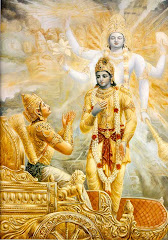

 Posts
Posts