Thursday, January 10, 2013

Reclaiming our History | Decoding the Ramayana: The *real* Shri Ram: Whether he was a "bad husband" and what is 'Ram-Rajya'? (Part-XV)


Author's Note: Please visit - The 'Real' Ramayana/ Ram-Rajya - to read the other parts of this series, so as to be able to fully understand or grasp the contents of this one.

What does the 'Buddh-avatar' signify? What were the *real* reasons behind the Ramayana War and the Mahabharata War? What was achieved at the end of these wars? What was 'Draupadi's Vastraharan' all about, and *how* did Shri Krishna come to her aid, despite not being present in Hastinapur? What does 'divya-drishti', 'aakash-vaani' and 'daiva-vaani' really mean? Notes on: genetically engineered humans (cloned humans + highly-evolved humanoids), holographic image, 'Yogeeswara'; 'Kali Yug', 'Dharma Yuddha'; untying of the 'sikha', etc.

As you are aware, based on our earlier discussions: that the 7th avatar of the 'Dasavatara' - the Ram-avatar - represented humans that were born out of their mother's womb but were not conceived the natural way. That is: these humans were a result of very advanced In Vitro Fertilization or IVF therapy. Shri Ram and his siblings were such humans. [Do read: Part-V.]

The 8th 'avatar' in the 'Dasavatara' is 'Balaram', and he is depicted with a plough or 'hal' - probably indicating that after the humans born due to IVF therapy made their appearance (as represented by the 7th 'avatar' - the 'Ram-avatar'), there was a period of calm and prosperity (meaning: there was a lull in such experiments.) Therefore: 'Balarama' depicts an era where various vocations, especially agriculture - flourished. [Do read: Part-XIII.]

[For the 4th-avatar - the 'Narasimha-avatar' and the 5th-avatar - the 'Vamana-avatar', do read: Part-III and Part-XIX. For the Hayagreeva, do read: Part-VIII.]

The 9th avatar or the 'Krishna-avatar' essentially represents yet another set of humans that walked on this earth - the genetically engineered humans (including cloned humans.) [We will discuss this in greater detail soon.]

The 3rd era (Dvapar Yug) saw a big number of genetically engineered humans (cloned humans + highly-evolved humanoids) - who were difficult to kill, possessed extremely destructive weaponry, and could not procreate the natural way. Hence: Gandhari, Kunti and Madri had to take the help of advanced medical science - in order to beget progeny. Even Draupadi's five sons (one by each of the Pandavas): Prativindhya, Sutasoma, Srutakirti, Satanika, and Srutakarma are said to have been spitting images of their respective fathers - the 5 Pandavas. This again points towards cloning. [As for Draupadi's birth, do read: Part-V.]

Genetically engineered humans (cloned humans + highly-evolved humanoids) were a major reason for the Mahabharata War to happen. These unnatural (cloned + genetically engineered) humans had to be eliminated - for civilization to sustain itself and progress naturally. Post the Mahabharata War, this objective was achieved: since all experiments regarding creating unnatural humans were stopped. As a result: civilization progressed in a reasonably smooth manner - as signified by the 10th 'avatar' (the 'Buddha-avatar') in the 'Dasavatara'. [This 'avatar' does not have anything to do with Bhagavan Shri Gautam Buddh per se.]

Why 'Kali Yug'?

The fourth era is known as the 'Kali Yug' - since this was supposed to be the best yug of all. Kali is not a demon (since we do not have such concepts in our culture.) Kali is a "bud" (and a bud is beautiful to behold. It slowly opens and then gradually metamorphoses into a lovely flower, whose appearance and fragrance is appreciated by all.)

Ram and Sita were able to undo a lot of social ills in Treta Yug. Dvapar saw the advent of a new set of humans: the genetically engineered humans (including cloned humans.) However: these unnatural humans were eliminated via the Kurukshetra War (and this no doubt would have helped civilization to progress naturally.) Also: a lot of wisdom and knowledge had been accumulated by then; there was peace and prosperity (since all experiments regarding creating unnatural humans were abandoned after the Mahabharata War.) Hence: the current era was all set to become (largely) a period of tranquility - as represented by the 10th avatar of the 'Dasavatara' - the 'Buddh-avatar'.

The 4th era or the Kali Yug was supposed to be the best yug of all. And it was a great era indeed... until this period of prosperity and relative tranquility was shattered by the arrival of barbaric Mlechchas (as depicted by the Kalki figure.)

[These Mlechchas and their ancestors were folks that ate snakes and lizards; mistreated their women; buried their daughters alive; coveted and kidnapped other peoples spouses; mercilessly put people to the sword; attacked caravans; murdered, looted and plundered with abandon. Strangely: we seem to have no dearth of people that profess to uphold many of these very aspects - by forcibly calling them: "a part of our ancient culture and tradition"...!! Amazing, indeed.]

The 2nd era or the 'Treta Yug' accepted the humans born as a result of IVF therapy as 'full-fledged humans' and as good for society - given Ram and his siblings' noble deeds. And this would have undoubtedly helped childless couples, especially women (who otherwise have to bear the brunt of taunts or the stigma of childlessness.) However: the 3rd era - the Dvapar Yug - rejected genetically engineered humans (cloned humans + highly-evolved humanoids.)

[As to why Shri Ram and Shri Krishna are depicted as blue-skinned, do read: Part-XIII.]

The Ramayana and the Mahabharata are part of different eras or yugs - with very different societies and challenges. The former is the history or itihasa of the 2nd era (the Treta Yug), while the latter is the itihasa of the 3rd era (the Dvapar Yug). There are similarities as well as differences; hence, we should not try to mix them.

However: neither the Ramayana War nor the Mahabharata War was fought over riches or territories. Both were 'Dharma Yuddhas' or 'Battle of Principles'. Meaning: these were wars fought over principles, in order to establish certain norms in society - for the greater good of mankind (Loka-sangraha or Loka Kalyana). These were wars fought to determine the way of life that ought to prevail in society, to defend the right principles (dharm) and to undo certain social ills and negative aspects (adharm).

The Ramayana War took place in order to establish certain guidelines in society; this era accepted the following: 1. It accepted humans not born the natural way i.e. humans born out of an advanced IVF procedure - as humans. [Shri Ram and his siblings were born as a result of IVF therapy.] 2. It accepted forest-dwelling humans (i.e. various groups of "van-nar" or "Vanaras") - as full-fledged humans. 3. There was a big improvement in the status and position of women and other marginalized people - in society. 4. Ram was able to safeguard the lives of humans from unnecessary bloodshed (and thereby protected this planet from annihilation.) 5. Cannibalistic humans were largely eliminated - and this helped the non-cannibalistic humans to thrive (which in turn helped civilization to progress smoothly.) 6. Humanoids (e.g. Kumbhakarna) were eliminated. [To know more about Kumbhakarna, do read: Part-XVIII.] 7. The noble principles of the "Sanaatan Dharma" were salvaged, since Ram was able to establish a just society (Ram-Rajya), by undoing an assortment of social ills (that prevailed in the garb of 'accepted societal norms' or "maryada"); in the process successfully breaking the influence and stranglehold of a certain class. [Do read: Part-I, Part-II, Part-III and Part-VII - for more details.]

Note: As for the Mahabharata War or the Kurukshetra War, it was fought for the following reasons: 1. In order to eliminate the unnatural humans, who possessed dangerous weaponry; these humans were much advanced, far more numerous and several times more destructive than Kumbhakarna. 2. To put a stop to all experiments regarding creating unnatural humans. 3. To protect this planet (Prithvi-loka) from destruction (due to the unnatural humans + destructive weaponry), and to help civilization to flourish naturally and peacefully. 4. To establish certain noble or dharmic ideals and principles in society and to eliminate certain negative or adharmic aspects. 5. To preserve the noble principles of the "Sanaatan Dharma". [Sanaatan = timeless, eternal. Dharma = right path, noble principles/way of life.]

Mistreatment of women (insulting women or behaving violently with them or coveting other people's spouses, etc) - was considered to be the lowest of the lowest form of 'paap' or sin - in the "Sanaatan Dharma". Duryodhan and (his younger brother) Dushyashana crossed this very red line by insulting and making lewd gestures at Draupadi - the wife of their cousins (the Pandavas)... and therefore, their "Kula-Vadhu" as well. [Kula, kul = family, lineage.] Draupadi's Vastraharan or the disrobing of Draupadi - is an event that we all are very familiar with; however, this event is also a metaphor to suggest that she was constantly harassed and demeaned by the Kauravas (led by Duryodhan and Dushyashana.) None came to her aid; despite being cognizant of the fact that what was happening should not have happened in the first place, nor should it have been allowed to happen - ever. Dhritarashtra was helpless and blind to his sons' fault; while the others like: Dronacharya or Bheeshma may not have had the strength of character to intervene, or may have simply opted for silence - given Duryodhan's nature. Shri Krishna's use of power (for the greater good: loka-sangraha or Loka Kalyana - "welfare for all" or "welfare of the world") is precisely what should have inspired or engaged Bheeshma Pitamah: to protect the noble/dharmic and destroy the wicked/adharmic, paritranaya sadhunam vinasaya ca duskrtam. [Part-VIV.] Unfortunately, that did not happen. These great men (Bheeshma Pitamah, Dronacharya, et al) were too busy deliberating about who should succeed Dhritarashtra, i.e. whose right it was to ascend the Hastinapur throne: whether Yudhistira or Duryodhan; instead of fighting adharm - that was unfolding right in front of their eyes. [Dronacharya of course had scores to settle with Draupadi's father - Raja Drupad, and this too may have clouded his judgment and better sense. He failed to rise above narrow selfish thoughts for a larger cause - to confront and prevent adharm, despite being fully aware of the havoc such adharm could wreck on society.]

Duryodhan was someone that did not listen to good counsel; he did not even heed the advice of his parents or elders (including the wise and widely-respected Vidur.) And though the current versions of the Mahabharata extol the virtues of the Pandavas, glorifying a weak-willed Yudhistira as 'Dharmaraj' (or the very 'incarnation' of 'dharma' or righteousness), while conveniently sidelining two great women (Kunti and Draupadi) - we must not forget that a lot of water has flown under the bridge. Meaning: that there have been innumerable mistranslations and mutilations of our ancient texts, not to forget concerted attempts towards their 'contemporisation' (post the demise of the Gupta era.) While some efforts have clearly gone into turning the flighty Arjun into a (sort of) 'part' or 'manifestation' of Shri Krishna (and hence, by extension: a 'part' of Shri Vishnu as well - i.e. of what various people thought or believed to be Shri Vishnu); there have also been much efforts invested (by a succession of humans) to turn both Shri Ram and Shri Krishna into 'avatars' or 'physical manifestations' of Shri Vishnu (meaning: 'physical manifestations' of what various people thought or believed to be Shri Vishnu). [Do read: Part-X.]

Bheem possessed immense physical strength, but somewhat lacked in strength of character. While the twins - Nakul and Shahadev - were great warriors and handsome in appearance. But that's about it; all the five Pandavas together could not match up to Draupadi; in fact, they remained passive observers, even when she was being insulted.

The only one who came to Draupadi's aid was her best friend (sakha) - Shri Krishna. He was also her brother-in-law, since Kunti was his paternal aunt (his father, Vasudev's sister.)

Krishna was not in Hastinapur at the time. Yet he was able to help Draupadi. How?

Well, we all know Krishna was an immensely knowledgeable and wise person. He is also known as Hrishikesa - the master of the senses. He had not only gained mastery over his own senses (indriyas), but also over those of others. Hence, he was 'illusionist' par excellence - the best of his era no doubt, but of all times as well. [This 'illusionist' is not to be confused with what passes for magic and magicians these days. Krishna's mastery over the senses was due to 'yog' - a combination of illumined knowledge and very advanced technology. He was a 'Yogeeswara' - which is a Sanskrit word, and means: 'a great yogi who is equivalent to the Almighty (Ishvara or Parameshwara.) However, 'yog' should not be confused with what passes for 'yoga' or has been passing for 'yoga' - since many decades.]

Shri Krishna had mastered Yog - in all its forms, and derived his immense strength and power, of the body (sharira), the mind (manas) and the senses (indriyas) - from this timeless treasure-trove of illumined knowledge (jnana) - Yog. He had acquired profound wisdom, perception, insight and foresight, as well as awesome technology - thanks to Yog.

In a way, he had become Trikalagya, a "bhuta-bhavya-bhavat-prabhu" or "The Master of all things past, future, and present". [Nirukti - trikAla vartinAm seshi - The Master of all things that exist in the past, present, and future.]

In short: he had 'acquired' the Tritiya-Nayan - the Third-Eye. Meaning: he had acquired (or was able to inculcate) great powers of perception + tremendous amount of wisdom and knowledge. Hence, it is a small wonder that Shri Krishna was not only able to figure out the way events were going to unfold, but was also able to provide guidance to those concerned - for the greater good, accordingly.

[Shri Krishna was able to rise above his own attachments and emotions. His adherence to Karm Yog (action), especially Nishkam Karm Yog (selfless action) - helped stabilize civilization, and helped preserve the noble principles of the "Sanaatan Dharma".]

Krishna was able to aid Draupadi through very advanced technology - despite not being physically present in Hastinapur. The Krishna that appeared in the Hastinapur Court and successfully foiled the shameful designs of Duryodhana and Dushyashana - was his holographic image. A highly advanced, realistic and human-like hologram or holographic image that not only looked like or resembled Krishna completely (or at least very closely), but was also able to perform a variety of tasks (including: inducing illusion and hypnosis, by gaining control over Dushyashana's senses or indriyas), so as to prevent a great adharm from materializing. [Possibly by controlling Dushyashana's brain and thoughts; some kind of inception. Result: Dushasana was led to believe that Draupadi's sari was an unending one; and so, he continued to 'unwrap layers and layers of it' (under hypnosis), and finally fell to the ground - exhausted.]

Now, how did Shri Krishna get to know what was unfolding in the "Kaurav" Court (in Hastinapur)?

The narrative says: Draupadi prayed to him, requesting assistance. This could be an allusion to "telepathy". Though we are aware of "telepathy", we are yet to figure it out fully. Krishna and Draupadi were the best of friends, and so, Krishna may have shared this procedure with her. Also: we cannot rule out television (referred to as: "divya-drishti"). Krishna may have caught the goings-on @ the Hastinapur Court via television. Remember: Sanjay too was able to view the goings-on in the Kurukshetra War and narrated the events to Dhritarashtra due to television (divya-drishti) - thanks to Veda Vyasa. [Though "divya-drishti" is also a reference to one's "mind's eye" (or "manas-chokshu"), but here it means television. Even the role of radio or wireless or satellite phone (aakash-vaani, daiva-vaani) cannot be ruled out; meaning: someone may have informed Krishna via wireless or satellite phone.]

Later translators did not understand the references to technology or advanced medical science (in our ancient texts, including the Ramayan and the Mahabharat) and hence, in an effort to 'fill in the blanks', tweaked the narrative as per their (mis)understanding or as per the sign of the times. Technology has been referred to as 'trickery' or 'illusion', and attributed to either super-human powers or to magic...! Needless to say, a lot has been lost (or altered) in translation. Sadly. The views and perceptions of various humans have crept in, and an assortment of negative influences have also made their mark. We must try and peel off these unnecessary layers and embellishments, and try to salvage the real/original narrative as best as we can. The Ramayana and the Mahabharata are part of our ancient history or pracheen itihasa, and we should be very clear on that. Hence: we must view them as part of our ancient history and heritage, and not as some discourse on excessive morality or Bhakti. That is very wrong. We must learn to view the various characters that people these ancient texts as humans and not as some magical beings. Some of them were great humans who accomplished various noble deeds.

Krishna's clarity of thought and action is exemplary. Once this event (Draupadi's Vastra-haran) happened, and though he was able to prevent it, it was no longer a matter of succession for him. Duryodhan's conduct was contrary to the accepted guide-lines/rules of that era (meaning: it was contrary to the noble principles of "Sanaatan Dharma".) Our ancients followed the Arya (noble) way of life and subscribed to a set of principles: they did not indulge in rape, molestation, slave-taking or pillaging - even when they fought amongst themselves or conquered other kingdoms. They did not kidnap or covet other people's spouses either. This is because: such actions were against the Kshatriya-dharma and the Arya-dharma (or the noble way of life that prevailed in this great land.) Yet, despite all this, Duryodhan behaved in such an abominable manner with his own Kula-vadhu. If such a man ascended the throne, what values would prevail in society?

Hence: for Shri Krishna it was no longer a matter of succession; instead, it was a matter of: paritranaya sadhunam vinasaya ca duskrtam, protect the noble/dharmic and destroy the wicked/adharmic, so as to preserve the noble principles of the "Sanaatan Dharma". [Also: it had become necessary to eliminate the unnatural humans. Therefore, though Krishna rarely picked up arms - to fight, he chose the time, the moment of action, and the instruments of action - with precision, in order to be able to eliminate the negative entities successfully.]    

However, the events at the Hastinapur Court had saddened and angered him - since it was also an eye-opener/indicator of how passive society had become. Therefore he asks: a society that stood by silently and simply watched such a shameful event (the "vastrahaaran" or the disrobing of Draupadi); a society that did not react nor protest the "apamaan" (insult, dishonour) of the Queen of Hastinapur, the daughter of Raja Drupad, the wife of the Pandavas, an extraordinary woman and an important personality in her own right, what will such a society do when ordinary people, the weak and the defenseless, including ordinary women, are subjected to ill treatment and injustice?

It will shatter society and give rise to all kinds of ills. When women are not treated well, society falls.

Therefore: Shri Krishna advises Arjun (and through him to all of us) - to do our "duty": to uphold "dharma" (or the right principles - as best as we can), without thinking or worrying about the consequences or aftermath. 'Coz, if we fail to do our "duty" when we should, or are overwhelmed with worry or fear, or choose to remain passive or inactive, adharm will creep in and pervade every aspect of our lives. It will destroy us. Krishna urges us to fight the forces of darkness (aasuric entities and adharm) - as soon as they become apparent. He asks us to remain vigilant and not become lethargic; 'coz if we choose to ignore the warning signs, we should not blame external factors later on (for the decadence of society.) In other words: we should not blame external factors - for the decline in the right values or in the right societal principles [dharm], since: everything happens due to our action only (including misguided action, lack of action and/or lack of timely action.)

[Unfortunately: his words are being echoed today. No wonder our lethargy and inaction has turned this beautiful "bud" (Kali) into an age of decadence. And it is us that have allowed things to come to such a pass.]

Draupadi also undertook a vow (Draupadi Shapat) in the assembly (court) of the 'Kauravas' (the 'Kurus'), after Duryodhana and Dussasana insulted her: that she would remain with disheveled hair until the perpetrators of adharm (the Kauravas) were completely destroyed. In another era (the Kali Yug), the great Chanakya (son of Chanak) too undertook a similar vow - to leave his long 'sikha' un-knotted or untied - until he succeeded in humbling the Nanda Kings (the decadent ruler of Magadha, King Dhana Nanda, and his drunkard and wastrel Princes). True to his oath, it was only after he had engineered a swift demise of the debauched and worthless rulers of the Nanda dynasty, did this great man tie up his tuft of hair (sikha) again.

[The 'sikha' (also called 'shikha') is a Sanskrit word that refers to a long tuft, or lock of hair left on the top or on the back of the shaven head of a male member of the priestly class. Though traditionally, all males (that were a part of the Sanaatan Dharma) were required to wear a 'sikha', yet, today it is seen mainly amongst those that have taken up Brahmacharya (i.e. celibate monks), and temple priests. The 'sikha' is tied back or knotted - to perform rituals, rites or ceremonies. Only funerals and death anniversaries are performed with the 'sikha' tuft untied or with disheveled hair. Disheveled hair is considered inauspicious, and represents times of great sorrow or calamity.]

Both Draupadi and Chanakya were from two different eras ('yugs'), yet they have left their footprints on the sands of time, and their actions have had far-reaching and epoch-making consequences.

[We will continue our discussions in the next post...]


(Do stay tuned…)

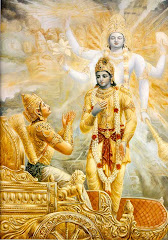
Pictures: Illustrations of Bhagavan Shri Ram, the Buddh-avatar and Draupadi-Vastraharan.  

Thursday, January 3, 2013

Reclaiming our History | Decoding the Ramayana: The *real* Shri Ram: Whether he was a "bad husband" and what is 'Ram-Rajya'? (Part-XIV)


Author's Note: Please visit - The 'Real' Ramayana/ Ram-Rajya - to read the other parts of this series, so as to be able to fully understand or grasp the contents of this one.

What does 'Bhagavan', 'Bhagavati' and 'Avatar' mean? Notes on: 'mrityunjay', 'amaratva'; 'dev', 'devi'; 'idol'; 'Aham Brahmasmi'; 'Mahavakyas'; 'Vasudhaiva Kutumbakam'; Satya/Sat Yug; 'Charaiveti'; 'Yug Purush'; etc.

Bhagavan or Bhagavati comes from 'Bhagavat', which means: 'Fortunate' or 'Blessed'. 'Bhagavat' in turn is derived from 'Bhagah', meaning: 'good fortune'. Therefore, any mortal human who is able to rise above his or her own needs, wants, fears, emotions or attachments, and perform great deeds (keerti) for the greater good of mankind or for the good of society, is: "the Fortunate One" or "the Blessed One" (or in other words: a Bhagavan or a Bhagavati).

"Fortunate" or "Blessed" - since he or she attains "eternal life" and thus "lives forever", through the greatness of his or her actions and exemplary deeds (keerti).

These exceptional humans become "mrityunjay" (mrityu = death, jay = triumph). They manage to triumph death (which is inevitable for all) - through the sheer force of their actions and deeds (keerti) - that continues to transcend eras or yugs. Their memories get etched in the hearts of the people... and their stories are carried forward by generations.

This way these great humans attain "eternal life" or become "amar"... and "live" eternally - through their everlasting legacies.

This has been happening since time immemorial (right from the 1st era [the Satya/Sat/Krita Yug] or maybe the early part of the 2nd era [the Treta Yug])... ever since Parvati and her comrades (Vaishnavi, Bhadrakali, Brahmi, et al) chose to take on the forces of darkness, including the perpetrators of poisonous mindset - Rakta-beej. Their actions not only salvaged the lives of the people from the stranglehold of certain aasuric or negative entities, but also saved their crops and livestock (and thereby their livelihood) from the attacks of gigantic-sized (daitya) ferocious, wild animals. Mahisasura symbolizes all of this.

These great women went on to become "mahishAsura mardinI" - the vanquisher (mardinI) of negative or aasuric entities (mahishAsura) - that disturbed the balance in society and in civilization. Due to their remarkable deeds, their Karm Yog, the people of that era revered Parvati (and her comrades) as devi-s, i.e. manifestations of the divine Mother, more precisely that of Maa Shakti - the feminine force behind the cosmos. [Do read: Link.] Their stories have since been passed on from one generation to the next. Their legends have endured and will continue to endure.

Siya-Ram and Krishna too are part of such transcendental legends of this land; great humans that became: Bhagavan.

[Note: Even now we say: "Bhagya" - to indicate "fate" or "fortune", and "Bhagyavan" - to indicate "a fortunate person" or "someone on whom fate is smiling". 'Bhagya' and 'Bhagyavan' are just variants of Bhagavan.]

It is humans; it has always been humans, mortal humans of flesh and blood, wise and courageous men and women of flesh and blood, that have always risen above themselves (above their own needs, wants, fears, emotions, attachments, etc) during very difficult times and against great odds - to bring about the necessary changes in society, to protect the people and to restore the balance.  

Our ancients, through the ages, have not only revered such great and exceptional mortals, but have also elevated them to the status of the divine.

[Divine probably comes from 'dev', which in turn comes from 'daaivic', meaning: noble traits or qualities. Therefore, divine = one who possesses noble traits or qualities. It can be animate or inanimate.

Dev (an honorific for a great male) or Devi (an honorific for a great female) comes from 'daaivic' (meaning: one who possesses noble traits or qualities.) Devi is essentially a reverential honorific for a female (entity, person, power, force or energy) - that is worthy of respect and worship. Dev is the male version.

However: Devi is equated with 'goddess', while Dev is translated as 'god' or 'Lord'. But these are not quite correct, 'coz the alien translators belong to different cultures and possess different mindset - one that includes concepts like 'race', 'religion' and 'ism'. Neither Ram nor Krishna is 'Lord' - simply because they weren't Ingleesh peers. :) ]

Great humans were revered (by our ancients) as "manifestations" of the unseen or formless Cosmic Energy (the forces behind the cosmos.) Mortal humans - men and women - that stood up to assorted negative or aasuric forces/influences, and thereby saved this world and its inhabitants from aasuric stranglehold (or from annihilation), through the ages - have been given the status of the divine and revered as a Bhagavan or a Bhagavati. [Perhaps: this was our ancients' way of honouring these great souls - that have been instrumental in preserving the "way of life" or the "Sanaatan Dharm" - as it ought to be, despite great odds. As a result: civilization has been able to progress and flourish well.]

In other words: our ancients believed that the unseen and formless forces of the universe or the energies behind the cosmos "manifested" themselves through these great humans. Meaning: they saw the unseen "Almighty" through these great humans.

[The unseen "Almighty" is variously known as: the Supreme Soul [the Paramaatma] or the Supreme Being [the Parameswar); the Brhaman, the Ultimate Truth, the Ultimate Knowledge or the Ultimate Reality.]

For our ancients, these great humans were "avatar-s" or "manifestations" - of the formless forces of the universe or the energies behind the cosmos. 

Even positive traits or qualities were and are considered to be "Bhagavan" - since it is only after imbibing such traits or qualities can a mortal human achieve great deeds and thereby leave behind an everlasting legacy. Hence: Shri Ganesh is worshiped as a "Bhagavan". [Do read: Part-XI - to know more about Shri Ganesh.]

However: Bhagavan (an honorific for a great male) or Bhagavati (an honorific for a great female) - does not mean or refer to the unseen or formless 'Cosmic Energy' per se.

This is because: the Cosmic Energy is not a person; IT is formless, cannot be seen and has no gender, though IT is omnipresent, omnipotent and omniscient.

The Cosmic Energy (the Paramaatma or the Parameshwar i.e. the Supreme Soul or the Supreme Being, etc) manifests Itself everywhere; the whole of creation represents and 'manifests' the Paramaatma, or the Parameshwar. Everything, whether animate or inanimate, so long it is a part of this world, this universe or this creation, automatically is a 'part of', a 'manifestation of', or 'representative of' the unseen Cosmic Energy. 

However: since the human mind is unable to visualize, fathom or comprehend vacuum or anything that is without form or shape (nirākārā), it needs something - anything - as a reference point.  

Meaning: the nirākārā (formless, all-pervading, omnipresent) + Nirguna (unmanifested) form of the Cosmic Energy (also known as the Supreme Soul [the Paramaatma] or the Supreme Being [the Parameswar, etc] is not easily comprehended. But the medium through which we can reach or 'see' that formless, unmanifested Cosmic Energy is the ākārā, i.e. the with form + manifested version: the Saguna. 

And hence: the temporary, transient idol. The temporary, transient "idol" is a "manifested" version (or form) of that timeless, eternal, formless, unmanifested Cosmic Energy (the Paramaatma or the Parameswar). The "idol" can be seen with mortal eyes. However: "idols" can include anything that is found in nature, and is not limited to just the mud or terracotta idols that are officially classified thus.

Mother Nature (Prithvi) and Creation or Shrishti (that are also part of the formless Cosmic Energy) - is the source of all the knowledge and wisdom accumulated by our ancients.

The forces of the cosmos are everywhere. Whatever is to be found in creation (whether seen or unseen, animate or inanimate) is a part of that "divine" or "noble" force or energy - the Cosmic Energy. IT includes our mortal body (sharira) and our immortal soul (aatman) - though this realization exists only in enlightened persons:

Aham Brahmasmi (ah-HUM brah-MAHS-mee)

[Brhadaranyaka Upanishad 1.4.10 of the Yajur Veda]

Translation:

Aham = I, Brahmasmi = am Brahman

Meaning: I Am Brhaman.

[Do read: Link - for greater clarity.]

The other Mahavakyas are:

·  prajñānam brahma - "Consciousness is Brahman" (Aitareya Upanishad 3.3 of the Rig Veda)

·  ayam ātmā brahma - "This Self (Atman) is Brahman" (Mandukya Upanishad 1.2 of the Atharva Veda)

·  tat tvam asi - "Thou art That" (Chandogya Upanishad 6.8.7 of the Sama Veda)

The subject matter and the essence of all Upanishads being the same, all the Mahaavaakyas essentially say the same in a concise form. The Upanishads are inexhaustible sources of the spiritual knowledge of ancient India. The focus of Upanishads is proclaiming the glory of 'Brhaman' or 'Brahman' - the Infinite Supreme Spirit or the 'Paramaatma' (also: the Supreme Being - the 'Parameshwar'; the Ultimate Truth; the Ultimate Reality; the Ultimate Knowledge.)

However: this 'Brahman' should not be confused with 'Brahmin' - the name of a 'caste'. As to how this caste came about, we have discussed it a bit in Part-I.

[Note: Mahavakyas are "The Great Sayings" of the Upanishads, the foundational texts of Vedanta. Though there are many Mahavakyas, four of them, one from each of the four Vedas, are often mentioned as "the Mahavakyas".]

Begin by meditating for a few minutes, and then imagine that you are a crystal bead. You reflect the light of every being in the universe, and your light is reflected in them. Silently repeat the words "Aham Brahmasmi" and continue to envision yourself as a beautiful jewel, reflecting and absorbing the light of the entire universe. Rest in the silence and feel the expansiveness of your being - an expression of the infinite field of intelligence and all possibilities.

[Frankly: if we can have the realization that we are one with Brahman (the ultimate reality), we can respect each other and love all living and non-living beings. If I realize that you and I are part of Brahman, how can we hate or destroy each other? I am destroying myself when I attack others, isn't it?]

Hence: we have this philosophy Vasudhaiva Kutumbakam that inculcates an understanding that the whole world is one family. It is a Sanskrit phrase, meaning: the whole earth is one family. The first word is made up of three Sanskrit words - Vasudha, Eva and Kutumbakam. Vasudha means the earth, Eva means emphasizing (is as a) and Kutumbakam means family.

It is a philosophy that tries to foster an understanding that the whole of humanity is one family. It is a social philosophy emanating from a spiritual understanding that the whole of humanity is made of one life energy (the Cosmic Energy; variously known as: the Supreme Soul [the Paramaatma] or the Supreme Being [the Parameswar); the Brhaman, the Ultimate Truth, the Ultimate Knowledge or the Ultimate Reality.)

The concept of Vasudhaiva Kutumbakam originates from Hitopadesha (though the original verse is contained in the Maha Upanishad 6.71-73.) Hitopadesha is a collection of Sanskrit fables in prose and verse. According to the author of Hitopadesha, Narayana, the main purpose of creating the Hitopadesha is to instruct young minds the philosophy of life in an easy way so that they are able to grow into responsible adults. It is almost similar to the Panchatantra. The whole philosophy of Vasudhaiva Kutumbakam is an integral part of ancient Vedic philosophy (the Sanaatan Dharma.) 

There is nothing that is "evil" in this world (Bhuvan), in the universe (Brhmaand) or in creation (Srristi) - as per the wisdom of our ancients, and as per the "Sanaatan Dharm" or "the timeless way of life" - rooted in Vedic wisdom. [Sanaatan = timeless or eternal, Dharm = the path or the 'way of life'.]

So, even when the miscreants (negative or aasuric forces or entities) are dealt with (by some or the other great human), it is not a punishment, but an opportunity for redemption - provided to these aasuric entities by these great humans.

Both 'Sur' or 'Sura' (i.e. positive forces or entities) and 'Asur'/'Ashur'/'Asura' (i.e. negative forces or entities) are required for creation, and they are present everywhere: in creation, in the universe and in this world; they are present within us (as traits), within society and within civilization as well - so as to sustain it, or rather, so as to maintain the balance.

Imbalance is also part of nature. ['Vikriti' is also part of 'Prakriti'.]

Hence: the first era or yug - known as the Satya Yug (also: the 'Sat Yug' or the 'Krita Yug') is not 'the era of truth'. Meaning: it is not an era where 'everyone was truthful' - as is widely believed. Such a view is a result of mistranslation and has come about since 'Satya' or 'Sat' has been literally translated as 'Truth', while 'Yug' = era.

However, no era can be 'the era of truth' per se; it will result in stagnation. It is a utopian impossibility. There has to be presence of 'balancing factors' - for civilization to flourish and sustain itself.

Only when the 'balancing factors' reach an alarming stage, civilization is threatened and cannot flourish. Meaning: only when there is great imbalance, there is cause for alarm. However: the complete absence of 'balancing factors' too will result in civilization itself stagnating.

Therefore: the 1st era - the Satya/Sat/Krita Yug - is essentially named thus, so as to signify that at the end of the sleep stage (ghum), the Brhmaand will re-energize or regenerate itself once again. And that: the sleep-stage is not the end, but a new beginning. This is the ultimate 'truth' or 'reality' - the Satya or Sat. [More on this in our later posts.] 

Avatar: various titles (like: Avatar, Bhagavan, Bhagavati, Yug Purush, etc) were honorifics bestowed out of reverence, and as acknowledgement of a person's great deeds (which in turn left a positive impact on society and on people's lives.) Our ancients acknowledged the ones that made the highest contribution towards the welfare of society (and thereby touched and impacted the lives of a vast number of people) - as "avatar" or "Bhagavan"/"Bhagavati". 

And through these extraordinary humans, our ancients "saw" the unseen and formless energies behind the cosmos.

So in a way: the finite met the infinite, the created met the uncreated, the mortal met the immortal. [Here: the 'finite', the 'created' and the 'mortal' = the human element, i.e. great humans. While the 'infinite', the 'uncreated' and the 'immortal' = the unseen and formless Cosmic Energy.]

However: the only path to achieving this status (that of "Yug Purush", "Avatar", "Bhagavan" or "Bhagavati") is through selfless service - for the greater good. That is: "Nishkam Karm" and "Karm Yog". [There is no 'magic potion' or 'vardaan' for achieving 'amaratva' or 'eternal life'. These are just metaphors or imagery, just like how 'curse' has been depicted in our ancient texts. Though a few instances may have been references to the usage of advanced medical technology to improve one's health and/or increase one's longevity.]
 
Here is arguably the most famous verse from the Srimad Bhagavad Gita (Chapter IV-7):

|| yada yada hi dharmasya
glanir bhavati bharata
abhyutthanam adharmasya
tadatmanam srjamy aham
||

Meaning:

Yada: whenever; yada: wherever; hi: there is; dharmasya: in the principles and ideals of 'the right path' or the 'way of life' as it should be - for the greater good of mankind and for civilization to flourish well; glanih: alarming decline or discrepancies; bhavati: seen, perceived, becomes; bharata: O descendant of Bharata: since Arjun was a part of the 'Puru Vansh' or the 'Puru lineage', also known as: the 'Bharat vansh'. [Do read: Part-VIII]; abhyutthanam: and there is predominance; adharmasya: of 'adharm' i.e. wrong ideals or principles; tada: at that time, only then; atmanam: self, myself; srjami: manifest; aham: I. 

Translation:

Whenever and wherever there is an alarming decline or discrepancy in the principles and ideals of 'the right path' or the 'way of life' as it should be (for the greater good of mankind and for society/civilization to flourish well); or when such an alarming decline is perceived or becomes a bane; O descendant of Bharata, only then, I, manifest Myself.

It essentially means: whenever and wherever 'adharm' i.e. wrong ideals or principles turn into a storm and threatens to engulf everything in its fold, someone will always come forward to confront it, and thereby stop it in its tracks. [This is the measure of true greatness; these humans are revered as: "Avatar", "Bhagavan" or "Bhagavati".]

[Srimad = honorific, Geeta = Geet or songs; Srimad Bhagavad Geeta = 'the Songs of the Blessed One' or 'the Songs of the Fortunate One'.]

The Chapter IV - 8 of the Srimad Bhagavad Geeta says:

|| paritranaya sadhunam
vinasaya ca duskrtam
dharma-samsthapanarthaya
sambhavami yuge yuge ||

Meaning:

Paritranaya: for the deliverance; sadhunam: of the devotees; vinasaya: for the annihilation; ca: also; duskrtam: of the miscreants; dharma: the principles and ideals of 'the right path' or the 'way of life' as it should be - for the greater good of mankind and for civilization to flourish well; samsthapana-arthaya: to reestablish; sambhavami: I do appear; yuge: millennium; yuge: after millennium. 

Translation:

In order to rescue/deliver the good and the pious (the noble-hearted) and to subdue/annihilate the miscreants, as well as to reestablish the principles and ideals of 'the right path' or the way of life as it should be - for the greater good of mankind and for civilization to flourish well, I advent Myself millennium after millennium.

Here, mankind should not be taken as humans only, but creation per se - all living beings.

The good and the pious (the noble-hearted) do not mean the profoundly devout or ritualistic people (the ones that diligently perform rituals.) It is a reference to ordinary people who largely harbour good, positive thoughts and intentions (in their hearts and minds) and who are somehow making an effort - in their own way - for the betterment of society (or are at least trying to.)

Miscreants do not mean 'evil' people, since there is no concept of 'evil' in the Vedas or in the philosophy of life rooted in the ancient Vedic wisdom. [Veda comes from the root vid, which means: wisdom, knowledge. [Do read: Part-XI - for greater clarity.]

The soul (aatma) after departing the mortal body (sharira) does not 'rest in peace' as is believed by some sections of society. The "Sanaatan Dharm" has this concept of "Charaiveti" - to keep going, in some other form, based on one's Karm (actions committed in that life) - as per the principles of 'Karm Yog'. A great soul (based on one's accumulated 'Karm Phal' or the fruits of one's 'Karm') will be reborn to carry on the good work - in whatever form or capacity; but every soul (irrespective of its accumulated Karm phal) will be reborn accordingly. And in case of negative 'Karm Phal', it will get an opportunity for redemption.

The soul has no form, no shape, no gender; only the outer covering or the mortal body takes the shape of a human (a man, a woman, a tritiya prakriti or the 3rd gender) or an animal, a plant, a fish, a bird, an insect, a reptile and so on and so forth.

Even the annihilation or the destruction of the miscreants by the 'avatar' is not to be viewed as a punishment, but as a step towards their redemption. Since: 'Karma' is not punishment but an opportunity to redeem oneself.

[Avatar: a great human whose adherence to "Nishkam Karm" and "Karm Yog" earned him or her the reverence of the ordinary people who considered him or her to be a 'manifestation' of the unseen Cosmic Energy - also known as: the Parmaatma, the Parameshwar, the Brhaman, etc.]

Both 'Sur' or 'Sura' (i.e. positive forces or entities) and 'Asur'/'Ashur'/'Ashura' (i.e. negative forces or entities) are required for creation, and they are present everywhere: in creation, in the universe and in this world; they are present within us (as traits), within society and within civilization as well - so as to sustain it or rather so as to maintain the balance. 

However: whenever the negative content increases to alarming levels, it threatens creation, society, and families... and in effect it threatens civilization. In such scenarios or times, some extraordinary men and women come forward ... and through their words, deeds (keerti) and lingering influence restores the balance. [This has happened in all eras or yugs.]

Through the sheer greatness of their actions, these extraordinary men and women leave behind a keerti or legacy that in turn transcend time and space... and even triumph death.

The Srimad Bhagavat Geeta, Chapter-2, verse - 37:

|| hato va prapsyasi svargam
jitva va bhoksyase mahim
tasmad uttistha kaunteya
yuddhaya krta-niscayah
||

Meaning:

Hatah: being killed; va: either; prapsyasi: you will gain; svargam: the heavenly kingdom; jitva: being victorious; va: or; bhoksyase: you enjoy; mahim: the world; tasmat: therefore; uttistha: get up, arise; kaunteya: O son of Kunti; yuddhaya: to fight; krta: with; niscayah: determination, certainty.

Translation:

Die and you are assured heaven [i.e. if you are slain in battle, you will gain heaven; you'll be mrityunjay - and live forever], victorious and you will enjoy sovereignty of earth [i.e. you will rule peoples hearts - you will be much admired and respected by all]; therefore, arise, O Kaunteya [O son of Kunti; Arjun] determined to fight.

In other words: for those who fight for a just or noble cause, there is nothing to lose. 

Krishna was advising Arjun to follow his "swa-dharma" - his duties as a warrior/a brave-heart or a Kshatriya. [Ksat means injury, and tra means deliver. Hence "Kshatriya" means: one who protects others from harm or from negative (adharmic) entities/influences.]

However: through Arjun, Krishna is advising each and every one of us to shed our inhibitions, negative attitude and lethargy and go forward to work hard for any righteous cause including our duty as a good son/daughter, parent, citizen or employee. By discharging one's duty (to the best of one's ability) and by abstaining from what ought not to be done; one automatically contributes towards the betterment of society.

Krishna also advises us to try and overcome adharm within ourselves; adharm in our thoughts, minds and hearts - that pushes us towards committing actions that are best avoided. He urges us to try our best to overcome negative thoughts and words: like greed, rage or anger. If one were to be filled with rage on finding injustice (adharm) meted out to someone and protests against it, then it is welcome; but rage or anger that results in the destruction of property or loss of innocent lives; or leads to the mistreatment of the elderly, or of women and children, or of animals, or of one's spouse - is to be avoided. One must try and overcome such emotions. If someone is greedy about doing something good for the people - in the spirit of public service without expecting anything in return, then such greed is good. But if someone indulges in acquiring wealth and fame in the garb of social service, then such persons or such thoughts should be resisted. 

The whole life of Bhagavan Shri Krishna is like the roaring sound of a conch. He undertook a vow: to fight adharm - injustice and profanity in all its forms, and to re-establish dharm (justice, right principles) by restoring peace, order and balance in society... and did his best to fulfill it.

The same goes for Bhagavan Shri Ram. Therefore, it is a small wonder that Shri Krishna paid the highest tributes to Shri Ram in the Srimad Bhagavat Geeta, while describing the best of creation and action (karm): "I am the Wind among the purifiers, and Shri Rama among the warriors." [Here "warriors" = Kshatriya; one who protects others from harm or from negative (adharmic) entities/influences.]

The great Yug Purush - Chanakya - was their worthy disciple.

Unfortunately: we have labeled Chanakya as a 'misogynist', which he clearly was not. [Frankly: our great talent for labeling people as 'misogynist' is only surpassed by our dazzling talent - at labeling yet others as 'celibate'. :)] 

I am tempted to attempt a definition of the word 'Yug Purush'. The renowned American thinker, poet, author, historian, philosopher and leading transcendentalist, Henry David Thoreau, said: "A man is wise with the wisdom of his time only, and ignorant with its ignorance." This is true of people like us, because we are mere ordinary mortals, ordinary people. But, once in a while or perhaps in every era (yug), a handful of people appear amidst us - who prove to be an exception to this rule. At one level, these exceptional and extraordinary people are products of their time, but at another level they transcend their times. Their perceptions, their insights, their thoughts, their actions and their concerns are truly universal, in time and in space; since they are neither constrained by the circumstances of their birth nor are they limited by the ignorance of their time. They are truly incomparable. Shri Ram, Shri Krishna and Chanakya are three such exceptional transcendental 'Yug Purush', who belong to all 'yugs' or eras, though Shri Ram and Shri Krishna have also attained the status of 'Bhagavan'. However: in these times of turbulence and violence, their wisdom, their knowledge, their advice, and their philosophy are more relevant than ever before. 

[Note: The Kurukshetra War was not fought over riches or territory; it was a 'Dharm Yuddha'. Meaning: it was a war fought over principles; in order to establish certain norms in society - for the greater good of mankind (for Loka-sangraha or Loka Kalyana). It was a war fought to determine the 'way of life' that ought to prevail in society. We will discuss this in greater detail in our later posts. Do read: Part-XII.]

However: as you may have noticed, Shri Krishna uses the word or term "duskrtam" - for aasuric or negative forces/entities. It means "miscreants". [Even today we use a variant of this Sanskrit word: "duskrtam". We say: "duskritakaari", meaning: miscreants.]

Krishna does not use words like "evil" - since such a concept is neither a part of our culture nor a part of the "Sanaatan Dharma" - the philosophy of life rooted in Vedic wisdom. And also because of "Charaiveti" - to keep going; the rebirth of the soul based on one's 'Karm Phal' and opportunities for redemption. [Veda comes from the root vid, which means: wisdom, knowledge.]

There are several stories about Hiranyaksha and Hiranyakashipu, Ravan and Kumbhakarna, and Dantavakra and Shishupala having been Jaya and Vijaya - Shri Vishnu's door-keepers or Dvarapala at Vaikuntha. We are told that Jaya and Vijaya had to take several births on earth so as to redeem themselves (after being 'cursed' or chastised by the four sages - the Sanat-kumar.) We will discuss this in greater detail in our next post. But do note the similarities between this story and the one mentioned in the 'Uttar Khand' chapter of the Ramayana (between Lakshman and Rishi Durvasa) and in the Caitanya Caritamrta (involving Jagai-Madhai.)

[Incidentally: the 'Uttar Khand' chapter of the Ramayana is accepted as a later addition. Do read: Part-IX.]

Unfortunately: this great land, her heritage, and her culture have suffered terribly, and so has the 'Sanaatan Dharma' or the ancient Vedic 'way of life'. We are still reaping the toxic harvest of all the poisonous seeds sown for over a millennium. 

E.g: 'Religion' or 'Caste' is foreign words, and as I have said before, its meaning and connotations were unknown to our ancients. But perhaps not to our not-so-ancient vested interests - homegrown as well as from beyond our shores (that raised their ugly heads post the demise of the Gupta era.) These vested interests used our ancient texts to not only accumulate power, influence and other materialistic aspects for themselves, but also used them to stratify society along gender lines, apart from community, 'race', 'caste', linguistic and ethnic lines of course. Result: one group was pitched against the other; some stereotyped as martial race, others labeled as agrarian or trading classes, while still others were conveniently but shrewdly sidelined either as 'backward' or as 'savage tribal'. Sanskrit - a language steeped in antiquity was blithely termed as 'communal', while fantastic invasion theories were bandied about with much aplomb! In case you think 'race' and 'ethnicity' are one and the same, I would say: it's a double whammy. Sadly: our friendly colonizers were ably and amply aided in their 'mission' by internal vested interests that blatantly mistranslated and twisted our ancient texts - in order to underline their own supremacy and influence in society (so as to enjoy the benefits that accrued with such a position.)

But with what result? 

[We will continue our discussions in the next post...]


(Do stay tuned…)

Pictures: An illustration of Arjun and his 'sarathi' or charioteer - Shri Krishna; an illustration of Parvati and her comrades fighting the forces of darkness.