Showing posts with label My Take. Show all posts

Wednesday, January 16, 2013

It is the "reel" that impacts the "real".


Does art imitate life? Or the other way around? Or do they reinforce each other as in resonance?

This has been a much-discussed topic. I say: it is the "reel" that impacts the "real".

This is because: the visual medium is very strong. We may read something or hear something. But when the same disgusting, regressive and negative aspects are projected on the big and small screens relentlessly and then glorified (however subtly) - it makes a huge impact. When such things become a trend, they become the harbingers of... and bring about (negative and regressive) cultural changes: changes in perception, thinking and behaviour; which in turn results in the glorification of machismo and a forcibly advocated subdued position of women. [Though our big-and-small-screen-worthies have been happily propagating such negative stuff under the garb of 'our ancient culture and tradition'.]

Glorification of violent and regressive behaviour on the big screen, especially by big heroes (who act as the reference point or idols for a large chunk of the population) - gives it social acceptance. This is indisputable.

Remember: It has always been far easier to bring about negative change than positive ones... since the former creates formidable vested interests. 

Therefore, when filmmakers quip that films have also been talking about peace, amity and communal harmony... but that doesn't mean that communal discord has been wiped off India - they are simply trying to skirt and/or deflect the issue, by deftly defending the role played by the big screen - in bringing things to such a pass. 

'Coz: It is much easier to think and behave in a negative or regressive manner with the female of the species than to bring about peace in society. And it is much easier to resort to crude language and lewd gestures, or to indulge in domestic violence et al than to bring about communal harmony. [However, if the regressive, misogynist and negative values (as propounded by the big and small screens) were to be curbed, or at least were to be largely curtailed, it will undoubtedly contribute towards peace in society and in our lives - but this will take years rather generations to happen, provided there is an all-round sustained effort in that direction. Changing negative mindset/perception is not easy. There is no switch that can be turned-off.]

One must also examine the films depicting peace, amity and communal harmony, viz: 

1.   How many such films are there? And how many of them depict these noble virtues in a pristine manner? 

2.  What percentage of each of these films are dedicated to these noble aspects, and what chunk of the same films are occupied by "other narrative", including jingoistic and violent behaviour; regressive values, gestures and dialogues - especially with respect to women; misogynist jokes; crude demeanor of the hero (the male lead/star/super-star/mega-star); depiction of women as objects of titillation - including raunchy 'item numbers' and 'songs' with crude and suggestive lyrics... and the like.]

Trust me, once we take a closer look at our films, including the ones supposedly propagating noble virtues, doodh ka doodh aur paani ka paani ho jayega. :)

[The role of the small-screen too should not be ignored. Their reach and impact is equally powerful - and has been utilized to the hilt.]

Granted, that one or two films will not make much of a difference. However, if such regressive films depicting women in a derogatory manner become a trend, they bring about a (negative) change in perception and alter mindset - without much ado.

For example: If big heroes are shown slapping or demeaning women, such behaviour gets the seal of social acceptance. If dialogues like, 'only a husband has the right to beat his wife' gets woven into the narrative, and is then mouthed by big heroes, they make a powerful impact - albeit a negative one. Ditto - if big heroes/stars glorify machismo as something that is naturally ordained, and propagate the subjugation of women as part of 'our ancient culture and tradition'.

Once these toxic aspects are injected into society, they result in negative mindset and negative perception. These in turn bring about regressive cultural changes that also include violent behaviour towards women. Rolling back such poisonous aspects is a Herculean task; it will take hundreds of years + sustained efforts throughout. Are we up for it?

The big and small screens have a huge impact on the society and on our lives - whether we acknowledge this or not. They are the major vehicles or channels for creating mindset and perceptions; and have been used to the hilt.

The last four decades have been particularly nasty, and has had a very negative impact on society; despite huge hits having been delivered, mass heroes garlanded, and umpteen jubilees celebrated. Prior to that, negativities have been injected in small doses (possibly as a "warm up" exercise). E.g. a harmless looking old man (usually playing the role of a respectable family elder or a learned school master) sagely blames women - for all disputes or unhappiness within a family and/or society. Or stresses on how 'in their times' women did this or that - and thereby 'upheld our ancient customs and traditions'. There were references to the 'western clothes' (jeans, trousers) worn by loose/immoral women - the ones that did not 'uphold our ancient customs and traditions' - by wearing those 'western clothes'. However, nothing has ever been said about the jeans and trousers worn by the men-folk on screen and all over the country. Umm, were/are these not 'western clothes' then? :)

The tone and tenor of the dialogues, the slant of the scripts, the demeanour of the heroes et al has been very different in the last four decades. Contrast this to say Shammi Kapoor in his heydays. You notice the difference, don't you?

Also: if we are to rewind a few years (rather: decades) and trace the etymology of the obnoxious behaviour displayed by a certain section of society (like ricksha-wallas, bus drivers, mechanics et al) - towards women and their other passengers, we can trace them all to the impact of the big screen. More specifically, to the on-screen shenanigans of much-garlanded "mass heroes" and their glorification of such behaviour (via their on-screen demeanor and crude dialogues.)

This section of society (ricksha-wallas, bus drivers, mechanics, and the like) take pride in watching "first-day first-show", love to display posters and stickers of their favourite heroes, and try to imitate their matinee idols' on-screen style and behaviour. Sadly, this trend has not only endured but continues to this day via regional films and serials. [Yes, the small screen does play its part. Diligently.]

Women coming out of homes will not make much of a difference; so long there is no negative and/or disgusting perception(s) about them.

Misogynist jokes and dialogues, "item numbers", regressive advertisements et al are just part of this whole game of creating negative mindsets. Do scrutinize the regressive dialogues, crude and misogynist jokes and clichés; so-called comedy and laughter shows (once again filled with clichés + misogynist jokes), and the negative body language of big heroes and comedy show participants. The message sent out is relentless, besides being extremely potent.

And all of these - things/aspects/behaviour - catch on very fast and very easily. Undoing them is a Herculean task though.

Incidentally: many people try to point towards the restrictive societies and then innocently ask (in an effort to absolve the big screen no doubt) - as to how come rape and violence against women are rampant within restrictive societies as well.

The answer is: these restrictive societies (where rape and violence against women is rampant) have always been not only restrictive, but violent too. These societies have essentially been savage societies; though members of these societies may have now gained greater influence through certain means, their ancestors have always been barbaric people that mistreated their women, buried them alive, coveted other people's spouses and forcibly took them away. These societies have always treated women as dirt; as nothing more than child-bearing machines. So the cultural influence has always been there, and hence, such regressive perception and disgusting behaviour vis-à-vis women is de rigueur.

As for 'item numbers' (including suggestive body language and gyrations), the heroine or the female swaying to such 'songs' is of course partly responsible - for their impact. However, the ones that insist on incorporating such repulsive stuff should shoulder the lion's share of the responsibility; the onus lies on them, since they are the ones that supply the Vitamin M.

Plus: 'item girls' - unless they are big names/heroines, are NOT role models. Neither are the villains.

Hence: the major impact-makers are the big heroes; the big male leads/stars/super-stars/mega-stars/the matinee-idols/the screen gods. 'Coz, they are the role models/idols for a large chunk of the population and so, their on-screen shenanigans (dubbed and celebrated as herogiri) are the reference points - for their legions of worshiping fans.

Regressive aspects, negative values and violence - once glamorized by these big heroes/stars - automatically give all of it the cloak of respectability... and thence, instant social acceptance.

However, the focus should also be on the ones supplying the Vitamin M, besides on the ones penning such sad dialogues and lyrics, as well as on the ones directing such drivel.

"Patriarchy" per se is not to be blamed, since it does not have a life of its own. It is the caliber and quality of men that has fallen sharply.

Relationships and intimacy has been so degraded that retrieving it is practically impossible. What kind of words and phrases has become part of our psyche and our vocabulary? How do we think and/or view certain events, or rather have become accustomed to thinking and viewing them?

Rape and violence has been injected in such a manner, and in such large doses, that we have been completely de-sensitized. We do not even blink: when daughters and sisters are raped by their fathers/uncles/brothers! Strangely: either the 'debate' is firmly steered towards the "victims' clothing" or is centred on the "victim having ventured out at night"... and hence having "asked for it"...! Always.

Surely, a sister or a daughter never "asks for it" from her father, uncle or brother, right?

And a baby, a toddler, a little girl or the elderly too does not "ask for it" - from anyone. Is it not?

Rape is a heinous crime. Yet the perception has been successfully created that it is the victim that is somehow to be blamed. So: the rapists' faces are covered to 'protect their identity' while the victim is ostracized. Else: a debate is initiated about the feasibility of punishment or the rapist being a "juvenile". Someone capable of committing such a horrendous crime is a "juvenile", how odd is that?

We come across lots of instances of guys fighting over girls in colleges and localities. And this violent behaviour and regressive mentality (of viewing girls as objects) can be traced to the deluge of movies that have gloried violence and such negative behaviour.

It is not about venturing out at night, since these incidents are happening at all times - 24/7. It is not about clothes either: since babies, toddlers, little girls and senior citizens are being regularly molested and raped, even by their close relatives.

It is not about alcohol too, since no drunken man has ever lain in the middle of the road. So they clearly retain their senses and faculties sufficiently enough, don't you think?

It is not about subjugation of women or women's empowerment per se.

It is about what is being done under this garb. If a woman sheds clothes, mouths strange dialogues, does suggestive dance numbers, or 'acts' in nothing-left-to-the-imagination bedroom scenes - all of it is hailed and labeled as "liberated", "bold", "daring", "glamorous", "empowered" and so on

So you see?

It is a double-edged sword; the impact - both ways - is detrimental for women in general... and society - in particular. [In light of what has been done to words/phrases/perceptions/gestures like: "bold", "daring", "liberated", and the like... families will not even think of providing the necessary wherewithal to their daughters - so that they can become truly "empowered" or "liberated". And what do you think all this will eventually lead to?]

Recently, there were a couple of ads: one was about 'whitening' a certain area of the body - to make one look much more 'attractive' to the male of the species; another was about 'feeling like a virgin' - after undergoing a certain procedure. Women were being used to depict these strange concepts, and both these ads worked under the garb of "women's empowerment"...!

So?

A fairly recent mega-buck-grossing 'super-hit' has the pumped-up hero mouthing: "pyaar se de rahe hain rakh lo, warna thappad maar ke bhi de sakte hain."

Implying: the woman should be grateful, since the man is giving something nicely/politely, 'coz he always has the right to slap - the "thappad". [The concerned female is shown blushing and thereafter a love affair ensues...!]

What values are being conveyed and what mindset nourished? And where is all this leading?

Here's a heroine-speak: "If a particular song-dance sequence shows a woman being stalked and wooed by a bunch of men in a playful and romantic manner and she is enjoying the attention that she is getting then it in no way sends out a wrong signal."

Need I say more?

BTW: these days we also have someone claiming to have "revered women" since his childhood - via interviews in various newspapers. Bhatt naturally...!!

And a certain super-duper-mega-star became a much fawned-over "matinee idol" through a specific brand of cinema. What kind of cinema do you think this man with the carefully cultivated gentleman image has been a willing part of? And what impact did those films have on society? I mean: what has been the lasting legacy of all those fiery dialogues and gestures?

Picture: Courtesy link.

Wednesday, September 12, 2012

1888 Dial India by Anuvab Pal


This one makes for a nifty read. Nifty - in all its myriad shades and meanings that is, if you know what I mean.

Anuvab Pal is an acclaimed playwright and screenplay writer. His screenplays include the award winning The Loins of Punjab - "a witty musical comedy with a sharp political edge" as per the NY Times, and The President is Coming - a low-budget English-language film that "takes a healthy snigger at the desi self" according to Nikhat Kazmi (from the Times of India.)

However, what has been overlooked so far is Anuvab's stellar selling skills and awesome pursuing power. Here's why: In the foreword itself (titled: Why am I writing a memoir?) he mentions and I quote, "I have always wanted to hire a Bengali secretary. I have always wanted to hire a Bengali secretary with an MA. Ideally in English Literature. I won't go into why. It has something to do with Aparna Sen getting wet."

Then towards the end of the book he writes, and I quote, "The only Bengali I like is Aparna Sen because she got wet in a movie I saw a little bit of, and yes, maybe I was a bit drunk that night because of Antara leaving. The point is, I like wet Bengalis. But definitely not the dry ones."

And here's the clincher: on the back cover of this book, like a masthead, stands the words, "Pal is one of the funniest people I know!" - Konkona Sen Sharma.

Well, we are all familiar with Konkona, aren't we? She featured in the Aparna Sen-helmed Mr. and Mrs. Iyer, Vishal Bharadwaj's Omkara (a desi take on Othello), the Madhur Bhandarkar directed noir film named Traffic Signal and Page 3, Anurag Basu's Life in a... Metro, Zoya Akhtar's Luck by Chance and Ayan Mukerjee's romantic comedy Wake Up Sid - in which she starred alongside Ranbir Kapoor.

But that's not the point. The point is: Konkona is Aparna Sen's daughter. So, now (hopefully) you will fully understand why I said that the author (Anuvab Pal) possesses stellar selling skills and awesome pursuing power, what?! :)

Frankly speaking, I too have watched loads of Bangla movies, including several featuring a young Aparna Sen, though I don't recall any movie where she got wet. But then I did not watch those films for her; I watched them for their sublime humour, great storyline, lovely songs ... and Soumitro Chattopadhyay (not necessarily in that order though). Here are a few of those movies: Basanta Bilap, Baksha Badal, Akash Kusum, Chhutir Phande. [Caveat to self: I better not venture into Soumitro territory, 'coz then this would no longer be a book review; in which case Random House will stop sending me any more books. See my point? Good.]

As for wet and dry Bengalis, am not quite sure what they are. You see, once upon a time Bengal was officially called West Bengal, but pronounced as Oaest Bengal; this erroneously gave the message that it was actually Waste Bengal. Therefore, Didi very prudently changed it to Poschimbongo - so that the rest of the folks (outside of Bengal and Bengalis) could have a real tongue-twister to contend with. Methinks: this well-intentioned thoughtfulness probably qualifies Didi as a dry Bengali. Also, Mamma Mia, Behenji, Amma, et al are unlikely to ever visit Poschimbongo or even mention it. There you are, several birds with one tongue-twister! Didi is bheree clever, I tell you.

Book Blurb: 2009-year of the slump. America is in the grip of severe economic hardship and unemployment. The only numbers that are on the rise is the suicide rate.

Arun Gupta, entrepreneur, lothario, Aramis cologne user, evangelist of new India's new dreams, sees a glimmer of a business plan form out of the American crisis. He wants to save lives. And he wants to do it sitting in his baroque Navi Mumbai office. His idea is simple. If everything can be outsourced to India, why not the saving of American lives?

Part rant, part satire, 1888 Dial India documents, through the politically incorrect words of its anti- hero, the dreams of corporate India.

My Two Pence Worth: Anuvab Pal, through his central character, Arun Gupta, the semi-comical, clueless (self-proclaimed) serial entrepreneur has held up a mirror to "new India". This book (in the form of a memoir) is a searing satire on "new India" - her people, the youth, their attitude, the captains of industry, the policy makers, the many businesses cropping up ... and the like; the superficiality and the shallowness of it all. In fact, the author has managed to cover the whole spectrum in just 230-odd pages of this slight book.

Liberalization arrived over 21 years ago, but the shining Information Technology (IT) industry came up about a dozen years back, thanks to the Y2K bug that had to be fixed. These bug-fixers later became glorified software engineers ... and the backbone of an emerging industry (which relied primarily on outsourced work - from the developed world.) Shortly thereafter, came the offshoot - the Call Centre and the BPO business. Work outsourced from the developed world yet again; work that the inhabitants of the developed world were either uninclined (too busy or too big) to do themselves, or even if they did, it cost 5, 6 or 7 times more than what they could easily manage here - in this promised land of outsourcing.

Many a starry-eyed youth decided to swim in this attractive sea. Attractive since the pay was considerably higher than the pocket money they received from their parents. So, chunks of our youth chucked college (read: studies) and queued up for a sum that had one or two extra zeros more than what their regular pocket money possessed. The lure for a couple of extra zeros made them to blithely brush-off the numerous health side-effects and even unsettle their body-clocks by turning nocturnal. As modern architecture, symbolized by shiny glass-and-chrome buildings, swallowed up our grass-fields, parks, agricultural lands, playgrounds and even lakes, India became more and more 'developed' and 'culturally evolved'. All thanks to this outsourcing phenomenon (read: the numerous outsourced jobs) - that unfailingly become an issue in the US of A - come election time; though the captains of industry there aren't at all keen on getting it done in the land of cowboys, Pepsi, Coke, KFC and McDonald's. But then, why would they, when they can have their cake and eat it too?! But a total focus on perceived profits and a mad rush to identify sunrise sectors - have their own story to tell.

What have our policy-makers done? As usual, gorminted and are still gorminting! Has there been any system or processes in place - to deal with the issues arising out of sudden five-figure salaries, assumed names, fake accents, alien culture, nocturnal jobs or studies left mid-way? Well, my guess is as good as yours. What's even worse is that, there has been no attempt to scale up on the quality and type of work that was being outsourced and accepted in the name of 'synergy', 'growth' and what-not. (This scaling-up should have happened a long time ago, but hasn't.) Whether this was due to lack of vision or complacency or something else, we shall never know. But the bubble is bursting. Where's the product-driven work, where's R&D, where's cutting edge? Nowhere in sight! We have firmly stayed put as a cost centre, and turned the young workforce into a bunch of cyber-coolies instead.

We have managed to create a large pool of engineering, law, medical and management graduates, even post-graduates and PhDs - thanks to proliferating educational institutes. But what is the quality of either of them? And what is the type of work they are doing, if at all? What sort of India is being built, painted brightly and then termed "new India" and all that jazz? A mirage looks good and alluring from afar, but can a nation and people become so?

The pompous central character, Arun Gupta, runs an outsourcing company specializing in suicides. He has decided to turn saving lives into a profitable venture. In his typical over-confident manner, he is convinced that a suicide help-line is a veritable goldmine (especially at a time when the US of A is reeling under the body blow dealt by the Lehman Brothers.) ... And what's more, he has decided to run it from apna Mumbai (more precisely, from Prestige Business Centre) along with his entire workforce consisting of: Rashmi (aka Meghan) and Ramesh (aka Gregory aka Greg).

How he (Arun) goes about it all - setting up, sales pitch, VC funding, training, hiring, motivating, inter-personal skills, people management, and so on and so forth, is a tongue-in-cheek, over-the-top satirical take on how a lot of things have been done and are still being done in this country and elsewhere. It is also a commentary (albeit with dollops of sarcasm and irony) on businesses that first latch on to and then depend on outsourced work, but what happens if this work is heavily dependent on precariously balanced lives and economy?

Verdict: Anuvab's prolific pen rather keyboard, drips with satire and sarcasm; it pokes fun at every issue, every entity and every institution. There's the sublime mixed with the in-your-face, which in-turn is blended with slapstick, over-the-top and whacky. One cannot really classify all this as humour; he is clearly not a humour-writer. He is a satirist that weaves in heavy dozes of biting sarcasm camouflaged as humour and wit; and he does it very well indeed. From Tata, Godrej, Ambani, Rajesh Khanna, Amitabh Bachchan, product endorsements, SRK, Facebook, TCS, Satyam, Tiger Woods, Osama, Obama, Tom Cruise, Brad Pitt, Hillary Clinton, Manmohan Singh, George Michael, Imran Khan, garbage, garage, skyscrapers, mortgage, hot-shot business schools, matrimonial ads, nothing has been spared.

There's even the bit about someone deciding to invent penicillin in order to save the life of his little boy ... while also laying the foundation of a huge empire on the side. That's new-age philanthropy and care.

Not too different from Starbucks and how they've successfully built their business since 1971. It is interesting to note how the company's mission statement is not to sell a lot of coffee, but rather "to inspire and nurture the human spirit - one person, one cup and one neighborhood at a time."

Do pick up this book and read it. It's not a weighty tome, and makes for a breezy read; though it deals with a mélange of issues - all of which we can easily identify with. But once you have turned the last page, do try to exercise your gray cells and figure out the many layers and decipher the camouflaged language. As for moi, I'll make sure to catch Anuvab's movies and read his books - henceforth.

Rating: 4/5

The production value of the book is good, editing errors are rare and therefore negligible. The book jacket cover is bright, the book name embossed in red and gold - also the colours of the state that houses India's Silicon Valley, and complete with the image of a young girl wearing a call center headset. It instantly catches the eye. But behind all the shine and glitter is a faceless supplier of cheap labour; one whose identity, thoughts, emotions, imagination and creativity has been stunted and altered by outsourcing - forever. But above all - have we even attempted to grasp the heart, the soul and the future of a nation that is being built as the promised land of cheap labour?

Details of the Book: 1888 Dial India/ Author: Anuvab Pal/ Publisher: Random House/ Binding: Paperback/ Publishing Date: 2011/ Genre: Fiction/ ISBN: 9788184001587/ Pages: 232/ Price: Rs.150.

Picture: The book jacket cover of '1888 Dial India'. Courtesy: link.

Tuesday, August 14, 2012

Our ‘Magnificent Mary’!


Pussy-cat, Pussy-cat,
Where have you been?
I have been to London,
To meet the Queen!

Pussy-cat, Pussy-cat,
What did you bring?
I brought some Olympic medals,
Bling Bling!

Two silver and
Four bronze,
The brightest belongs to
Mary Kom!

Very well-played, Magnificent Mary,
Your Bronze - IS gold.

Congratulations Vijay - victory became yours,
Congratulations Narang, you reached for the Gagan.
Brave-hearts that touched the stars!

Congratulations Yogeshwar and Sushil
You carried a heavy burden:
An entire nation's wish - to fulfill!

Congratulations to our badminton champ,
It was Saina vs China:
The Great Neh-wal of Saina vs the Great Wall of China!

Congratulations to Kashyap.
Man! You were sharp.

And Devendro Singh,
You packed some punch and some sting!

Congratulations to Joydeep Karmakar,
And to Amit and Manoj Kumar.

Congratulations Vikas Krishnan and Sumit Sangwan,
You WON !!
You played and won - fair and square,
Your opponents played and 'won' - fair and lovely!

Hat tip to the great Gopichand as well.
You dreamt big and reached for the moon,
And got it too! Woo-Hoo !!

In the end:
Bronze was gold!


Mary Kom is our hero, or our heroine, if you may. She is our pride, Magnificent Mary as we say.

Mary is a five-time successive World Boxing champion, the only female boxer to have won a medal in each one of the six World Championships. [Do read more about her at: India's shot at Gold and HERE.]

For many, many, people ... ordinary people, ordinary Indians - like us; Mary has always been a star. And that's what she will remain. Forever.

The yardstick for judging a woman - in any profession or field - be it in leadership or administrative roles or even in sports, are very different and far more stringent - compared to a man.

Mary Kom - is a woman, a woman who has struggled very hard and faced difficulties and hardships with grace and spunk. She has succeeded on her own, through sheer dint of hard work and dedication - in a sport that has very few takers in India: women's boxing. In fact women's sports in this country hardly get any attention or coverage, though in recent times Saina Nehwal has been able to undo that - to some extent. Yet despite humungous challenges, Mary has won many laurels for the nation for a dozen years now and competed with the best in the world; with sportspeople that were the products of the best of diets, world-class facilities and who had the constant support of their governments and sponsors.

Mary had none - for the most part of her glowing career. Our gormint has always been too busy gorminting, and there has never been any hope of gormend.

Yet she has soldiered on and emerged triumphant, every single time; when she won trophies and medals, as well as when she did not, because her effort and dedication remained the same. She gave her best - all the time, every single time.

Hers has been an incredible journey that culminated in glory, for she created history. She worked her way up two weight classes in three years - to 51kg. She had to bulk up without slowing down. She had to work on a tight defence against bigger boxers. Four of Mary's five championships have come as a 46kg pin-weight. At the Olympics there were only three weight categories for women, as opposed to ten for men. In her new weight category (51kg, flyweight) she had fought the Asians, but never faced the Europeans, until close to the Olympic qualifiers held in May. [The first time Mary fought in this category, 51kg - was in the 2010 Guangzhou Asian Games.]

So, changing categories, gaining weight, building strength, learning new techniques, facing new opponents - who have been playing in that category for years; in so little time ... and still bagging a podium finish, that too at the Olympics, is a gigantic achievement. It's extraordinary to say the least. Let us celebrate her stupendous feat. Let us celebrate her as a sportsperson. Let us celebrate her as a source of inspiration. For ALL of us. For India. And not just as a woman or for women.

That, to my mind, would be the most befitting tribute to a true champion, a true legend. We have much to learn from Magnificent Mary, including: grit, determination and humility. Let us also tip our hats to her husband, Onler Kom and to her parents, Mangte Akham Kom and Tonpa Kom, as well as to the rest of her family - for they have been her pillars of support throughout. And let us give all our love to her adorable twin cubs: Leinai and Rengpa.

Parting shot: Two people that deserve the Bharat Ratna: the phenomenal Mary Kom and the chess maestro Vishwanathan Anand. And I hope that Amar Chitra Katha (ACK) brings to us the stories of our sporting greats and Olympic champs - soon.


Photograph: Found while trawling the net, don't remember the link :(

Wednesday, August 8, 2012

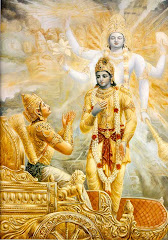
Shri Krshn: Notes on his ‘Leela’ and why he is 'Neelamber', 'Ghanshyam' and 'Shyam'.


Author's Note: This is the 2nd in this 'Shri Krshn' series. Do read Part-I [HERE]. There I have tried to explain why he is called 'Bhagavan'. 

You may also read the 'Pot Luck' series: Part-I [HERE] and Part-II [HERE].  

In this post, I will try to share my thoughts about (what is popularly known as) Shri Krishna's leela and why he is depicted as having a sky-blue (Neelamber), dark (Ghanshyam) and dark-blue (Shyam) complexion.

Krishna (also: Krishn, Krsna. Sanskrit: Krshn) means "that attracts" or "all-attractive". From classical texts we gather that Shri Krishna possessed a magnetic personality, crimson cheeks, 'coral lips', eyes shaped like lotus petals (Pundarikaksha, Padmalochan, puṣkara-locanaḥ, puṣkara-akṣaḥ, puṣkara-īkṣaṇah), head bedecked with peacock feathers, a fascinating face, an enchanting smile, a perfectly proportioned body and a sky-blue complexion - features largely due to the delicate blending of the martian, saturnine, venusian and lunar characteristics (i.e., due to the dominance of the influences of the Moon and Venus, with Saturn and Mars.)

So, what we can conclude is this: Shri Krishna was a figure of matchless good looks, grace and splendor that no mortal eyes had ever witnessed. He also possessed extraordinary conversational ability. However, to my mind, his 'sky-blue complexion' is a metaphor - to indicate that he achieved the exalted status of divinity (that of 'Bhagavan') and was regarded as a part of or a manifestation of the Parameshwar or the Parmaatmaa, by the people of the Dwapar Yug, the 3rd era. So, His depiction with a 'sky-blue complexion' is perhaps to essentially state that since he is divine, he has 'descended from the skies'. [The 'Supreme Being' or the 'Supreme Soul' - the 'Parameshwar' or the 'Parmaatmaa' - the forces of the universe, has no shape, no form and no gender. Do read the 1st part of this series: HERE. There I have tried to explain as to how and why Shri Krishna became 'Bhagavan' Shri Krishna.]

'Neel' means blue and 'amber' means sky, therefore 'Neelamber' means 'the blue sky'. 'Neelesh' means 'the Blue God', and is one of the many names of Shri Vishnu, "The Preserver." The name is a combination (sandhi) of two words: Neel (Blue) and Ish (Master, Lord or God). Ish or Esh is also a Sanskrit word for head. Hence, the name can also be interpreted as 'Blue Head,' which refers to Shri Vishnu who too is often described as the 'Lotus-Eyed One'. 'Neelesh' also means 'the destroyer of adharm'. Shri Krishna is a friend to the wise and the good-hearted (the dharmic), a foe to the wicked and the malicious (the adharmic); he fought the latter in order to restore the balance in society. He is therefore considered to be a manifestation (avatar) of Shri Vishnu - "The Preserver" or "The Balancer."

The name 'Neelesh' is also used to refer to Shiva, who too is known as "The Destroyer of Adharm." Shiva is said to have absorbed the poison that was generated as a result of the 'churning of the ocean' (samudra-manthan) and acquired a bluish hue. However, his action protected mother Earth (Prithvi, Bhu-Loka) and prevented Prithvi, Prakriti (nature) and Srishti (creation) from coming to harm.

Krishna also means 'dark' (Ghanshyam). However, the word 'Krishna' has yet another meaning, that of the all-absorbing one.

During his lifetime, he was the target of malicious attacks. Accusations, abuse and insults were hurled at him; several small-minded people orchestrated these. But Shri Krishna never stooped low nor responded back in kind. He simply tolerated them, rather absorbed them all - with his characteristic grace, and hence is also referred to as the all-absorbing one. He possessed a passionate zeal to safeguard dharma - the principles and ideals of 'the right path' or the 'way of life' as it should be - for the good of mankind and for civilization to flourish well. He was focused in his pursuit of dharma and his energies, actions, thoughts and words were accordingly channeled. ['Sanaatan Dharma' or the 'Sanaatan Path' rooted in the Vedic wisdom is the 'way of life' that Shri Krishna endeavored to re-establish, by cleansing it of the unwanted aspects and elements that had seeped in over time. Sanaatan = timeless.]

Krishna is often shown as having a dark-blue complexion. Not just blue, but, a deep blue, like the velvet blue that sometimes can be seen in a dark sky, like a blue that one may have at times seen from the deck of a ship thousands of miles from shore on the Pacific Ocean.

This perhaps can be explained thus: whenever there is something of unfathomable depth, it appears to be deep blue - be it the sky or the ocean or anything else. The water of the ocean looks blue from afar. But if you go near and take the water in your palms, you will no longer find it blue; it will be very clear, transparent.

It's darkness or dark-blue hue is illusion (maya), not the illusion that we understand today - the type practiced by modern-day magicians (also referred to as 'illusionists'), but something far deeper, something that is much more intense and unfathomable ... and is part of Prakriti (nature) and Srishti (Creation) itself. Krishna was an awesome 'illusionist' too - the best of his era (yug) no doubt, but of all times as well. He was a Yogeeswara.

'Yogeeswara' - is a Sanskrit word and means 'a great yogi who is equivalent to the Almighty'. It is also defined as 'one who reaches the level of Ishvara (the Almighty) through Yog and meditation'. Shri Krishna had mastered Yog - in all its forms, and derived his immense strength and power, of the body (sharira), the mind (manas) and the senses (indriyas) - from this timeless treasure-trove of 'illumined knowledge' (jnana) - Yog. This illumined knowledge (jnana, also: gyana) illumines the mind (manas) to such an extent that one is blessed with profound wisdom, perception, insight and foresight. That is to say, one becomes Trikalagya, a "bhuta-bhavya-bhavat-prabhu" or "The Master of all things past, future, and present". [Nirukti - trikAla vartinAm seshi - The Master of all things that exist in the past, present, and future.] In short, one 'acquires' the Tritiya-Nayan - the Third-Eye. This 'illumined knowledge' (jnana) had been accumulated by the great sages of yore (the Munis, the Rishis, the Yogis, the Maharshis and the Brhmarshis) through the ages - from nature (Prakriti), universe (Brhmaand) and space (Vyoma; this word contains the word "OM" or "AUM" - the sound of primal energy, the sound of the universe itself). The great sages of yore passed on this immense jnana to their deserving disciples and pupils (shishyas) - in the 'guru-shishya parampara' (tradition). It is due to his mastery of Yog that Shri Krishna was able to perform many tasks that appear to be magic or a miracle - to us, and which we refer to as his leela. [Yog should not be confused with what passes for Yoga - in modern times.]

The new moon (also referred to as Neelesh) appears to be dark or deep blue in colour. 'Neelesh' means 'god of the blue sky' and refers to the moon. Dark blue skies and a glowing moon exude peace and serenity. Shri Krishna is much admired for his radiance, calm and serene disposition even in the face of adversity. He is without ego (ahamkara). 

The Go-loka: though interpreted as Shri Krishna's abode in the spiritual sky (Goloka-Paravyoma), methinks: it perhaps refers to the entire Brhmaand (Universe and beyond). And it is dark or dark-blue in colour - Krishna-loka. Even the planet that we inhabit, mother Earth (Prithvi-Loka or Bhu-Loka) appear to be dark or dark-blue - in and from space (Vyoma).

Dark or dark-blue is all pervading, is omnipotent, is everywhere. Yet it is maya, illusion, and is a manifestation of the deep, unfathomable aspect of Prakriti and Srishti (nature and creation). And no matter how much we endeavour to unravel all the mysteries of nature or creation, some aspects of it will continue to remain incomprehensible and elusive to us - as maya or 'illusion'. This IS symbolized by dark or dark-blue. Therefore, for the sake of balance in creation (whether in Brhmaand, Prakriti or Srishti) we must understand and accept this, and bow to Prakriti (and to Srishti). [Dark-blue is Shyam; the colour of dusk - the colour that Prakriti wears after sunset. Dark is Ghanshyam; the colour of Prakriti - at night.]

The dew-covered grass, the predawn hours, the dawn, the mist-covered hills and the cloud-kissed forests seem dark-blue. The pristine snow on the mountains, the Pārijāt, the Banyan tree (Sanskrit: Vata vrksha), the Peepal tree (Sanskrit: Ashvatha), the Tulsi (Sanskrit: Tulasī), the Aparaajita, the Palash, the Atasi, the Akund (Sanskrit: Arca), the Ashok, the Bel (Sanskrit: Bilwa), the Champak (Sanskrit: Campaka), the Yuthika (Juhī), the Kadamba vana (the Kadam forest), the Japāa kusuma (Hibiscus rosa-sinensis), the Bakulah (Maulsari), the Karnikār  (karnayoh karnikāram, Kanak Champā), the Tamāl (Tamala, Himalayan Garcinia), the Mālatī, the Punnāg  (Punnaga, Sultan Champa), the Mādhavī (Atimukta, meaning: completely liberated), the Kovidār (Kovidara, Purple orchid tree), the Ketakī (Kewdā), the Pātal (Paral), the Gunjā (Gunjaa, Gunj), the Kund  (Kundo, Star jasmine), the Bandhook  (Midday Flower) - all appear to be dark-blue, draped in the morning mist or in the evening twilight. Even the elegant deodars (Sanskrit: devadāru) have dark bluish-green leaves. [Hari and Hara, means 'green' and green is the colour draped by Prakriti - during the day. Vishnu and Shiva - the cosmic forces of the universe are also known as Hari and Hara respectively, and as Hari-Hara in their syncretic form.]

Therefore, dark (Ghanshyam), dark-blue (Shyam) and green (Hari-Hara) are the colours of the universe and of creation, rather they signify creation per se. Our ancients' understood this and revered nature. They also worshiped the water-bodies: the oceans (samudra), the rivers (nadh and nadi) and the lakes (sarovara.)

According to the scriptural description of the Brhmaand the entire planet earth is called Bharatavarsha, but particularly the area that lies south of the Himalayas has also been referred to as Bharatavarsha (also: Bharatvarsh.)

Bharatavarsha literally means the continent ('varsha'. Sanskrit) that is dedicated ('rata') to light, wisdom ('bha'). Our Vedic Rishis and Munis devoted themselves to the quest for the eternal truth or 'illumined knowledge' and ultimate reality or bliss for the mind and soul, kevala jnana, satchidananda.

Bharata means "the cherished", Bharatavarsha is the land of Bharata; it is the bhumi of the Bharatas. The ancient 'Bharatas' worshipped Ma Ganga (the holy and mighty river Ganga), the mighty Brahmaputra (Brhmaputr), the sacred river Saraswati (now lost, but which existed during Shri Krishna's time), the Alaknanda (also: Alakananda, one of the two head-streams of the river Ganga), the Bhagirathi (the other head-stream of the river Ganga, it is longer than the Alaknanda and is the source stream), the Mandakini (one of the five head-streams of the river Ganga), the Kaveri (the river Cauvery), the Tapi (the river Tapati), the Narmada, the Sindhu (the river Indus), the Suvastu (now: the river Swat), the Sutlej and the Chenab (known as Śutudri [or Satadru] and Chandrabhaga respectively - during the Vedic period), the Ravi, the Vipasa (the river Beas), the Jhelum (Sanskrit: Vitastā), the Karnali (Ghaghara) ... among several more.

The waters of all these rivers sustain life - be that of humans, animals, birds or plants. They sustain the lives of all living beings and have been doing so since time immemorial. Their waters appear to be blue, dark-blue, but in reality IS transparent. One can see one's image in them. [Shri Krishna too is transparent, yet the possessor of unfathomable depth: of wisdom, of knowledge, of intellect and of perception. And He holds a mirror to us, so that we can see ourselves, or rather the outcome of our actions and words - in it.]

The waters reflect the colour of the sky, but the sky too is transparent, yet appears to be a clear blue - during the day, and takes on a dark-blue hue after sundown, during the night and during a gathering storm. This dark-blue hue of the sky or the clouds is maya, illusion, and is a result of the deep, unfathomable aspect of Prakriti (or Srishti). [Shri Krishna's complexion is similar to the waters of these rivers - on whose banks he has lived and learnt. His complexion is also similar to the dark-blue skies - beneath which he has slept. This is symbolic of the necessity to preserve nature in all its beauty and glory and make it an essential reason for our being. It is a lesson not to destroy, exploit and denude Prakriti's or creation's gifts to mankind.]

But what we have done - for several generations now - is the complete opposite. We must reflect on our actions and try to make amends - collectively. Or else, we shall all perish.

If we were (or are) to heed Shri Krishna's words and advise, we would prosper - collectively. But if we do not pay heed and what's more, if we do just the opposite, and are blinded by greed and selfishness, we are doomed - collectively. [This is another reason why Shri Krishna has been depicted with dark or dark-blue complexion. Black is all absorbing while dark-blue represents calm and serenity. However, both dark/black and dark-blue can be used to indicate something fearsome, like a gathering storm, a cyclone, a tornado, a hurricane or an eclipse. Or perhaps something far more fearsome: Pra-laya or Mahapralaya - destruction and annihilation. Remember, Vishnu - the force of preservation and balance is Hari (green), while Shiv - the force of destruction is Hara (green); yet they both are depicted as blue. They are Hari-Hara, one and the same. Shri Krishna symbolizes this perfectly, he encompasses both Vishnu and Shiv, hence he is the greatest of all avatars.]

Shri Krishna propounded and extolled the concept of loka-sangraha in the Srimad Bhagavad Geeta. The principle of loka-sangraha is based on the idea, rather on the intent of "welfare for all" or "the welfare of the world". Meaning: to run the world selflessly by taking care of each other with affection, compassion, love and truth. This is the daivi sampada (noble virtues) that Shri Krishna enunciated in the Bhagavad Geeta. These principles sustain life. 'Coz we can live and grow only when we make others to live and grow, i.e., collectively. But this 'collectively' also includes all living beings (all jiva: birds, animals, plants, insects, etc) and in harmony with nature and creation (i.e., Prakriti and Srishti). This IS the Sanaatan Vedic Dharma. [Methinks: Shri Krishna, through his concept rather philosophy of loka-sangraha urged every right-thinking person to reach-out to each other, i.e. reach-out to other like-minded persons. In other words: to gather people that are bound by the principles of dharma and are committed to upholding them - so as to achieve certain common goals, that needless to say, would benefit society. BTW, the word 'Vedic' means: from the 'Veda'. 'Veda' comes from the Sanskrit root 'Vid' which means: 'to know' and this in turn has given rise to 'Vidya' or knowledge. So, 'Sanaatan Vedic Dharma' IS the treasure-trove of timeless knowledge - that our ancients learnt from nature (Prakriti), universe (Brhmaand) and space (Vyoma) - and then accumulated within the Vedas. This timeless knowledge IS essentially a 'way of life'.]

Shri Vishnu is called "The Preserver" or "The Balancer", and given Shri Krishna's inclinations towards Loka-sangraha or Loka Kalyana, he is 'attached' to Shri Vishnu. That is: considered as an avatar (manifestation) of Shri Vishnu.

However, we need not look too far in order to see or understand what is happening around us. People indulge in all sorts of adharm and then go back and offer a few grains of sugar to the ants - so as to negate bad karma! This is the result of words and actions dictated by arrogance and ignorance, among other aasuri sampada (ignoble traits or qualities).

Our environment is being ravaged, our mountains are being desecrated, our hills are being razed to the ground, our trees are being massacred, our birds and animals are struggling to survive, our water-bodies are being indiscriminately polluted, nuclear wastes are dumped in them; civilizations are being decimated and there is a competition to grab the resources of the world. No tactics is considered too low - in order to achieve all this. And to top it all: some folks are now all set to mine the asteroids too and after Curiosity ... let's hope that Mars continues to hold on to its title: that of being the 'Red Planet'.

Nations and people are being torn apart: in the name of faith, charity, history, culture, language, friendship, research, media, commerce, sports and what have you. One group is pitched against the other; some stereotyped as martial race, others pampered as agrarian or trading classes while the least useful ones are sidelined as savage tribals. Ethnic differences are so rife that once the friendly colonizers and 'liberators' leave, a once-prosperous nation finds itself engulfed in civil war and in economic ruins. It cannot sustain as one country any more. People are too busy saving this beautiful planet from sundry aliens and extra-terrestrials on 70 mm, while decimating nations, culture and priceless heritage in real time.

From one point of view, Maharshi Ved Vyas's 'Mahābhārat' is a study of the use and abuse of power. It is not that power is good or bad in itself. It is essentially a force, a weapon that can be used to save and foster or to harm and extort. Shri Krishna's over-riding concern has been that those who use power rightfully, for establishing dharm or for loka-sangraha, must be victorious. He does not suffer from the limitations of Bhishma Pitamah or Karna regarding attachment to a vow as a be-all and end-all.

He had no hesitation in surmounting loyalty to kith and kin in slaying his maternal uncle, Raja Kansh - who had become a tyrant; as well as his cousin, Shishupala, who had allied himself with the imperialistic ambitions of the nefarious Jarasandha, the ruler of Magadha. Free from greed for personal aggrandizement, Krishna refused to become the ruler of the Yadavas in Mathura, and reinstated the old Ugrasena back on the throne. Kansh had let himself be manipulated by his friend Jarasandha, then dethroned and imprisoned his own father - the aged Ugrasena. [The 'Yadavas' refer to the Chandravanshi or the moon-worshiping Yadava clan/Yadu vansh/Yaduvamsa to which Shri Krishna belonged.]

The opposite of Jarasandha in his goal, Krishna would be no samrat or emperor, for his status is that of svarat, he removes the tyrants and aggrandizers of public wealth. Finally, the killing of Jarasandha restores independence to nearly a hundred chieftains/kings, frees the Yadava clans and indeed the country as a whole - of the spectre of the all-constricting Magadhan python. Here is the idea of loka-sangraha ("welfare for all" or the "welfare of the world") exemplified. Shri Krishna's use of power is precisely what should have engaged Bhishma Pitamah: protect the virtuous - the dharmic, and destroy the malicious - the adharmic [paritranaya sadhunam vinasaya ca duskrtam.]

Shri Krishna was not motivated by personal glory, nor was he looking to earn a great name for himself. He did not annex territories, expand his kingdom or indulge in rape, loot and plunder. Whatever he did was for the greater good of mankind and for civilization to flourish well (Loka-Kalyana). His was Nishkam Karm; he was simply doing his duty, that of upholding dharm - without expecting anything in return.

Years ago, a statue of Shri Krishna (carved out of stone) was discovered during the excavation at Gorakhpur (in Uttar Pradesh.) The English version of the Sanskrit sloka found on it is as below:

"When there are clouds of hypocrisy and when the sins turn into the storm, then - my melodious flute takes a form of small spear."

This is just another way of saying what he had already said - in his prequel to that legendary Dharmyudh [the battle of principles, of righteousness and of moral ethics] - in the Dharmshetr Kurukshetr:

paritranaya sadhunam
vinasaya ca duskrtam
dharma-samsthapanarthaya
sambhavami yuge yuge


[The above sloka is part of the Srimad Bhagavat Gita, Chapter IV-8. Please do read the 1st part of this series: HERE, for my interpretation of it.] The whole life of Bhagavan Shri Krishna was like the roaring sound of a conch. He undertook a vow, that of fighting adharm - injustice and profanity in all its forms, and establishing justice - by upholding dharma, restoring peace, order and balance in society, and did his best to fulfill it.

It is the very humanness of Shri Krishna that is part of his aura and charm, and is also behind the irresistible fascination that he exercises and exerts over millions - transcending eras. You see, He graced this earth some five millennium ago, in the previous era - the Dwapar Yug, and this is the twenty-first century/the Kali Yug. Frankly, even without going into the Srimad Bhagavad Gita, just a reading of the Mahābhārat itself brings out powerfully the remarkable qualities of the head, the heart and the hand (kara-puṣkara - lotus palms) that makes Shri Krishna pre-eminent among statesmen, counselors, diplomats, philosophers and among leaders of people and nations too. He was not a Warrior-Prince or a Warrior-Saint, but a Soldier-Statesman that strove to re-establish dharma - by fighting all forms of adharm. He was a Yug Purush that also became Bhagavan

I am tempted to attempt a definition of the word 'Yug Purush'. The renowned American thinker, poet, author, historian, philosopher and leading transcendentalist, Henry David Thoreau, said: "A man is wise with the wisdom of his time only, and ignorant with its ignorance." This is true of people like us, because we are mere ordinary mortals, ordinary people. But, once in a while or perhaps in every era (yug), a handful of people appear amidst us - who prove to be an exception to this rule. At one level, these exceptional and extraordinary people are products of their time, but at another level they transcend their times. Their perceptions, their insights, their thoughts, their actions and their concerns are truly universal, in time and in space; since they are neither constrained by the circumstances of their birth nor are they limited by the ignorance of their time. They are truly incomparable. Shri Krishna is one such exceptional transcendental 'Yug Purush', who belongs to all 'yugs' or eras. And in these times of turbulence and violence (that has become the hallmark of 'Kali Yug' in the last millennium or so) - his wisdom, his knowledge, his advice and his philosophy are more relevant than ever before. 

On the auspicious occasion of Janmashtami (the birth anniversary of Bhagavan Shri Krishna), I pay my humble tributes to this transcendental legend, this magnificent 'Yug Purush', this greatest of Bhagavans.

Shubh Janmasthami. II Jai Shri Krshn II


(More later…)

Photograph: Courtesy: Link.