Author's Note: This is the 1st in this 'Shri Krshn'
series.
You may also read the 'Pot Luck' series: Part-I [HERE] and Part-II [HERE].
In this post, I will endeavour to bring out why Shri Krishna became Bhagavan Shri Krishna.
This is the auspicious month of Shravan and today
(July 29) - marks the commencement of 'Jhulon Utsav' (also: 'Jhulan Yatra,'
'Jhulan Purnima,' 'Hindola,' or the Swing festival) - that celebrates the love
of Radha-ji and Shri Krishna. [Sanskrit: Sri Krsna].
Tonight, the rain gods permitting, we should be able to
admire the serene full moon (Jhulon Purnima) and continue to celebrate till
August 02.
To me, both Radha-ji and Shri Krishna were
humans and not God; to me they were (and are) made of flesh and blood, and not
celestial beings. And I do not subscribe to this theory of divine love
between them. To my mind, Love is an emotion of myriad hues and shades;
one aspect of which is divine. However what it is clearly not, is the manner in
which it has been and is still being portrayed or depicted - by our showbiz and
entertainment bigwigs and silver screen Czars and Czarinas.
To me, Shri Krishna is an extremely multifaceted, talented
and charismatic person, with immense insight into events and human nature,
apart from possessing rare foresight. He meant different things to different
people and was perhaps an awesome illusionist too - the best of his era (yug)
no doubt, but of all times as well.
There is no one Krishna - so to speak. There is
this baby born under extraordinary circumstances into a royal family, a baby
separated from his parents (Devaki Ma and Vasudev) right after birth and brought
up by a family of milkmen (Yashoda Maiya and Nanda Maharaj), a baby that killed Putana;
a naughty (natkhat) toddler that loved to steal butter, an extremely
intelligent boy who spent his childhood in the village - as a cowherd (gopa),
and the twinkle-eyed teenager that playfully teased the milkmaids - the gopis.
There is also the extraordinary philosopher and guide - to Arjun and the other
Pandavs, a dear friend - to Sudama and Arjun, a sakha - to Draupadi, the
slayer of the ruthless Raja Kamsa (Kansh), and the consort of Radha - in an eternal romance
that transcends eras. And there is also the handsome King of Dwarka, a great
warrior, a fountainhead of knowledge and wisdom - as enshrined in the 'Srimad
Bhagavad Gita' that consists of 700–verse and is part of the celebrated
'Mahabharat' - the comprehensive itihaas (history) of the 'Dwapar Yug,'
... and much more.
His advise to Arjun about doing one's duty, i.e., about upholding
one's Dharm - during the course of the 'Kurukshetra War' is today
revered as the 'Srimad Bhagavad Gita,' or the 'Song of the Blessed
One or the Fortunate One.' ['Srimad' is an honorific, 'Bhagavat'
means 'Fortunate,' or 'Blessed' and is derived from 'Bhagah' which
means 'good fortune,' while 'Gita' or 'Geeta' means 'Song'.]
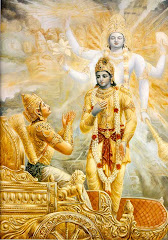
The Bhagavad Gita begins before
the start of the climactic Kurukshetra war, with the Pandav prince Arjun
becoming filled with doubt on the battlefield. Realizing that his enemies are
his own relatives, beloved friends, and revered teachers, he turns to his
charioteer and guide, Krishna, for advice. Responding to Arjun's confusion and
moral dilemma, Krishna explains to Arjun his duties as a warrior and prince,
elaborating on a variety of philosophical concepts.
Krishna, through the course of the Gita, imparts to Arjun
wisdom, the path to devotion, and the doctrine of selfless action (Karm Yog). The Gita
upholds the essence and the philosophical tradition of the Upanishads. However,
unlike the rigorous monism (Advaita) of the Upanishads, the Bhagavad Gita also integrates
dualism (Dvaita) and theism (āstika). [Note: I have not read the Upanishads, and hence have simply mentioned
what I have gathered from other sources, though I would like to add that the pattern
of life based on Vedic wisdom being a way of life, the word 'rigorous'
and its connotations - should and would be quite alien to it.]
The Bhagavad Gita occurs in the 'Bhishma Parva' of
the 'Mahabharata' and comprises of 18 chapters from the 25th through to the 42nd
and consists of 700 verses. However, according to the recension of the Gita
commented on by the Adi Shankara, the number of verses is 700, but there is
evidence to show that the old manuscripts had 745 verses. [What happened to
these additional 45 verses, I know not. But what I can say with certainty is this:
that it has been our loss; we have been deprived of priceless knowledge and guidance. And whether there were more than 745 verses, many of which now lost in the mists of time or to the elements - both natural and human, while several of the remaining ones misunderstood or misinterpreted or not, I leave it to your discretion.]
Early in the text, responding to Arjun's despondency,
Krishna asks him to follow his swadharma. 'Swa-dharma' literally means
'work born out of one's nature' and in this verse, is often interpreted as the
'varna dharma' or the 'duty of a warrior'. The 18th chapter of the Gita
examines the relationship between 'swadharma' and 'swabhava' or essential
nature. In this chapter, the 'swadharma' of an individual is linked with
the 'gunas' or 'tendencies arising out of one's swabhava'. [Therefore,
one has been advised to ascertain one's own self, in order to best understand one's
own nature, tendencies, inclinations and bent of mind; and then to apply
oneself accordingly - into an area or field of work that one is best suited for.
This way, one is able to do justice to one's talents and with that comes
contentment. A contented or satisfied person is good for one's family and to society as well, while a frustrated or dissatisfied person does no good to anyone.]
The 'Srimad Bhagavad Gita'
distills the timeless knowledge of the 'Veds' (whether of all the four - the Rg
Ved, the Sama Ved, the Yajur Ved and the Atharva Ved - I know not; but of the Rig Ved certainly) and those of the 'Panchatantra,' the 'Upanishads,' the
'Ramayan,' etc., as well. It is a book that holds immense wisdom and knowledge
within its pages and is the jewel of ancient India's spiritual wisdom, one that
is not constrained by time and space.
The Veds, the Panchatantra, the Upanishads, the Ramayan,
etc are all part of another era - a different yug. The 'Ramayan' is the
comprehensive itihaas (history) of the 2nd era - the 'Treta Yug,' while the 'Mahabharat' (of which the 'Srimad Bhagavat Gita' is a
part of) has come into our possession from OUR forefathers who lived in the
3rd era - the 'Dwapar Yug'.
And WE all are part of the fourth era - the 'Kali
Yug'.
Therefore, how has Shri Krishna, who walked on this planet in a
completely different era, when there was no 'religion' or 'ism,' been branded as a 'Hindu God' is a mystery to me. And how his knowledge, wisdom and advice - his legacy - his gift to us, rather his gift for
the whole of mankind, been dubbed as a part of 'Hindu literature,' is also something that I have been unable to fathom. [Please do let me know in
case you have made any headway in this regard :)]
Which other 'ism' existed in the earlier 'yugs' (eras or kalpas)?
None that we know of! Since 'religion' and 'ism' were not part of the 'way of
life' - in the preceding eras.
Strangely, these days, a mere
change of name, attire, the manner of 'offering prayers' and a change of the
respective 'place of worship' is all that is required - to connect with the
divine and with one's inner self - the soul. But how does one change the DNA -
the mark of one's forefathers - firmly embedded within one's marrows? How
indeed?? And does anything ('religion' included) come from vacuum? Is there
nothing that influences or precedes it?
For OUR forefathers, the stress
was not on 'religion' (this word and its connotations were unknown to them) but
on dharm, that elusive word, which lays down what is right, rather indicates
one's righteous duty - no matter what the obstacles in its path. 'Dharm' - was
a way of life ... and had not yet come to mean either 'coalition dharma' or
'religion'.
As for our 'mythologies' and
'epics,' can it not be that OUR ancients were farsighted enough to deliberately
camouflage the events, etc, in coded texts? Knowledge falling into wrong
hands can have devastating consequences, and history documented 'as is'
- is vulnerable to 'amendments' - at the hands of sundry forces. But 'coded
texts' have to be deciphered first, and if they are also doubly insured as
fantastic stories, then chances are that young children would grow up listening
to them - and would be unlikely to forget. In this manner our heritage too gets
carried forward without much ado. [Not that various forces have not altered the
narrative or changed our perception.]
Coming back to Shri Krishna, is it not possible that OUR forefathers gave the status of 'Bhagavan' - to someone who touched their lives and
was a harbinger of change - positive change - in society, and whose life and
times transcended eras?
Can it not be that Shri Krishna was one of the many wise
and accomplished men and women of their time who achieved this exalted status
of divinity (that of 'Bhagavan') - through sheer dint of their will and effort as well as their influence, their
work, their vision, their wisdom and their legacy?
We have this concept of the 'Paramatma' - the 'Supreme
Being' or the 'Supreme Soul' - of whom we are all a part of. Can it not be that
these great people - wise and accomplished men and women that did great service
to society, to mankind and therefore to civilization, through their words and
deeds - were given the status of 'Bhagavan' and were considered to be a part of
(i.e., a manifestation of) that Supreme Being or the 'Paramatma' - through
the eras/ages (yugs, kalpas)?
I am referring to the 'avatar' concept that OUR ancients -
through the ages - have referred to. [An 'avatar' is taken as a part of, or a
manifestation of, the 'Paramatma' or the 'Parameshwar' - the 'Supreme Soul' or
the 'Supreme Being'.]
The Chapter IV - 8 of the Srimad Bhagavad Gita - says:
paritranaya sadhunam
vinasaya ca duskrtam
dharma-samsthapanarthaya
sambhavami yuge yuge
Meaning:
Paritranaya: for the deliverance; sadhunam: of the devotees; vinasaya:
for the annihilation; ca: also; duskrtam: of the miscreants; dharma:
the principles and ideals of 'the right path' or the 'way of life' as it should
be - for the good of humankind and for civilization to flourish well; samsthapana-arthaya:
to reestablish; sambhavami: I do appear; yuge: millennium; yuge:
after millennium.
Translation:
In order to rescue/deliver the
good and the pious (the
noble-hearted) and to annihilate the miscreants, as well as to reestablish
the principles and ideals of 'the right path' or the way of life as it should
be - for the greater good of mankind and for civilization to flourish well, I
advent Myself millennium after millennium.
Here humankind should not be taken as humans only,
but creation per se - all living beings.
The good and the pious (the
noble-hearted) need not mean the
profoundly devout or ritualistic people, but refers to ordinary folks who
largely have good, positive thoughts and intentions and are somehow making an
effort - in their own way - for the betterment of the society or are at least
trying to.
Miscreants do not mean evil people, since there is no concept
of 'evil' in the Vedas or in the philosophy of life rooted in the Vedic wisdom. [Veda comes from
the root vid meaning: wisdom, knowledge.] The
soul after departing the mortal body does not 'rest in peace' as is thought by some sections of society. The
"Sanaatan Dharm" has this concept of Charaiveti
- to keep going, in some other form, based on one's Karm (actions committed
in that life) - as per the principles of 'Karm Yog'. A great soul (Mahaatma) will be
reborn to carry on the good work, in whichever capacity; but every soul
(irrespective of its accumulated Karm phal, the fruits of its Karm
- in the previous birth) will be reborn accordingly, and get an opportunity
to redeem itself. The soul has no form, no shape, no gender; only the outer covering or the mortal body takes the shape of a human (a man, a woman, a tritiya prakriti -
the 3rd gender) or an animal, a plant, a bird, an insect, a reptile
and so on and so forth.
Even the annihilation or the destruction of the miscreants
by the 'avatar' (manifestation of the Parmaatma or the Parameshwar) is not to be viewed as a punishment, but as a step towards
their redemption.
Both 'Sur' or
'Sura' (i.e. positive forces or entities) and 'Asur'/'Ashur'/'Ashura' (i.e. negative
forces or entities) are required for creation, and they are present everywhere: in
creation, in the universe and in this world; they are present within us (as
traits), within society and within civilization as well - so as to sustain it or rather so as to maintain the
balance.
Imbalance is also part of nature. ['Vikriti' is also part
of 'Prakriti'.]
However, whenever the negative content increases to
alarming levels, it threatens creation, society, and families and in effect it
threatens civilization. In such scenarios or times, some extraordinary men and
women come forward ... and through their words, deeds and lingering influence restores
the balance.
It has been people and it IS people, mortal humans of
flesh and blood, wise and courageous men and women, that have always risen
above themselves (their own needs, wants, fears, emotions, attachments, etc) in
order to bring the necessary changes in society so as to restore order - in
creation, in civilization. This has happened in every age, in every era. Is it not??
And through their actions, these extraordinary men
and women have left behind a legacy that has in turn transcended time and space
and even triumphed death.
We have this concept of 'mrityunjay' - one who
conquers death, don't we?
To my mind, Shri Krishna was one such "Yug Purush", an illumined
man of extraordinary caliber, a man of nonpareil intelligence, a
larger-than-life legend. But there have been many more (Yug Purush and Yug
Manavi) through the eras/ages/yugs, and this can be observed even in the current
difficult era and times - the Kali Yug. What?
Parting shot: Despite this being 'Jhulon Utsav'
or 'Jhulan Yatra' - the celebration of love - Radha-Krishna's love; yet
somehow it seems love is against 'our ancient culture and
traditions.' Strange, no?
(More later...)
Photograph: Found while trawling the net. Don't have the link :(



 Posts