Author's Note: Please visit - The 'Real' Ramayana/ Ram-Rajya - to read the other
parts of this series, so as to be able to fully understand or grasp the
contents of this one.
Thoughts on: Devi Brahmi
and Devi Kaumari; Rudra and "the archer"; the meaning of the colours: Red (Lohith or Rohitah), Peet/golden-yellow and Blue (Neel, dark blue - Shyam); Shri Krishna and the "Vishwaroop"; Shukracharya's 'curse'; Raja
Yayati and his progeny. Notes on: the Brahmi script; Kartik and Skanda; Devasenapati; Rajarshi; Trikalagya; Sagun Swaroop. *Continuing* with our *discussions* on the "Devi
Mahatmyam" - the "Sri Sri Caṇḍī Pāṭha".
Shiv is known by many names and is also hailed as the "Devadidev
Mahadev" - the best of the Devas or the best amongst the
Aryas/Kshatriyas - people who adhered to noble principles and protected others
from negative entities.
... Though even he, along with Vishnu, shied
away from taking on the forces of darkness that successfully defeated the
mighty Devaraj Indra and banished him (along with other notable Devas)
from Svargaloka. These negative entities then began plaguing the lives
of the people + spread poisonous aspects (the metaphoric sowing of poisonous
seeds - Rakta-beej). Result: anarchy reined supreme and negative aspects
swiftly supplanted the noble culture and heritage of the people. [For
Svargaloka, Deva/Sura and Kailash, do read: Part-XIX,
Part-XX and Part-XXI.]
The terrified and demoralized people then
appealed to Vishnu, Shiv and Brahma - to rescue them. Indra and the other
influential Devas (like Varuna and Yama) too appealed to Vishnu and Shiv... urging them to
subdue the negative entities (collectively known as Asura but not to be
confused with the Asura clan/people, since negative entities were Mlechcha
or Yavana entities and hence, not Arya.) [Note: Brahma probably was the title bestowed upon the most learned person of that era. See:
Part-XXI.]
However, despite the appeals of the stricken
people, Shiv and Vishnu (both stupendous warriors themselves), concluded that
the said forces of darkness were way too powerful. Hence, all of them (Brahma,
Vishnu, Shiv, Indra, Varun, Yama, other influential Devas + the ordinary
people) then collectively appealed to Parvati - urging her to end their
miseries and re-establish the noble way of life. They also gave her
their weaponry.
You can now gauge Parvati's caliber as a
warrior, right? [She did not have ten hands though, that is imagery to indicate her tremendous skills as a warrior + her knowledge of various weaponry. Do read: Part-XIX.]
It is possible that Shiv and Vishnu did not
quite realize the extent of damage caused, or maybe... they misjudged what the forces of
darkness were up to. Meaning: they probably regarded it as an attack on
Svargaloka + loss of life + material loss.
Parvati did not. She rightly understood what
the aasuric entities were up to. She saw their activities as an attack
on the culture and ethos of the land. Such attacks devastates like no other. It
is equivalent to... rather worse than annihilation. Therefore, she did not
hesitate. She heard the anguished cries of the people and responded to it.
Parvati is the central figure of the "Devi
Mahatmyam" (the Sri Sri chandipATh), 'coz she's the lynchpin. She identified
and gathered her troops/forces led by great warriors (some of whom we have
already discussed in Part-XIX,
Part-XX and Part-XXI.]
The battle may have happened in one go or maybe in two or three phases. So
imagine the planning involved and the logistics too. And imagine the caliber
and intrepidness of those greats. We can only marvel at them and their karm,
right?
... But do also spare a thought for what could
or would have happened had Parvati not responded to the anguished cries and
fervent appeals of the people. Imagine the scenario that would have prevailed...
had Parvati not done what she did. What havoc would have ensued? Wouldn't it have been far worse than total
annihilation?
What do you think?
.........................
Let's discuss Devi Brahmi. Here is
what the "Devi Mahatmyam" (the Sri Sri chandipATh) says:
Hamsa-Yukta-Vimaana-Sthe
Brahmaannii-Ruupa-Dhaarinni |
Kaushaambhah-Kssarike Devi Naaraayanni Namo[ah-A]stu
Te ||11||
Meaning:
11.1 Hamsa = swan; Yukta = yoked by; Vimaana = aircraft; Sthe
= in; Brahmaannii = her name: Brahmi or Brahmani; Ruupa-Dhaarinni = as, in the form of.
11.2 Kaushaambhah = water with kusa grass; Kssarike = sprinkle; Devi = one who possesses
noble traits or qualities; essentially a reverential honorific for a female
- entity, person, power, force or energy, that is worthy of respect and worship; Naaraayanni = the balancer or
the preserver; the restorer of balance in society and civilization + the
protector of the noble principles of the Sanaatan Dharma, the
Arya-Dharma and the Kshatriya Dharma. [Naaraayanni is
an honorific - since the cosmic force/energy that our ancients called
"Vishnu" was viewed as the "balancing or preserving
force"]; Namo[ah-A]stu Te = salutations,
reverential bow - in prayer.
Translation:
11.1 (Salutations to You O Narayani) Who in the
form of Devi Brahmani rode the celestial vimana yoked by swans.
11.2 (I bow to) the great Brahmi who sprinkled
water with kusa grass.
Now, all this is clearly camouflaged
language. Let's make an attempt to de-code it.
Vimana yoked by swans: is a clear reference to an
all-terrain aircraft. 'Coz the swan is comfortable both on land and in water.
Its feathers remain untouched by water. Hence, these aircraft were capable
of landing on rocky terrains, on plains, on snow... apart from on water of course.
[And all this points towards a stupendous vaayu-sena.]
Sprinkled water with kusa grass/'Kaushaambhah-Kssarike':
well, our forefathers to cover food - to protect it from the harmful infrared
rays of the sun during eclipse - used the kusa grass. Therefore,
'sprinkled water with kusa grass' can be interpreted as either laser or
something similar, which turned things to ash. It is also a reference to aerial
bombardment.
If we consider the names of the slain aasuric
entities [Part-XX], we find Bhasmasura. And Bhasma =
ash. Therefore, Bhasmasura (along with his companions) may have been reduced to
ash or blown to bits - as a result of the actions of Brahmi and her vaayu-sena
(air-force).
Now, who was Devi Brahmi?
She was a Rudra or a Maruta, known to our
ancients as the "storm-deities" or "wind-gods" (possibly: vaayu-devas i.e. Devas
who were expert in flying a variety of advanced and high-performance
aircraft). They possessed immense power, wore gold necklaces and were "like
lighting-illuminated clouds". This indicates their physical strength,
wealth and tejasvi (radiant) appearance, as well as their tremendous
flying skills + highly advanced weaponry. They are also described as: armed with golden
weapons, clearly: lightning and thunderbolt. [See Part-XXI
- to know what lightning and thunderbolt (vajra/vajrastra) means.]
Brahmi or Brahmani hailed from ancient
Persia. She is also known as Brahmacharini, meaning: a traveler on the
path illumined by Brahma. That is: she was a very learned person... who pursued her quest for
knowledge throughout her life. Brahmi played a major role after the great
battle ended. We will discuss that later. However, there's an ancient
script known as Brahmi, right? Did Devi Brahmi/Brahmani have
anything to do with it? Was the earliest form of this script given by her? Was
it named after her?
What say you?
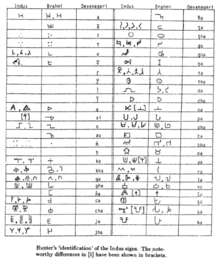
[Note: The Brahmi script is one of the most important
writing systems in the world by virtue of its time, depth and influence. It
represents the earliest post-Indus corpus of texts, and some of the earliest
historical inscriptions found in India. Most importantly, it is the ancestor to
hundreds of scripts found in South, Southeast, and East Asia. Rather: the
Brahmi script was the ancestor of all South Asian Writing Systems. In addition,
many East and Southeast Asian scripts, such as Burmese, Thai, Tibetan, and even
Japanese to a very small extent (vowel order), were also ultimately derived
from the Brahmi script. It was also used in Central Asia, during the final
centuries BCE and the early centuries CE. The Kharoṣṭhī is its "relative".
The best-known Brahmi inscriptions are the rock-cut edicts
of Ashok in north-central India, dated to the 3rd century BCE. Inscriptions in
Tamil-Brahmi, a Southern Brahmic alphabet found on pottery in South India and
Sri Lanka, may even predate the Ashokan edicts. [An example of Tamil Brahmi: link.]
The Gupta script of the 5th century is sometimes called "Late
Brahmi". From the 6th century onward, the Brahmi script diversified into
numerous local variants, grouped as the Brahmic family of scripts.
The
mysterious script of the Indus Valley civilization (the Sarasvati civilization), which is not deciphered yet,
may have some ancestral connection with the Brahmi script. The Harappan people
probably used an older form of the Brahmi script. Maybe: we should also
study the Kalash script and language. Despite the passage of time + various
influences, who knows we may still be able to find something in them, what?
Brāhmī
was used to write the early versions of Prakrit. Surviving records of the
script are mostly restricted to inscriptions on buildings, etc as well as
liturgical texts. However, Brāhmī is not a perfect match for Sanskrit; several
Sanskrit sounds cannot be written in Brāhmī. Therefore, it is possible that Brahmi is derived from (the
various versions of) Sanskrit... and Devi Brahmi may have been the one to achieve
this feat.]
Incidentally, for a while now, Shiv and
Rudra have come to be regarded as one and the same. We will discuss this in
some detail in our later posts.
Let us briefly discuss the symbology
associated with Rudra: the "archer".
Rudra
means: the eliminator
of evil (negativities/aasuric entities) and usherer of peace. He is called "the archer" (Sanskrit: Śarva) and the arrow is an essential attribute of
Rudra. The word is derived from the Sanskrit root śarv, which
means "to injure" or "to kill". Hence, the name Śarva can be interpreted as: "One who can kill the
forces of darkness". The names Dhanvin
("bowman") and Bāṇahasta
("archer", literally: "Armed with arrows in his hands"/ Bāṇa = arrow, hasta = hand)
also refer to archery/the archer. [Rudra is described as armed with a bow and
fast-flying arrows (baan/bāṇa).]
[Note: Shiva
(Sanskrit śiva) means: "the
kindly/auspicious one". And though Shiv is depicted holding the "trishul"
(trident) or the "damaru" (a small two-headed drum), his main weapon is his
bow, the great Pinaka (Ajagav).
Ram's bow is the
legendary Kodanda. Hence, he is also known as Harakodhandarama: the one who is armed with the
curved Kodanda bow. Shri Ram is also
known as Dhanurdhara: One with a bow in hand and Dhanvine: Born of the Sun
race/Solar dynasty (Suryavansh) or Sun-worshipping/Sun-flag-bearing clan.
Ram (also: Ramchandra) comes from the Sanskrit Rāma,
which means: black, dark; Chandra means: moon (in Sanskrit). Therefore:
Ramchandra means: the Rāmamoon. It can also mean: as gentle as the moon (which distills the brilliant rays of the Sun).
Shri Ram has been described as: 'big-eyed' (vishalaksha) or the 'lotus-eyed
one' (i.e. one whose eyes are shaped like lotus petals). Krishna and Parvati
too are 'lotus-eyed'.
Shri Ram successfully broke the 'Shiv-dhanu'
at Sita's Swayamvar. However, given that our ancients used a lot of
metaphors in their writings, the 'Shiv-dhanu' has been depicted as a bow (dhanu
= bow). It was not a 'bow' per se, but the most destructive of
all weapons (of that era). Obviously, a consensus would have been reached
amongst the rulers + other notables and influential entities of that era, to dismantle
that fearsome weapon. Shri Ram did it.
Arjun's bow is the Gandeeva.
Shri Vishnu also has a bow called: Sarangh or Sarnga.
Parvati wields an
assortment of weaponry; the bow is one of them. The bow and arrow in Parvati's
hand suggests she is a markswoman. However, the arrow may symbolize an idea,
and the bow is the spine in you.
Parvati, as you know, is
"Mahisasuramardini" and "Asura-vinashini" - the vanquisher of negative entities/forces
of darkness. She is also "Durgati-nashini" - the eliminator of sufferings or misery and "Durga". "Durga" is derived from durg, meaning:
fortress; Parvati's actions fortified this great land and her people, thus
shielding them from negative or aasuric entities and their influence. Hence, Maa Parvati is Mahadevi - the devi of all devi-s; the best amongst the
Aryas/Kshatriyas - people who adhered to noble principles and protected others
from negative entities/aasuric influences.
Even Kartik is depicted
with a bow. Krishna rarely picks up a weapon; he prefers to wield the Sudarshan
Chakra instead, coupled with his 'illusion-inducing abilities', of course [refer: Part-XVII - to know what the "Sudarshan Chakra" represents.]
However, Krishna is clearly an "archer", 'coz he too
"injures" or "kills" i.e. subjugates or vanquishes the forces of darkness.
Siya-Ram, Shiv-Parvati and Krishna are "Rajarshi" [Raja + Rishi/ Royal Ascetic or Royal Saint] -
meaning: they were frugal or spartan and remained detached even in the midst of plenty or
opulence. They were never enamoured by it, instead they strove for the greater good of mankind - Loka-sangraha or Loka Kalyana. [For "Rishi", "Muni", "Maharshi" and "Brhmharshi", see Part-XVI.]
Shri Ram is a Warrior-Saint. (Here, Saint is not to be
construed as 'celibate' or 'having a propensity towards asceticism'. It means: Rajarshi). Shri Krishna, another Rajarshi is a
Soldier-Statesman-par-excellence. Here, warrior or soldier = one who confronts adharm.]
Now... let's discuss Devi Kaumari.
This is what the "Devi Mahatmyam"
says:
Mayuura-Kuukkutta-Vrte
Mahaa-Shakti-Dhare-Anaghe |
Kaumaarii-Ruupa-Samsthaane Naaraayanni Namo[ah-A]stu
Te ||13||
Meaning:
13.1 Mayuura = peacock; Kuukkutta = rooster; Vrte = surrounded;
Mahaa = great, immense; Shakti = strength; Dhare
= holds; Anaghe = spear or lance (shool).
13.2 Kaumaarii = her name, Kaumaarii means 'of Kumaar' and
'Kumaar' is another name for Shiv-Parvati's son Kartik; Ruupa = form; Samsthaane = assuming; Naaraayanni = the balancer or
the preserver; the restorer of balance in society and civilization + the
protector of the noble principles of the Sanaatan Dharma, the
Arya-Dharma and the Kshatriya Dharma. [Naaraayanni is
an honorific - since the cosmic force/energy that our ancients called
"Vishnu" was viewed as the "balancing or preserving
force"]; Namo[ah-A]stu Te = salutations,
reverential bow - in prayer.
Translation:
13.1 (Salutations to You O Narayani) Who is
surrounded by peacocks and roosters and wields the great Spear/Lance.
13.2 (I bow to) the great Kaumaarii, Salutations
to you O Devi.
All this is camouflaged language - yet
again.
Kaumaarii, as we know, is her
name. Kaumaarii means 'of Kumaar' or 'belonging to Kumar'... and 'Kumaar' is another name for
Shiv-Parvati's son: Kartik.
'Surrounded by peacocks and roosters' could
mean: that she led a team of Nipa/Nepa/Neepa warriors (a
peacock-worshipping clan and/or a clan with a peacock-totem + a sub-clan of this
group that displayed a rooster-totem)... in this battle. [See Part-XIX.
The Nipa/Nepa/Neepa is clearly a reference to some ancient people/clans of
modern Nepal.]
However, the peacock can also be a reference
to an all-terrain vehicle that was resistant to naag-paas/nagapash. [Peacocks devour
serpents... remember? For naag-pash/nagapash, refer to: Part-XVIII.]
Kartik too is depicted with a peacock as his
'vaahan' or 'vehicle'. Therefore, he may have lent her his 'vaahan'.
As for the great Spear/Lance that Kaumaarii
wields in the battle, Kartik may have given it to her as well. I say this
'coz: Kartik is depicted with a variety of weaponry: a javelin, a mace, a discus and a
bow. His army's standard depicts a rooster. [Did the ancient
Nipa/Nepa/Neepa largely people it?]
However, though Kartik rides a peacock and wields a bow in battle,
the Lance/shool is a weapon closely associated with him. Given to him by his
mother, Parvati, it embodies her energy and power. This possibly means: that
the Lance was a weapon that Parvati wielded in various battles... before
giving it to him. [Now, whether it was really a lance or some other weapon, my guess
is as good as yours. We will discuss the birth of Kartik and try to de-code it
as best as we can - in our later posts.]
Kaumaarii is probably Skanda Mata
(mother of Skanda). Therefore, Skanda, a great warrior himself, was most
certainly the son of Kaumari-Kartik. [Due to the passage of time, Skanda and
Kartik have come to be regarded as one and the same. As Kartik's son, Skanda can be referred to as Kartikeya, and this may have caused the confusion.]
And so, all those texts that depict Kartik
as a Brahmachari/bachelor may be incorrect. [Wonder why we are so keen to depict
everyone as ascetic, celibate and/or bachelor. Any thoughts? :)]
Also: Kaumari (the consort of Kumāra/Kartik)
is
none other than Devasena - the daughter of the Devaraj Indra and his
consort Sachi/Aindri [Refer: Part-XXI.]
Hence,
Kartik is also known as Devasenapati - the commander-in-chief of the Deva Sena (the mighty Deva army) - yes, but also:
husband (pati) of Devasena. Devasena is also known as Deviyani, Deivanai and Jayanti. [Kumar means Prince - on account of Kartik's
handsome and radiant looks. Even today, a handsome man is compared to Kartik.]
Perhaps, Skanda was a greater
warrior (defender of the Kshatriya way of life or Kshatriya-Dharma and
Arya-Dharma) than Kartik.
'Coz in the Srimad Bhagavad Geeta
(Chapter 10, Verse 24) Shri Krishna says:
|| purodhasam ca
mukhyam mam
viddhi paartha
brihaspatim
senaninam aham
skandah
sarasam asmi sagarah
||
Meaning:
Purodhasam: of all purohiths, preceptors or
priests; ca: also; mukhyam: the chief; mam: Me; viddhi:
understand; paartha: O son of Pritha (Pritha is the real name of Kunti);
brihaspatim: Brihaspati; senaninam: of all commander-in-chief; aham:
I am; skandah: son of Devasena-Kartik and grandson of Shiv-Parvati; sarasam:
of all reservoirs of water; asmi: I am; sagarah: the ocean.
Translation:
Of priests, O Arjun, know Me to be
the chief, Brihaspati. Of generals I am Skandah, and of bodies of water I am
the ocean.
[Explanation: Indra is the
chief of the Devas (the Devaraj) and is known as the king of Svarga-loka
or Indra-loka. Brihaspati is Indra's chief purohith/priest/raj-guru/preceptor.
Indra is very powerful and influential; therefore, Brihaspati's influence,
knowledge and stature too can be regarded as higher than all other priests/preceptors. (Hence, he
is the chief of all priests). Skanda, son of Devasena-Kartik and grandson
of Shiv-Parvati, probably succeeded Kartik as the commander-in-chief of the Deva army. And he may have been a greater warrior (defender of the
Kshatriya-way-of-life or Kshatriya-Dharma and Arya-Dharma) than Kartik. Of all bodies of
water, the ocean is the greatest.
These representations of Krishna only hint
at His greatness, besides pointing to the Opulence of the Absolute (also known as: the Supreme
Being - the Parameshvar, the Supreme Soul - the Paramaatma, the Brahman - the
Cosmic Energy, the Ultimate Knowledge, the Ultimate Being, the Ultimate Truth or the Ultimate Reality).]
Shri
Krishna is very much like the ocean: unfathomable, yet so very mesmerizing,
isn't it? No wonder Blue is the color of the sky and the ocean.
In Part-XIII
we discussed why he is depicted as blue-hued. But Krishna is often shown as having a dark-blue complexion.
Not just blue, but a deep blue, like the velvet blue that sometimes can be
seen in a dark sky, like a blue that one may have at times seen from the deck
of a ship thousands of miles from shore on the Pacific Ocean.
This perhaps can be explained thus: whenever
there is something of unfathomable depth, it appears to be deep blue - be it
the sky or the ocean or anything else (such as: the blue pre-dawn hours). The
waters of the ocean looks blue from afar. But if you go near and take it
in your palms, you will no longer find it blue; it will be very clear,
transparent.
... Shri Krishna is just like the deep blue waters of the
ocean. Truly unfathomable and yet, he never ceases to fascinate. [Blue also stands for: meditation, peace, tranquility, depth, stability, trust, loyalty, wisdom, confidence, intelligence, patience, decision-making and truth. ]
He is also compared to Maa Parvati/Durga/Shakti -
due to the grandeur of his Karm and Nishkam Karm. Maa Shakti - the divine mother and her human 'manifestation' - Maa Durga - has 108 names, one of which is 'Padmapatrakshi' or 'eyes like the lotus leaf'.
Shri Krishna too is the possessor of 108 names and is known as the
'lotus-eyed-one' (with eyes as broad as the petals of the blue lotus). The dark-blue complexion of Krishna is compared to that of
the Neel-kamal - the Blue Water-lily (Utpala) or the Blue Lotus
(Pushkara or Indivara). Hence, this flower is also known as: 'Krishna Kamal'. Devi
Durga, the human 'manifestation' or the sagun swaroop of the divine
cosmic feminine energy (Shakti) - is worshiped with 108 'Neel-Kamal' or Blue
Lotuses. [Do read Part-XIII - to know more about the Blue Lotus and the Blue
Water-Lily.]
Krishna (also: Krishn, Krsna; Sanskrit:
Krshn) means: "that attracts" or "all-attractive". From
classical texts we gather that Shri Krishna possessed a magnetic personality,
crimson cheeks (the colour of lotus petals/pink or reddish-pink), 'coral lips' (some shade of pink), eyes shaped like lotus petals (Pundarikaksha,
Padmalochan, puṣkara-locanaḥ, puṣkara-akṣaḥ, puṣkara-īkṣaṇah), head
bedecked with peacock feathers, a fascinating face, an enchanting smile, a perfectly proportioned
body and a grayish/dusky-blue complexion - features largely due to the delicate blending
of the martian, saturnine, venusian and lunar characteristics. That is: due to the dominance of the influences of
the Moon and Venus, with Saturn and Mars.

Therefore, what we can conclude is this:
that Shri Krishna was a figure of matchless good looks, grace and splendor that no
mortal eyes have ever witnessed. [Hence, he is also compared to the peacock. Krishna's grayish
to dusky-blue complexion is similar to the colour of a newborn's skin immediately after
birth.]
Krishna was/is Hrishikesa: the master of the senses. He had
not only gained mastery over his own senses (indriyas), but also over
those of others. Hence, he was 'illusionist' par excellence - the best of his
era no doubt, but of all times as well. [This 'illusionist' is not to be
confused with what passes for magic and magicians these days. Krishna's mastery
over the senses was due to a combination of illumined knowledge or 'yog' +
awesome technology + his extraordinary conversational ability. He was a 'Yogeeswara' - which is a Sanskrit word, and
means: 'a great yogi who is equivalent to the Almighty (Ishvara)'.]
Krishna's extraordinary conversational ability helped him to create 'illusion' (in the minds of others) through his words and actions. And this was
one aspect of his 'leela' or 'illusion-inducing abilities'.
He was Trikalagya
as well: a "bhuta-bhavya-bhavat-prabhu" or "The Master of all
things past, future, and present". [Nirukti - trikAla vartinAm seshi
- The Master of all things that exist in the past, present, and future.] In
short, he 'possessed' the Tritiya-Nayan: the Third-Eye. [Just like
Parvati, who is also known as "Trya[i-A]mbake Gauri" - "the three-eyed Gauri" or "the three-eyed one" - on
account of her discerning and visionary nature. Do read: Part-XXI.] Incidentally: Shri Ram is also known as Purvabhashine: One who knows the
future and speaks of events to come.

The colour red (Lohith or Rohitah): Devi Katyayani [Part-XX] is traditionally
associated with the colour red, as is Devi Parvati. They are considered
as the primordial form of Shakti (also mentioned in Patanjali's Mahabhashya
on Pāṇini). Shakti is the name of the feminine force/energy behind the
cosmos. And just as Shakti holds the cosmos together, thus preventing
it's disintegration, Katyayani and Durga (along with their comrades) saved
society and civilization from disintegration and degradation.
[Red is the warmest and the most energetic colour in the spectrum. It stands for: energy, speed, strength, valour and
purity. Purity means: doing what is right, and here it essentially points
towards Katyayani and Parvati's role as "Neelkanth". Hence, Red is the symbol for a soldier or warrior - one who confronts adharm.]

Peet or golden-yellow: Krishna is "Peetamber" - draped in the colour gold.
It is also another name for Vishnu - the name of the preserving/balancing
force/energy behind the cosmos, whose 'avatar' (human manifestation) is
Shri Krishna. Parvati is also known as "Gauri" on account of her radiant/golden-yellow complexion. "Peet" is golden-yellow and "amber" is sky.
Hence, Peetamber also indicates the brilliant and glittering sky as well
as enlightenment (as in: an illumined mind). Shri Ram is also known as Peetavasane (one who wears yellow attire signifying purity
and wisdom). Purity means: doing what is right, here it essentially points
towards Ram and Krishna's role as "Neelkanth" and as soldier/warrior against 'adharm'. [See: Part-XVII
- for "Neelkanth".]
[Human manifestation or sagun swaroop is not literal. It
essentially means that through him we can "see" the balancing or
preserving force/energy behind the cosmos: Vishnu. This is because of the
greatness of Krishna's Karm - that helped preserve the noble principles of
Sanaatan Dharma, restored balance in society and prevented the disintegration/demise of civilization.]
Frankly, our ancient texts state that: it is only the female
that can confront and subdue or vanquish aasuric or negative elements.
[And this itself indicates the status/position of the feminine in Sanaatan
Dharma. Various 'amendments' + 'impurities' have mutilated this eternal way of
life, rooted in Vedic wisdom (illumined/enlightened knowledge). Sadly.]
During Navaratri/Durga Puja, Kaali Puja,
Jagadhatri Puja et al we not only bow to and invoke the divine Mother (Maa
Shakti) - the feminine energy behind the cosmos, we also acknowledge her
many human manifestations (in a manner of speaking, that is). Temples
dedicated to Maa Shakti or Maa Durga dot the country, but the deities
within bear a different name. Perhaps, a silent yet clear testimony: that
legions of women have confronted the forces of darkness - since time
immemorial. We bow to them all.
[Unfortunately, ever since women and
girls have been deprived of education, various negativities, whether
perceptions or superstitions, have taken firm roots; the metaphoric proliferation of Rakta-beej.
The greats of the renaissance movement stressed on women's education - for society
to progress and function in the right manner, yet we choose to ignore them. :)]
Parvati (along with her comrades: Vaishnavi, Kaali,
Bhadrakaali, Katyayani, Aindri, Brahmi, Varahi, Kaumari, et al) fearlessly took
on the forces of darkness, forces that had unleashed havoc on the land and the
people... when none wanted to confront them. Their
actions helped in re-establishing the noble/Arya way of life and restored peace
and balance in society; this in turn prevented the disintegration/demise of civilization and helped it to flourish well. Hence, her story/their story is called "the Devi Mahatmyam"; it is about her/their magnanimity, her/their magnificence and her/their glory.
[Sanskrit
māhātmya: "magnanimity, high-mindedness,
majesty". The title devīmāhātmyam is a tatpurusha
compound, literally translating to: "the magnanimity of the devi".
There must have been many other women who too joined
forces with them; yet, their names (somehow) have been lost to the sand of
time. However, when we pay our obeisance to the devi-s, we pay our
obeisance to all of them, besides to the feminine energy behind the cosmos
- Shakti and Kaali, which are one and the same.
Divine probably comes from dev, which
in turn comes from daaivic, meaning: noble... and indicates noble traits or
qualities. Therefore, divine = one who possesses noble traits or qualities. It
can be animate or inanimate. Daaivic (probably) is also the root word
for devi - one who possesses noble traits or qualities; and is
essentially a reverential honorific for a female - entity, person,
power, force or energy, that is worthy of respect and worship. Dev is the
corresponding honorific for a male.]
Parvati represents all the valiant women who fought
alongside her i.e. all the matrikas. When we pray to her, we
automatically pray to all of them. Though mere
mortals, Parvati (along with the other matrikas) triumphed death... by the sheer
force and grandeur of their deeds and actions (keerti, karm), so much so that
it has transcended time and eras (yugs). They are mritunjay; they will
live forever.
They are Amar.
Parvati's story has since been passed on from one
generation to the next and even after the passage of thousands of years, eras
(yugs) to be precise, colonization and much else, we still revere her and worship her.
Parvati (and her comrades) remain embedded in our souls; they have etched their
memories in our hearts and minds.
Their actions have simply reinforced Shri Krishna's words,
arguably the most famous verse from the Srimad
Bhagavad Gita (Chapter IV-7):
|| yada yada hi
dharmasya
glanir bhavati bharata
abhyutthanam adharmasya
tadatmanam srjamy aham ||
Translation:
Whenever and wherever there is an alarming
decline or discrepancy in the principles and ideals of 'the right path'
or the 'way of life' as it should be (for the greater good of mankind and for
society/civilization to flourish well); or when such an alarming decline is
perceived or becomes a bane; O descendant of Bharata, only then, I, manifest Myself.
The Chapter IV-8 of the Srimad
Bhagavad Geeta says:
|| paritranaya
sadhunam
vinasaya ca duskrtam
dharma-samsthapanarthaya
sambhavami yuge yuge
||
Translation:
In order to rescue the good and the
noble-hearted and to subdue or annihilate the miscreants, as well as to
re-establish the principles and ideals of 'the right path' or the 'way of life'
as it should be (for the greater good of mankind and for society/civilization
to flourish well), I advent Myself millennium after millennium.
The above verses (Srimad Bhagavad
Geeta Chapter IV-7 and Chapter IV-8) essentially means: whenever and wherever
'adharm' - i.e. wrong ideals or principles turn into a storm and
threatens to engulf everything in its fold, someone will always come forward to
confront it and stop it in its tracks. And that: this person(s) action(s)
will prevent society/civilization from destruction and degradation... by preserving the noble ideals and principles of the Sanaatan Dharma and/or
contribute towards its regeneration.
And that: this is the measure of true greatness;
these humans are revered as: "Avatar", "Bhagavan" or
"Bhagavati". [Do read: Part-XIV - to know what
"Bhagavan"/"Bhagavati", "Avatar" and "mrityunjay"
means + to know the above verses in greater detail.]
Frankly, Krishna was only distilling what our ancients
always knew.
However, we haven't quite figured out what exactly he meant by: "I, manifest Myself" and "I advent Myself millennium
after millennium", have we? Why did he say (to Arjun and through him to all of us) that
ordinary people/mortals do not remember their previous births, but that he remembers
all his previous births...?? How can that be? How is that possible? What is the concept of
"Chiranjeevi" all about then? What does "Chiranjeevi" really mean?
Umm, guess we need to ponder over all of these,
don't you think? Krishna (of the Mahabharata and the Srimad Bhagavad
Geeta) is truly a very fascinating figure. Wonder why we have (sort of) ignored him...??]
Even Krishna's "Vishwaroop" is yet to be fully fathomed, though we have made a humble attempt towards
discussing some aspects of it in an earlier post. [Do read: link. It is incomplete though.]
"Vishwaroop" refers to the formless Paramaatma
- the Supreme Soul, the Parameswar - the Supreme Being or the Brhaman
(also referred to as: the Cosmic Energy, the Ultimate Truth, the Ultimate Reality or the Ultimate
Knowledge) - appearing in a form that encompasses/incorporates the whole of creation/universe/cosmos in it. The word "Vishwaroop" is formed by joining two
Sanskrit words: "vishwa" meaning the universe/cosmos and "roop" meaning form.
In Chapter 11 of the Srimad
Bhagavad Geeta, before describing to Arjun (and through him to all of us) what
is now widely known as - His "Vishwaroop", Shri Krishna tells Arjun:
that only those who are truly "awakened" can "see" it. Those who are
yet to "awaken" - cannot "see" it. Here
"awakened" = one who is truly enlightened, one who has truly opened
his or her mind's eye (manas-chokhshu or divya-drishti). Such a person is
a "muni" and this
is irrespective of gender, age or anything else. A "muni" is one who is a true
"jnani" or the
possessor of illumined knowledge. [One does not come to possess
illumined knowledge (jnana) automatically i.e. by simply reading a variety of books or texts;
one also needs to be free from ego (ahamkara) and other base (negative or aasuric) traits, such as:
selfishness, anger, greed, resentment and so on.]
sri bhagavaan
uvaacha:
pashya
me paartha roopaani shatasho'tha sahasrashah
naanaavidhaani divyaani naanaavarnaakriteeni cha //
11.5 //
Translated: Sri Bhagavan Krishna says, "Behold, O
Paartha, by hundreds and thousands, My different forms: celestial,
varied in colours and shapes." [Paartha: as you know is another name
for Arjun, it means: 'son of Pritha', Pritha is Kunti's real name.]
While describing the "Vishwaroop",
Shri Krishna speaks in the first person, aham (I, Me); yet He is not referring to
Himself. He is simply describing that Supreme Force of the Universe or the
Cosmic Energy: that our ancients called the Supreme Soul - the Paramaatma, the
Supreme Being - the Parameswar, the Brhaman, the Ultimate Truth, the
Ultimate Reality or the Ultimate Knowledge... and which encompasses the whole of
Creation and the Universe (Brhmaand) itself. In short: Shri Krishna is
describing Creation or the Cosmos per se, as well as the best of creation (Shrishti)
and action (karm).
He did not
"transform" Himself into "His" cosmic form, as is somewhat
popularly believed. At least: not literally. He used advanced technology for the purpose - so as to substantiate his words.
In his description of the cosmos (once Arjun faltered in his duty/dharma - in the battlefield of Kurukshetra - the Dharma-yuddha), Krishna simplified things i.e. complex
science or vigjnana (logic, the mysteries of the cosmos, the cosmic plan, illumined knowledge or jnana,
spirituality and philosophy) to such an extent that it enabled Arjun to clearly
"see" the entire cosmos + fully
understand the Divine form of the otherwise formless Supreme Being/Cosmic Energy - in his
mind's eye (manas-chokhshu or divya-drishti).
[Note: The Kurukshatra War was not
fought over riches or territory; it was a "Dharm Yuddha". Meaning: it was a war (yuddha) fought
over principles (so as to establish certain norms in society - for the
greater good of mankind, for Loka-sangraha or Loka Kalyana). It was a
war fought to determine the 'way of life' that ought to prevail in
society. Do read: Part-XV. Also refer: Part-XII and Part-XIV.]
However: it is unlikely that the
conversation happened in the battlefield. It probably happened elsewhere, in
the presence of other people. Or it may have been facilitated by the use of technology, such as television screens (also known as: divya-drishti).
And this enabled a large number of people (besides Arjun) to "see" the "Divine
Form" of the otherwise formless Supreme Being/Cosmic Energy, and to hear Shri Krishna
speak about 'Karm Yog' and explain the cosmic process as well as the meaning of
destiny.
Hence: He says: "Behold, O
Paartha..." (pashya
me paartha).
By "... My different forms", Shri Krishna is referring to that
eternal, uncreated, without form and without gender Supreme Being/Cosmic Energy - of
which He too is (and we all are) a part.
Please note: I am using "is" - since
the soul or the atman is Energy; it is eternal, imperishable
and uncreated. The soul (aatman) is a part of that greater Cosmic
Energy (variously known as: the Supreme Soul - the Paramaatma, the
Supreme Being - the Parameswar, the Brhaman, the Ultimate
Truth, the Ultimate Reality or the Ultimate Knowledge).
[Refer: Part-XI.]
The "vision" - that of
"Vishwaroop" - is not a myth or legend... it is a spiritual experience.
Krishna clearly was aware of highly advanced
Science/Vigjnana (that we perceive as 'mythical skills' or 'magical abilities')
and had a much better grasp of the Supreme Being's Cosmic Plan! Of course,
He was spiritually far more advanced than us (mere mortals) and hence, smilingly performed his
(assigned?) role in salvaging society and Sanaatan Dharma. He kept the Universe running.
[We will have to continue discussing the "Vishwaroop" over several posts, 'coz Eternity manifests itself in endless ways on endless planes of existence... Hence, we will also have to delve into the other lokas that exist elsewhere in the cosmos (that we too inhabit).]
However, can it not be that Shri Krishna was/is
also pointing towards himself? That he is saying: he too has many roop/forms? That innumerable strand makes him up? That he too is not easily fathomed? That
he too is like the waters of the ocean (which looks blue from afar but if you go
near and take it in your palms, you will no longer find it blue; it will
be very clear, transparent)...??
Well, what do you think?
………………………………………………………………………
Let's get to Raja Yayati.
Raja Yayati, son of king Nahusha, had five sons.
With Devayani: Yadu and Turvasu. With Sharmishtha: Druhyu, Anu and
Puru.
Devayani was the only daughter of
Shukracharya, the preceptor of the Asuras. After the first Shrukracharya, all other preceptors or gurus of the Asura people (the Danavas, the
Daitayas and the Rakshasas) may have been known by this name/title.
Shukracharya was a descendent of Bhrigu - one of the Sapta-Rishi (or one of the
'seven enlightened sages').
[The Phrygians are descendents of Bhrigu
+ descendents of various Asura clans viz. the Danavas, the Daityas and the
Rakshasas - whose preceptor was Shukracharya. In India, we can consider the Bhargavas (besides some others, of course) as descendents of Bhrigu.]
Sharmishtha was the daughter of the great Daitya
King - Vrishparva. She was also a close friend of Devayani. However, by a sudden
quirk of fate, a petty dispute between them resulted in a permanent schism.
Devayani had loved and lost Kacha, the son
of Brihaspati - the guru/preceptor of the Suras/Devas; Kacha had rejected her, he had his
own reasons of course, which, given the era and the times... perhaps was/is
acceptable. Kacha was sent by his father (Brihaspati) to learn the secret of
the Sanjivani mantra (a hymn or rather mechanism for reviving the
dead) from Shukracharya, the guru of the Asuras. The idea was to help
the Devas with this knowledge.
[Note: After the first Brihaspati, all
the other preceptors or gurus of the Sura/Deva people may have been known by this name/title.
The Suras/Devas and the Asuras were
originally one people/clan, but with the passage of time, petty disputes
arose, along with a quest for greener pastures + an urge to escape unfavourable
terrain and climatic conditions, etc. Hence, a part of the Sura/Deva clan
separated and formed a distinct identity. These were the Asura people; the
Danavas, the Daitayas and the Rakshasas were Asura sub-clans. Do read: Part-XIX.]
Once Kacha refused to marry her (despite a long courtship),
Devayani is said to have 'cursed' him that he would never be able to use his
knowledge, while Kacha is said to have responded that though he would not be
able to use it, he would definitely be able to teach it.
[The word 'curse' cannot and should not be taken at face
value. This word appears in many of our texts essentially to convey: severe
chastisement, physical violence, punishment, banishment, extreme humiliation,
unfavourable medical condition, untimely demise, doing away with primogeniture etc. We need to choose
carefully after examining the narrative(s).
Possibly, later interpreters, a sizable
chunk of whom belonged to the priestly class, tried to glorify and elevate
themselves by attributing awesome and extraordinary powers to their ilk. And what
better way than to (mis)translate our ancient texts, that also served as
reference points? However, some of it may have come about due to genuine misunderstanding.]
Shukracharya's 'curse' on Raja Yayati
can be interpreted thus: Yayati developed a medical condition that precipitated his aging process, leaving him a doddering old man in the prime of his youth.
We must remember that Shukracharya was not only a very knowledgeable person but
was also Yayati's father-in-law; he was Devayani's father. Hence, Yayati
would have straightaway approached him after the raj-vaids (royal
physicians) failed to provide a remedy.
The narrative says: Shukracharya tells Yayati that 'his condition can be reversed only if any of his progeny willingly
takes on his old age in exchange for his youth'. [Now, whether this "willingly" bit has been added later, we have not a clue.]
Shukracharya's words clearly points towards advanced bone marrow
transplantation (possibly in conjunction with: advanced stem cell therapy +
advanced tissue and gene transfer therapies + advanced xenotransplantation),
something that the modern world is yet to see. It is unlikely that all this
could have happened instantly or overnight.
However, all those mentions of "thousand years" cannot
and must not be taken at face value. Granted that people in the earlier eras
(yugs) were much different from modern humans of the current era (Kali Yug) in every way... and
so, their longevity too would have differed greatly. But that does not mean
that human beings lived for thousands of years. "Thousand years"
essentially meant a fairly long duration, 'coz when we bless someone by saying:
'may you live for a thousand years' - it is not literal.
Four of Yayati's sons (Yadu, Turvasu, Druhyu
and Anu) probably refused to take part in the advanced bone marrow
transplant or stem cell therapy - to reverse Yayati's condition. They had their
reasons of course. [However, we cannot rule out the possibility of some physiological mis-match either.]
Finally, the youngest - Puru - (willingly agreed = physiological match), thereby enabling Yayati to regain his youth and vitality, which he then
put to good use - by consolidating and expanding his kingdom/empire and looking after
his people.
Yayati had earlier indicated that whoever
(among his sons) agreed to undergo the medical therapy (or was a physiological match?) would inherit
his (existing) kingdom - as a token of his gratitude. True to his words, at the
end of his "borrowed youth", Yayati did away with primogeniture to crown his
youngest-born - Puru - as his successor.
Hence, Puru inherited the "old" areas, the
ones that came under Yayati's rule... before he underwent therapy.
While, Yadu, Turvasu, Druhyu and Anu
were assigned the "new" areas - which Yayati brought under his control after his
successful therapy. Meaning: these new areas were divided amongst Yadu, Turvasu, Druhyu and Anu.
As for Puru and Yadu: well, Puru started the Puruvansh
(the Puru lineage - to which the Pandavas, the Kauravas and very likely
Parvateshwar/Paurav or Porus belonged), while the eldest - Yadu - started the Yaduvansh
(the Yadu or the Yadav lineage - to which Bhagavan Shri
Krishna belonged. Devayani was their ancestress). Puru is the progenitor of the Puru clan or the
Bharatas (from which 'Bharatvarsha'
derives her name).
We can say that (in a way) Bhagavan Shri Ram, Bhagavan Shri Gautam Buddh and
the Mauryas too were part of the Puru lineage.
[Dushyant and Yayati's stories are interlinked. Do read: Part-XIII - to know the meaning of Bharatvarsha.]
Yayati made Turvasu the ruler of the far western regions.
The descendants of Turvasu were known as Turvasus, who founded Turvaski. Over time: Turvaski became Turski and finally Turky. Even the Tusharas
(alias Tukharas, Tócharoi) were descendents of Turvasu. The Tushara country
mentioned in the Mahabharata could be Turkmenistan, now a Central Asian
Republic and/or the Turkistan of Afghanistan. [In India, people of the Tomar gotra have descended from
Turvasu.]
As for Druhyu, he and his descendents (the
Druhyus) settled in ancient Uruk... and probably had something to do with the
Sumerian civilization.
About Anu: both the Madras (or the Madrakas)
and the Kekayas (or the Kaikeyas) were the direct descendants of Anu. [Alternatively: they may have, at some point in time,
intermingled with the Anus and hence... gradually come to become "Anus" themselves (i.e.
descendants of Anu).]
Kaikeyi was from the Kekaya Mahajanapada
(kingdom). Madri of the Mahabharata hailed from yet another such 'Arya'
clan known as the 'Madras', 'Madrakas' or the 'Medes' (also: Madai) - which had
migrated to ancient Persia. Later on: some of them (probably) returned to
'Sapta-Sindhu' and re-settled themselves.
There are some Jat gotras: Anav, Bal and
Cheema that descend from Anu. Even the Aulakh Jats too may have some
affiliation with the Anus. (Anus = descendents of Anu).
Over time: the Anus, the Druhyus and some of
the Tusharas intermingled; hence, all of them together played some role in ancient
Uruk and thereabouts. Various Asura sub-clans and the Gandharvas too have made
their presence felt in that region. [Gandhari was an 'Arya' from ancient Gandhar. Do read: Part-XVIII
and Part-XIX
- to know more about the Apsaras and the Gandharvas.]
[We will continue our discussions in the next
post...]
(Do stay tuned…)
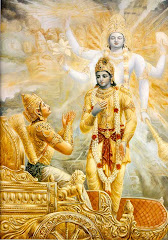
Pictures: Illustrations of: the mighty Devaraj Indra defeated and banished from Svarga-loka by Vrtra; Maa Parvati/Durga, Devi Brahmi, comparison of Indus Script and Brahmi Script; Rudra - the "archer", Shri Ram with his great bow - Kodanda; Devi Kaumari, Kartik, Skanda; a depiction of the "unfathomable"; a peacock feather; Maa Shakti - the feminine energy behind the cosmos; Shri Krishna - the Peetamber; some wise words; the "Vishwaroop"; Kacha-Devayani, Shukracharya 'cursing' Raja Yayati.





 Posts
Posts