Showing posts with label Book Review - Random House. Show all posts

Sunday, March 30, 2014

Dear Life by Alice Munro


Alice Munro, the doyenne of Canadian literature, is primarily known for her short stories and has published several collections over the years. She won the Man Booker International prize in 2009. 

(On a side note: Why is it called the 'Man' Booker? Maybe overly-enthusiastic title sponsorship. It was called the Booker-McConnell Prize or simply the Booker Prize from 1969-2001. ... Umm, at least it's not called the Adonis Prize.)

~ Winning the Nobel Prize in Literature 2013 perhaps enhanced Munro's reputation as a master of short fiction. The celebrated author announced her retirement at the age of 82 (last year). She is, perhaps, looking forward to doing something more sociable and less exacting than writing. Fame, or for that matter, the Nobel Prize, sit lightly on her unfazed shoulders. Apparently, she was simply unaware that there was a certain literature prize in the offing. One of her daughters woke her up with the news. 

Dear Life is Munro's most recent collection of short stories. ... I've never read her until now, so cannot quite share my thoughts vis-a-vis this book against her 14 other collections of stories.

This 2012 collection, republished in 2013 (possibly in celebration of the literature prize), is (thus) the valedictory of what has been a sparkling yet unpretentious literary career, unaffected by the paraphernalia of widespread recognition or accolades (rare public appearances, modesty - that rare virtue). The last four stories "are not quite stories... one that is autobiographical in feeling" - the closest to an autobiography, that is.

Munro is a gifted storyteller; her writing is clearheaded, concise, thoughtful, sometimes lighthearted, sometimes entertaining, open endings, a somewhat wiser perspective, non judgmental (like Satyajit Ray framing his universe through the lens of his vision), no pretentious or flowery language, no overstretching of metaphors, no lofty cliché-induced sentences that purport to make a point but don't. Attention to detail is meticulous, although her prose and stories are quite unlike those of (e.g.) Roald Dahl, O. Henry, Mark Twain, R. K. Narayan, Ruskin Bond or Sir Arthur Conan Doyle. Not quite Kiplingesque. Not quite Tolstoy-esque or Hemingwayesque in scope either. Chekhovian perhaps. Somewhat Tolstoynian - in that the situation or circumstance is the protagonist. The 14 stories spanning across 13 to 30+ pages cannot be read back-to-back, any more than one would attempt to read 14 novels back-to-back. Each needs to settle in the mind, it requires processing; they resonate very differently on the palate and possess the heft of a Russian novel, reminiscent of old-fashioned Russian literature.

The stories in this collection is neither obscure scholarly stuff, nor the nebulous kind of short story that leaves one wondering what is it that one read and why it was written. They aren't cynical or satirical either. Instead, these stories are mini-novels/novellas; they have characters and storyline... and offer a glimpse into a bygone era. It is a series of simple tales of everyday life and aspects of human nature woven together in spare but easily understandable language. The author explores the what-could-have-been or the wonder of what might have been - an action not taken at a significant moment, a lifetime spent in contemplation... wondering why not, small choices, imperceptible shifts and incremental changes that at some point down the line, eventually result in a change of destination, unacknowledged mutualism between individuals (that form quite naturally), and the like.

Poor decisions and quirky characters: endearing and hopeless, hesitant and persistent, courteous and snooty, loudmouth and incurious, characters that seem to make a cameo appearance, mundane writ large... but who eventually transform the narrative. ~ The casual is crucial. The ordinary is extraordinary. Later in the book, Ms. Munro states, "We say of some things that they can't be forgiven, or that we will never forgive ourselves. But we do - we do it all the time". This is a recurring theme in her stories. ~ That humans are not perfect, they do things they are not proud of, so much so they may even end up hating themselves... but there is a letting go of bitterness and forgiveness eventually. And that, despite anguish or despondency, it is possible "to put one foot ahead of the other".

Most of the stories are not contemporary; some are set in post-war Canada, while others take place in the countryside and rural towns around Lake Huron in Ontario, around the time of the Second World War, probably because the author herself grew up in rural Canada in the earlier half of twentieth century, far from the turmoil experienced by her contemporaries in Europe. ~ However, despite her sparse prose the average reader can vividly imagine each tale's surroundings. Here are a few lines from "Amundsen": 'Then there was silence, the air like ice. Brittle-looking birch trees with black marks on their white bark, and some kind of small untidy evergreens rolled up like sleepy bears. The frozen lake not level but mounded along the shore, as if the waves had turned to ice in the act of falling. ... Everything austere and northerly, black-and-white... So still, so immense an enchantment. But the birch bark not white after all as you got closer. Grayish yellow, grayish blue, gray.' ~ The terrain is so bleak that the sky is "so immense an enchantment". But as the young woman (Vivien) gazes on her new environment, the subtle shift in perception is palpable. Where initially she sees only black and white, it is not quite enough; she will also need to see various shades of gray. And she does. She learns to see, accept and respond to her new environment/situation/circumstance.

Munro describes her surroundings in rural Ontario: 'Beyond the river was a patch of dark evergreen trees, probably cedar but too far away to tell. And even farther away, on another hillside, was another house, quite small at that distance... that was to me like a dwarf's house in a story.'

'Then a bridge was built across the river, and it began to dawn on people how much more convenient it would be to live over on the other side, on higher ground, and the original settlement dwindled away to the disreputable, and then just peculiar, half-village...'

Munro is a curious writer, not merely a chronicler or bystander. Through the words flowing out of her pen, through her gaze upon the world, she shines a light upon the lives of ordinary people in small-town humdrum life. Her innovative stories, ordinary stories about ordinary people, absorb and reflect all of these facets - a veritable mélange of emotions and whatnot: pain, dismay, torpor, wrinkles, challenge - to walk the line between stress and boredom, leisure, understanding, kindness, energy, surprise, flippancy, eccentricity, gaping solitude, despair, caricature, exaggeration, departures and beginnings, merriment and grievances, bittersweet and humourous, reflective and nostalgic, forward-looking and hopeful, transformation, homecomings - both symbolic and real, redemption or better times; through the spiritual and unifying, through human passions and shortcomings, through a patch of light on bark or walls, through the ordinary, mundane and human. ~ To summarize, Ms. Munro brings forth the essence of a certain kind of people as they existed in a certain place and era - two generations ago, including the humiliations of being a woman when merely expressing an opinion was considered unbecoming. The female characters in her stories are (sort of) in pursuit of happiness and/or freedom from their sense of limitation, constraint or emptiness in the world they inhabited; her prose brings forth the possibility and responsibility that come with that pursuit/attempt/effort; the men they leave behind aren't stereotypical bad or villainous. The stories are free-flowing and somewhat open-ended, there are no contrived endings. Instead, there's an unshowy gentleness, an insightful subtle thoughtfulness, a pellucid straightforwardness even... sometimes finishing with a lightness that is both liberating and agreeable. There's something in the stories that is vaguely old-fashioned - in the best way.

Animals' drinking tins, a swing in the hammock, a few bits of puffed rice floating in the excess milk, corn niblets, eating chili out of clay pots, butter (actually margarine coloured in the kitchen), warming oven, woodpiles and clotheslines, turkey egg, porridge, shepherd's pie, bran muffin, the long curve of the river and the fields and the trees and the sunsets, woodstoves, fresh jam (made from wild berries), ancient skates, quilts already in tatters, a knitting factory, a foundry making old-fashioned stoves that were sold all over the world, cottage roll, strong black tea, homemade pie, Rice Krispies, pancakes and maple syrup, etc coexist alongside streetlights and running water, golf, Matilda and Stephen, Rhett Butler, fiction and poetry, steaming hot coffee, town library, doughnut shop, the thumping piano, spaghetti, omelettes, instant mashed potatoes, canned peas, little cakes topped with shredded coconut, diamond- or crescent-shaped shortbread, cello and violin, chocolate wafers, peanut butter sandwich and apple pie.

Munro is not quite a feminist writer (whatever that means) or an unembarrassed chronicler of particular abjection of being female (given the setting and arc of her stories). Instead, her stories contain whiffs of dry humour with perceptive young women wryly observing men's desire for dominance and other women's collusion with their own subsidiarity. In "Haven", a young woman staying with an uncle and aunt (while her parents are in Africa) sees firsthand the manner in which the uncle continually undermines his wife, or his (rather inexplicable) extreme dislike of a musically talented sibling. (Could it be that being music-illiterate he felt inadequate?) "There was a quantity of things that men hated..." the young woman observes. "Or had no use for, as they said. And that was exactly right. They had no use for it, so they hated it."

Munro tells women's and to some extent men's lives perceptively and deftly. A snippet from "Dolly": "I had thought how men are charmed by stubborn quirks if the girl is good-looking enough. Of course that has gone out of fashion. At least I hope it has. All that delight in the infantile female brain. (... they told me there was a time, not long ago, when women never taught mathematics. Weakness of intellect prevented it.)"

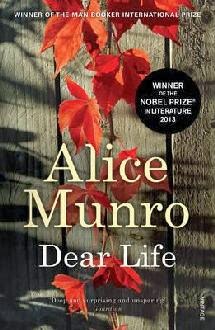
The book feels good to hold; hardly any editing errors. The jacket-cover is eye-catching - quite lively. There's a dusk to dawn light feel. Alice Munro appears in a mellow shade of yellow. Dear Life is embossed in white. Maple leaves - the most widely recognised national symbol/emblem of Canada is also representative of the passing seasons and their rhythms.


Details of the book: Dear Life/ Author: Alice Munro/ Publisher: Vintage Books, an imprint of Random House India/ Binding: Paperback/ Language: English/ Publishing Date: July 2013/ Genre: Fiction/ ISBN-10: 978-0-099-57864-2/ ISBN-13: 9780099578642/ Pages: 336/ Price: INR 450.

Picture: The book jacket cover of Dear Life. Courtesy: randomhouse.

Tuesday, February 25, 2014

Been There Bungled That by Paddy Rangappa


Been There Bungled That is a fictionalized autobiographical story stretched across almost 300 pages. They endeavour to put together snippets and anecdotes from the protagonist Jagannath Srinivasan's life. With a first-person narrative, it is a collection of unconnected short pieces more reminiscent of a blog or column than a book/novel.

Jagannath Srinivasan, fondly referred to as Jags (not Jughead), drifts through life in benign autopilot... armed with the impressive combo of IIT-IIM degrees.

Like millions of Indians he studied engineering - not out of interest, but because he took the entrance examination and secured admission. Rote learning played the all-important role. Soon the natural progression to Amul country follows - to fortify him with degree #2 (~ while also applying for an MS degree in the US - just in case). Thereupon, he embarks on a rudderless career journey... with carefully worded versions of resume - each expressing his boundless passion for banking, consulting, marketing and advertising. He finally settles for whichever offer comes his way ~ based on herd mentality or peer perception, i.e. whichever is more coveted by others. For example, banks and consulting firms come to campus on day 1, which means they are ranked higher. Even the best marketing jobs are all on day 2.

Highly confused and upwardly mobile, he is easily swayed by things he reads, people he meets, and advice he actively seeks and receives. Except sane ones of course, such as the ones offered by (his father's friend) Dr Sidelinger Wakefield (a professor at Brown University) and later from his wife, Vidya. Both counsel reflection - to discover and identify what he wishes to do. ~ These sorts of advice he instantly disregards - since their source(s) are ignorant of the managerial decision making process - that requires one to start at ground zero, which is data collection. This insight helps Jags to make discerning (in Jags' view) shifts from engineering to consultancy to advertising to marketing to banking - by trimming one to three years on the typical career curve.

Here is a snippet - Jags' discussion with Dr. Wakefield:

'You're studying engineering now, right?' I nodded. 'Why?'
'Thats easy,' I said. 'I passed the JEE - the Joint Entrance Exam. ... I did badly in the medical college entrance test.'
'What?! You actually wanted to be a doctor?'
'Of course not,' I said. 'Why do you ask?'
'Because you took the medical college entrance test. You just told me!' The professor was getting agitated and his voice was rising.
'Yes, I did,' I replied soothingly. 'But that was only as a back-up. I was not serious.'
The professor shook his head in bewilderment. 'Ok, so you really wanted to do engineering but just for fun, took the medical college test too. I understand - or at least I think I do...'

Dr. Wakefield is even more puzzled to know that Jags chose his area of specialization based on its relative popularity and the popularity of the institute.

'Yes, but it's not just the relative popularity of the specialization and the institute separately. It's the combination that's important. ... It's very complicated,' I said smugly. ('And therefore beyond your comprehension,' I added, but only to myself.)
'I'm not going to try to follow that,' said Wakefield. ('Exactly,' I said, again to myself.)

There's the bit about a strict professor (Prof. Thampi) and his charming daughter (Vidya) whom he eventually marries - whiff of '3 Idiots'.

My twopenceworth: The chapter titles including the chance meeting with Vidya while trying to submit a late assignment: 'Submitting the POM report... and meeting someone' - reveals too much, and dilutes the charm of the following pages. It somewhat interferes with (read: diminishes) the readers' interest.

Inside jokes about copywriters, bankers, consultants, brand managers etc pepper the book. There are anecdotes regarding Jags' travails on foreign shores. However, none of them can be called fresh or original. In humour writing, especially one with large dollops of perceptive satire, novelty makes all the difference. It is also advisable to eschew unnecessary meanderings... that alters the flavour and wearies the readers' mind. Reading becomes a chore then. With humour or satire that is a no no.

Using lots of very short chapters creates an impression in the reader of very rapid pace and lots of movement. For some genres (such as thrillers), this accelerated pace is exactly the effect that a reader wants. The same may or may not be applicable to other genres, such as humour or satire. Here the quality of writing makes all the difference. Having longer chapters doesn't quite preclude fast-paced movement, but it does allow for more breathing space and a sense of scope and continuity.

Been There Bungled That has been compared to Wodehouse... and this piqued my expectations. But after plodding through the frequent and needless winding of nearly 300 pages, the content leaves me quite wooden. It neither makes nor leaves an impact. Besides, it is Jags narrating the story, talking about himself, or explaining his points of view. The rest of the characters appear quite abrupt.

However, the book is genuinely funny in bits and parts; for instance, when Jags' mother wants to have a serious discussion, he coveys it with "So I did the South Indian equivalent of laying down my fork and spoon: I stopped mashing rice with my fingers and gave her my full attention."

The jacket cover is attractive. The author is observant and a decent raconteur, apart from having a good hand at humour and insightful satire (including a dash of gentle snarkiness). What's missing is some sharp editing to curb the debutant author's prodigal instincts.


Details of the book: Been There Bungled That/ Author: Paddy Rangappa/ Publisher: Ebury Press, an imprint of Random House India/ Binding: Paperback/ Language: English/ Publishing Date: Nov. 2013/ Genre: Humour/ ISBN-10: 978-8-184-00433-5/ ISBN-13: 9788184004335/ Pages: 300/ Price: INR 250.

Picture: The book jacket cover of Been There Bungled That. Courtesy: randomhouse.

Wednesday, January 22, 2014

Train To Delhi


A Note on the author: Shiv K. Kumar (born August 16, 1921) is a distinguished poet, novelist, short story writer, playwright, translator, academic and critic. He has published thirteen volumes of poetry, five novels, two collections of short stories, a play and a dozen books on literary criticism. Following stints as a lecturer and as programme officer at the All India Radio, he obtained his doctorate in English Literature from the University of Cambridge (~ here he was also tutored by the influential British critic F.R. Leavis). Kumar has been an academic, teaching British and American literature in India and abroad, for about four decades. In 1978, he was elected a Fellow of the Royal Society of Literature (FRSL), London. ~ Several of his poems and short stories have been broadcast over the BBC, and published in various widely-read journals, newspapers and magazines - like the New York Times, Poetry Review (London), Western Humanities Review, among others. He received the Sahitya Akademi Award in 1987. In 2001, he was awarded the Padma Bhushan for his contribution to literature.

Train To Delhi is portrayed as a "rollicking journey set in Delhi of 1947". [The novel was first published in 1998 as A River with Three Banks.] 

It recounts the tale of Gautam Mehta, a journalist in Delhi (assistant editor of The Challenge) - and the novel's quick-witted protagonist, alongside enameled snuffboxes, and hobson-jobson conversations ~ as India made its tryst with destiny.

Mehta arranges a quick divorce from his adulterous wife ~ by convincing a naïve Bishop and converting to Christianity. [However, during the simple ceremony, and before Father Jones sprinkles holy water on his head and shoulders, Gautam is particularly touched by a passage from Joshua in which Moses asks his followers to cross the river Jordan into the land of new promise. "Wasn't he too about to cross over to freedom!" He is also struck by the dignified manner in which the ceremony was conducted - including the bishop's prayer wishing him happiness - nobody was "mumbling incomprehensibly all the time."] ~ The Delhi of 1947 is chaotic and restless; despite the proficient Commissioner Thornton at the helm, there is considerable lawlessness. Gautam finds a dead man, and learns that the deceased was in search of his abducted daughter Haseena who had been kidnapped in Allahabad, and sold into flesh trade (in Delhi). This disturbs him, especially since he finds a striking resemblance between the deceased, Abdul Rahim, and his own father, Shamlal Mehta, ("the same arched eyebrows, the same chiseled chin and nose.") ~ Later, after sharing a bottle of champagne and some pakoras, followed by a supper of seekh kebab, raita, nan and some fried chicken at the Neel Kamal, his best friend Berry (Birendra Dhawan) suggests availing the services of a lady of the night to celebrate Gautam's divorce. Sensing his hesitancy, Berry playfully teases him as 'Knight-saviour' and 'Gautam Buddha'. ~ Somewhat reluctantly, Gautam negotiates with the pimp... and ends up (at the Bridge Hotel, run in close partnership with Neel Kamal) with a hauntingly beautiful Muslim woman of quiet dignity - Haseena. ~ Gallant Gautam introduces himself and informs her about the deceased man. Thereupon, they embark on an elaborate plan - to help the damsel in distress escape the clutches of the pimp (which the protagonist-hero compares to a concentration camp). With the help of Berry - who by now has adopted Haseena as his sister-in-law - they manage to get away from the villain/pimp (who is in hot pursuit) and are soon on the train to Allahabad to see her family. The rest of the story involves Gautam explaining the situation to his family, meeting Haseena's family (and asking their permission for marriage ~ in the process becoming Saleem Gautam); his one-on-one with the villain/pimp; their attempts to steer clear of the discord and antagonism; Gautam attending Gandhiji's meetings and prayers (concluded with a rhythmical hand-clapping and head-swaying to the Ramdhun); Berry's dalliances; snippets of the twilight of the Raj, and so on. Gautam - with the help of Berry's British connections - also arranges for (expedites the process, that is) the immigration papers... of Haseena's family (her mother - Begum Rahim and younger sister - Salma), and then escorts them safely to Wagah. Haseena, of course, stays back. (However, given the disquiet, they all travel up to Wagah under assumed names: Begum Rahim as mataji and Salma as Durga, while Haseena and Gautam sees them off as Seema and Gautam respectively.) ~ All in all, the novel ends on a strong note of spiritual universalism, optimism and humanism ~ that of a people having a definite past, their present somewhat disturbed by partition (of the sub-continent)... but that the future is possible.

Among the secondary cast of characters, Shamlal Mehta (Gautam's father) is relatively well delineated. ~ After his divorce Gautam moves in with his parents, into their small house at Anand Parvat. His father, a former Arya Samaji, initially assumes a somber expression on learning about Gautam's conversion - for the sake of easy divorce. But finally responds (as an indulgent father) with: "Maybe Christ too was a yogi, a real karma yogi," and then proceeds to argue his point. When Gautam counters, "But Christ died on the cross, nailed and bleeding till the end. Stone-dead he was when they pulled him down." Shamlal responds with, "No, my dear, Christ didn't die on the cross," ..."He was left there unconscious by the Romans as 'stone-dead' and buried later. But now I earnestly believe that being a yogi, he had controlled his organs, had sort of anesthetized himself before they nailed him on the cross. And since he went into a deep Samadhi, a yogic trance, he felt no pain - nor did he really die, so, he rose from his grave after a brief spell of what I think was a kind of subterranean meditation. That was the Resurrection!" ~ Shamlal later tells the Bishop (with a straight face) ~ that he has now come to believe in Christ as another manifestation (avatar) of Vishnu.

~ There's the bit about insipid British food - steam-boiled Brussels sprouts, mashed potatoes, and scrambled eggs. An Englishman's perennial obsession with weather too is woven in quite neatly.

'Lovely weather - isn't it? Not too oppressive.'
'Yes, it isn't too sultry.'
'We really don't mind the Indian weather at all,' the major said, ... 'We'd prefer it to the vile British winter - blizzard, mist and smog.'
'Yes, I guess.'
A brief pause.
'It's a great pity we have to leave India,' Foster resumed, rather wistfully...'

'Any other Indians coming?' Berry asked.
'No. Only my compatriots. All packed up to return home - to London, Liverpool, Glasgow...'
'So it's a sort of farewell party.'
'Yes, the play's done.'
'You know, Bob, they did a marvelous job here. I do feel sorry for them. I'm sure they're going to miss this bloody, hot country.'
'Miss?' said Bob, '...they're already feeling very low. A poor life awaits them out there. Meagre pensions, no servants, freezing winters - and the fog, the deadly, yellow fog.'
'Sounds ghastly,' said Berry. 'Then it was better here in spite of the heat and dust.'
'Any time. One can always beat down the heat with ceiling fans, khus-khus, and a little dust doesn't do you much harm,' Bob said, spraying himself with some perfume.'

My twopenceworth: Written with the Partition (which was a rather complex phenomenon) as the temporal setting, the author does try to portray a realistic picture of Allahabad and Delhi of that era. He has also attempted to weave the various aspects of partition (cultural, historical, spiritual, emotional, economic, and so on)... apart from the political/geographic division of the country into the texture of the novel. The Gautam-Haseena track provides a strong romantic tinge/motif through the story - though the eponymous train journey probably is an allegorical one, since in the book it takes up all of ten pages. The novel is more of a novella... and quite crisp; editing is decent, the language is simple and easy to understand, and so the story rolls along quite well, but the narrative sometimes meanders on. Gautam's character is reasonably well-etched, however, there is scope for improvement; the other central character, Haseena, comes across as uni-dimensional - so, plenty of space for improvement here as well; the secondary characters too could have done with some more exploration, fleshing-out and insight ~ to move the story along more succulently and cohesively. Maybe a better mix of drama, history and romance coupled with a sustained flow of satire and comic relief could have turned a great story into a great read.


Details of the book: Train To Delhi/ Author: Shiv K. Kumar/ Publisher: Vintage Classics, an imprint of Random House India/ Binding: Paperback/ Language: English/ Publishing Date: 1998, 2013/ Genre: Fiction/ ISBN-10: 978-81-8400-396-3/ ISBN-13: 9788184003963/ Pages: Approx 250/ Price: INR 299.

Picture: The book jacket cover of Train To Delhi. Courtesy: randomhouse.

Saturday, December 14, 2013

The Old Man and the Sea by Ernest Hemingway


"But man is not made for defeat," he said. "A man can be destroyed but not defeated." - Ernest Hemingway, The Old Man and the Sea.

Great quote.

Born (to Clarence and Grace Hemingway) on July 21, 1899, in Cicero (now in Oak Park), Illinois, Ernest Miller Hemingway served in World War I and worked in journalism before publishing his story collection In Our Time. He was renowned for novels like The Sun Also Rises, A Farewell to Arms, For Whom the Bell Tolls (nominated for the Pulitzer Prize), and The Old Man and the Sea, which won the 1953 Pulitzer.

Clarence and Grace Hemingway raised their son in this conservative suburb of Chicago, but the family also spent a great deal of time in northern Michigan, where they had a cabin. It was there that Hemingway learned to hunt, fish and appreciate the outdoors. In high school, Hemingway worked on his school newspaper, Trapeze and Tabula, writing primarily about sports. Immediately after graduation, the budding journalist went to work for the Kansas City Star, gaining experience that would later influence his distinctively stripped-down prose style. ~ While working as a foreign correspondent for the Star, Hemingway made the acquaintance of many of the great writers and artists of his generation, such as F. Scott Fitzgerald, Ezra Pound, Pablo Picasso and James Joyce.

Hemingway's first novel, The Sun Also Rises (1926) is widely considered his greatest work, artfully examining the postwar disillusionment of his generation. ~ His celebrated World War I novel A Farewell to Arms (1929), secured his lasting place in the literary canon. ... When he wasn't writing, Hemingway spent much of the 1930s chasing adventure: big-game hunting in Africa, bullfighting in Spain, deep-sea fishing in Florida. In 1951, Hemingway wrote The Old Man and the Sea, which would become perhaps his most famous book, finally winning him the Pulitzer Prize he had long been denied.

In 1954, Hemingway won the Nobel Prize (in Literature) "for his mastery of the art of narrative, most recently demonstrated in The Old Man and the Sea, and for the influence that he has exerted on contemporary style".

The Old Man and the Sea & my twopenceworth: Among Hemingway's later works, the most outstanding is (perhaps) this short novel, The Old Man and the Sea - the story of a Cuban fisherman who refuses to be defeated by nature.

"He was an old man who fished alone in a skiff in the Gulf Stream and he had gone eighty-four days now without taking a fish. In the first forty days a boy had been with him. But after forty days without a fish the boy's parents had told him that the old man was now definitely and finally salao, which is the worst form of unlucky, and the boy had gone at their orders in another boat which caught three good fish the first week. It made the boy sad to see the old man come in each day with his skiff empty and he always went down to help him carry either the coiled lines or the gaff and harpoon and the sail that was furled around the mast. The sail was patched with flour sacks and, furled, it looked like the flag of permanent defeat."

Though a slim volume, do not expect it to be a breezy read. Reading a classic requires lot of patience; this novella (Hemingway's last major work of fiction and published in his lifetime) packs in a lot... while meticulously chronicling the story of an old fisherman's journey - his long and lonely struggle with a giant Marlin and the sea, and his victory in defeat. [~ Hemingway said, "I was trying to show the experience of the fisherman so exactly and directly that it became part of the reader's experience."]

The Old Man and the Sea is in many ways a deceptively simple tale (especially given Hemingway's use of sparse, straight-forward prose). Santiago, the old Cuban fisherman, has had a significant run of bad luck (i.e., 84 days without taking a fish). "Everything about him was old except his eyes and they were the same colour as the sea and were cheerful and undefeated." Attempting to change his luck, he decides to take his skiff further out than he has ever gone before, "beyond all the people of the world." Eventually, he lands the largest Marlin he's ever seen and the bulk of the narrative details his epic struggle to reel in the fish and get it back to shore. “The fish is my friend too...I have never seen or heard of such a fish.”

"He rested sitting on the un-stepped mast and sail and tried not to think but only to endure."

"Every day is a new day. It is better to be lucky. But I would rather be exact. Then when luck comes you are ready."

... It takes some getting used to - in order to feel a connection to the story and/or be moved by the restrained power of the narrative.

Despite the many hardships and struggles that Santiago faces, or the epic battles he endures on the open sea (what with the elements, sharks and so on), one does not feel sorry for him. One does not pity him. ~ He is simply doing what he loves to do, it gave him purpose and fulfillment in life: struggling with an iron will to accomplish his goal. "I may not be as strong as I think, but I know many tricks and I have resolution."  The struggle is long, hard and difficult... but the reader only feels a great deal of admiration for Santiago. He is thin and gaunt. He lay cramping himself against the line with all of his body. The rope cuts his hands. His muscles strain. He talks to himself. He has no food or water. And yet he does not give up. He never loses hope or faith in himself.

"And what beat you, he thought. 'Nothing,' he said aloud. 'I went out too far.'"

"It is good to have an end to journey toward; but it is the journey that matters, in the end." - Ernest Hemingway.

The author's writing style coupled with spare dialogue and sparse simple prose can make this one a somewhat difficult-to-comprehend read: one that may not quite stir much within every reader. (~ So you will have to read and decide for yourself.)

However, this story can also mirror man's struggle with challenges (including old age and fading memory), and his indomitable will to win - with resoluteness or pride, no matter the odds. ~ To not be defeated. Come what may.

There's also reminiscing of/for youth and vitality. ~ Santiago is mentor and old age; Manolin, the boy, is pupil and youth. He loves and cares for Santiago. In him, the old man wishes to entrust his skill as a fisherman, and his memory.

Maybe the story in a way (metaphorically) also chronicles Hemingway's own struggle with depression and numerous conditions and ailments... that slowly but surely sapped his burly body and mind - even at the peak of his literary career. ["Most people were heartless about turtles because a turtle's heart will beat for hours after it has been cut up and butchered. But the old man thought, I have such a heart too." - Ernest Hemingway, The Old Man and the Sea.]

One never knows.

Santiago survives on a bottle of water and on (raw) dolphin fillets and a couple of flying fish (and eventually some of the marlin's flesh to sustain himself)... but ultimately succeeds in hauling the giant Marlin to shore to the collective wide-eyed admiration and awe - of tourists and fishermen alike. Upon his return (to his shack) delirious and exhausted, Santiago dreams of his youth - of lions on an African beach.

Though the great fish is now merely an 18-feet-long skeleton, its flesh eaten away by mako sharks, it is nevertheless a prized catch if there was one. It is the stuff legends are made of; it is (after all) the largest fish the villagers have ever known to come out of the Gulf Stream. It is to become a mute (yet permanent) testimony to Santiago's greatness. "There has never been such a fish." ~ It represents and brings Santiago the intangibles he craves... to give his existence meaning and dignity. It represents perseverance, hard work and also highlights the indomitable nature of the human spirit. ~ The boy, Manolin, too returns, eager to fish together, convinced he has much to learn. He no longer cares about luck anymore, or what his family might say. He professes his faith in Santiago (the old man) and everything he represents. ... And, when Manolin accepts the (marlin's) spear, he truly becomes his legatee; he accepts for all time everything that Santiago wishes to bequeath him.

Does it also symbolize Hemingway's last hurrah amidst his battle with deteriorating mental and physical health? ~ Well, my guess is as good as yours.


The book feels good to hold; hardly any editing errors - and that adds to the reading pleasure. The jacket cover is eye-catching; appropriate but could have been better.

~ Hemingway, known for his brevity and predilection for understatement, had a unique style. Here are a couple of his quotes:

1. "Never confuse movement with action."

2. "Write drunk, edit sober." 

Succinct, right?!


Details of the book: The Old Man and the Sea/ Author: Ernest Hemingway/ Publisher: Arrow Books, an imprint of Random House India/ Binding: Paperback/ Language: English/ Publishing Date: September 2013/ Genre: Fiction/ ISBN-10: 978-0-09-990840-1/ ISBN-13: 9780099908401/ Pages: 99/ Price: INR 110.

Picture: The book jacket cover of The Old Man and the Sea. Courtesy: link.