Showing posts with label Tales of Dacoits. Show all posts

Thursday, January 7, 2010

Tales of 'Dakats'... 'Ron-paa'/'Bojra'/'Panshi'... and 'Honour among thieves'... errr 'Dakats'!


This is my first post in 2010. Before I begin... let me wish you all a very Happy and Fabulous New Year! In this post, I intend to continue with my series on the dacoits... rather the Bengal dakats.

Author's Note: To read "Tales of Dacoits and one unique story... dating back three centuries!" click HERE. The story "Girl as Kali-Ma" can be read in this post.

"Life and times of the 'Bengal Dakats'... (Part - I)" can be read HERE. The equipments used and the unique mode of communication (including the 'gupto bhasha') followed by the dakats of yore can be read here.

"Tales of 'Dakats' and 'Dakate Kali'" is HERE. In this post you'll find the link leading to a compilation of 20 stories, "Bengal Dacoits and Tigers" (1916) by the Maharanee Sunity Devee, C.I. of Cooch Behar. An incident based on a true story involving the spine-chilling ritual/practice of 'nara bali' can also be found here. Read on...

Writers down the ages have been seduced by the literary possibilities of what can be termed the "outlaw" genre. Muscled bandits, eyes glowing through a lot of facial hair, with or without a heart of gold, riding hell for leather on powerful stallions, to raid houses in remote villages. Remember Sholay? Indian bandits - with the exciting backdrop of impenetrable jungles, wild animals and wilder exploits - have been storytellers' favourites for a long time now. Whether it was Daku Man Singh, the original bandit queen Putlibai or the more recent Phoolan Devi and Veerappan - who can resist the romance and danger inherent in their lives?

The Bengal dakats were not the usual horse riding kind. Their means of communication and transportation were truly unique... that cannot be found anywhere else. In those days, Bengal was undivided, meaning... there was no Bangladesh/East Pakistan. The entire area covering current West Bengal and Bangladesh (erstwhile East Bengal) was referred to as 'Bengal'. In the western part of Bengal (i.e., current West Bengal) people usually commuted on land, but in a riverine area like East Bengal (present-day Bangladesh)... people traveled via the waterways.

For commuting via these waterways, the dakats did not depend on conventional forms of travel... like boats (both passenger and fishing), steamers, launchs, ships, etc. They made some unique 'inventions'... which truly reflect their ingenuity and genius. More so... since they were usually uneducated fellows. But then, who said that 'education' or 'knowledge' is gained only within the four walls of the classroom in schools and colleges or by entering the hallowed portals of exalted universities/institutions... ??? 'Experience' is the greatest teacher and 'necessity is the mother of invention'... right... ??? Right!

The dakats invented the 'panshi' and the 'bojra' (country ship)... which were essentially 'slim long boats'. These were narrow boats with a paddle capacity/space of 20-30. Having many oars, these lightweight crafts could bear many people... and moved swiftly. Yes, that is the keyword... 'swiftly'. Infact, these panshis and bojras were very fast. The 'pirates' (jala dashshus) were in a class of their own. However, some of the bands of dakats who committed dacoity/dakaty on land... too availed of the 'panshi' and the 'bojra'. Deprived of good roads and transport to commute from one rural location to another - one had to remain alert for the attack of dacoits on the lonely stretches, during the night-travels on a bullock cart or a 'palki' (palanquin).

The present day 'pirates' or 'jala dashshus' ('Jala' is water and 'dashshu' is brigand/dacoit... in Bangla) usually commit dacoity... by traveling/using passenger boats on large rivers. On seeing any passenger boat/launch nearby, these dacoits request those passengers for a little fire: "Please spare us a little fire." Thereafter, on the pretext of 'borrowing' fire they bring their craft alongside their targetted boat/launch and proceed to attack. In this region, a class of cruel and wicked pirates named 'Bijanaa' commit dacoity on the river Padma in this typical fashion even today. Due to this, the boatmen engaged by the traders or jewelers and passenger crafts ought to never stop their boats out of compassion for lending fire or tobacco. Rather, the moment they hear a request, "a little fire please", "a little water ('mitha pani' i.e., 'drinking water') please", or "a little tobacco please"... they should not stop or slow down, rather increase their spead and move their craft far away. Among these criminal-natured pirates, the 'Sandaar' and 'Goaynaa' bands were/are notorious. These pirates roam about in boats and live on the fish they catch. Portuguese pirates (called 'bombete'), salt smugglers and dacoits operated in the Sundarbans... in the 17th century.

In the past many kings, Nawabs and Zamindars (landlords) used to take the help of these pirates quite often... during a war or to take possession of some land. After the fall of these landlords and princely houses/states, for some time these riverine bandits were forced to eke out their livelihoods only by means of dacoity. Like these pirates, the land dacoits were also extremely powerful in this region in the past. At places, their leaders have received honours equivalent to kings. In the past, landlords were even forced to pay them annual taxes. During the first part of the British rule in India, their power and influence was quite substantial. It is even said that the ancestors of some of the famous Zamindar families of today were dacoits.

The land dacoits used a type of bamboo staff called the 'Ron-paa' (stilt) for traveling. 'Ron' here signifies 'battle' and 'paa' is 'leg'. 'Ron-paa' is made of two pieces of slim bamboo. In the centre of these bamboo staffs... there is a knot. Placing their feet on these knots and thereby gaining in height or rather rising far up (from the ground)... these dacoits could travel at a speed of twelve miles an hour on these "battle-legs". With the help of these "battle-legs" they were able as a team... to cross through and across canals, tanks, fields, plains and undergrowth very swiftly. When these dacoits traveled on these "battle-legs", they would appear like 'massive giants striding on huge legs'. The use of these "Ron-paa" or "battle legs" demands great practice. Perhaps, just as none have been able to master the art of skiing on snow as well as the Finns... none but the Bengalis (and foremost among them were the 'Bengal dakats') have been able to use this "Ron-paa" so skillfully. The dacoits - expert in using it - can be compared with modern 'mechanized troops'. During the rule of the Bengali kings... soldiers used this "ron-paa" for speedy travel and because of this... these "artificial legs" were also referred to as the "battle-legs".

The Roman troops had several signature maneuvers in the battlefield... you must be familiar with them... they have been lampooned at in the Asterix series! Similarly, in ancient India too the ritual of battle was somewhat thus: in the first line, like the huge tanks of today, armoured elephants would crash through all obstacles and dangers with their huge bodies and behind these 'living tank-columns' would rush the chariots and cavalry, much like the motorized columns of today. But though this battle technique was effective on the hard ground and hilly terrain of North and South India, it was absolutely useless in Bengal... which was bereft of land routes and was full of marshy land. Therefore, in this region, kings and chieftains had to resort to fishing boats for traveling swiftly over the water bodies and to this "Ron-paa" for travel on land. In a way, the "Ron-paa" is an indigenous invention of the Bengali warrior. Needless to say, after the fall of the large royal families it was their scattered and disbanded soldiers who built up these dacoit bands in the past. The word "Ron-paa" and its near monopoly use by the dacoit gangs is a sure proof of this. From irregular acts of looting during famine/festivals etc... they graduated to indulging in the organised armed activities of professional dacoits.

When these dacoits came to eat at any zamindar's place - they would of course "self-invite" themselves - they refused to take salt. i.e., they used to have salt-less food, for they knew that good relations might not continue forever with these zamindars. Also 'salt' has a different connotation in our culture... it is equated with 'loyalty'. There is a saying: "namak khaya hai" (meaning: 'have taken salt'... which binds the person[s] to remain forever loyal to the one who has given/provided them the namak [salt]). One who breaks this hallowed/sacred bond/duty is taunted as a "namak haram" (meaning: disloyal/cheat/dishonourable). Even dakats would not want to be labelled thus! Talk about 'Honour among thieves'... errr dakats... !!!

Hunting for hidden treasure, they have even tied men to wooden posts and scorched them with 'kolkey' (clay pipes used for smoking tobacco). As for the women, let alone touch them, they have never even tried to take a single ornament off their bodies. They were true gentlemen indeed! What?? But this cannot be said about the dacoits of today. These modern dacoits at times perpetrate unspeakable atrocities on women and men... even on children and babies... indiscriminately.

Many of the dakat/dacoit gangs that came into being at the beginning of the British rule were 'sepoys' (foot soldiers) and 'lathials' (private army) dismissed by the zamindars. During the Pathan rule, these zamindars were fully autonomous with respect to internal government. Therefore, they had to establish these 'sepoys' and 'lathials' in the areas governed by them... in most cases, for generations... by gifting them land. So, by family tradition, their very profession became: 'fighting for the zamindars'. Even though under the Mughals the autonomy of the zamindars was slightly abridged, they went on sustaining these fighters for a long time for their personal requirements.

Under the English too, the responsibility for maintaining law and order was vested in these zamindars... for a while that is. Thereafter, on establishment of the police force (usually referred to as the 'lal pagdi' or the 'red-turbuned'... due to the red coloured 'turban' or 'head gear' they wore) and the judiciary, the zamindars had no longer any need for them. Many of these dismissed 'lathials' began to serve with the dacoit leaders of those times for their livelihood. Hence, at that time in every district of Bengal, several dacoit gangs had sprung up. It can be declared with surety that some dacoits of today (belonging to or categorized under the 'criminal tribes') are the unworthy descendants of these very warriors (sepoys/lathials). What a pity!

The dakats/dacoits of yore used to worship Ma Kali before embarking on any 'mission'. Hence, the form of Ma Kali worshipped by them was called 'dakatay kali'. Some even offered 'soma ras' or pure wine as a 'bhog' (offering of food) to appease the goddess... apart from 'nara bali' of course. With the passage of time... this custom changed and rams (male goats), sheep or buffaloes were sacrificed instead. It is said that Krishnananda Agamvagish (c. 15th-16th century) introduced the worship of *Daksinkalika in Bengal. During the time of Maharaja Krishnachandra Roy of Nadia (1710-1783, reign: 1728-1782), the worship of Ma Kali was well established in Bengal. Bengal also went through a phase of huge cultural revolution during his reign. His navaratna (nine jewels) sabha still plays a significant role in the cultural development of Bengal.

Legend says that Lord Shiva appeared before Maharaja Krishnachandra (the king of Nadia) in his dream, and told him that he was shifting his base from Kasi to his capital. So, in order to please the Lord... the Maharaja set up his new capital at Shivniwas, and constructed 108 (although historians have doubted this figure) temples in his honour. But historians have come up with a more rational explanation. They say that in the middle of the 18th century Maharaja Krishnachandra in order to save his capital Krishnanagar from the invading Maratha dacoits (Borgis) shifted it to Shivniwas, which was surrounded on three sides by the Churni River, thus providing a natural protection from the invading borgis. After shifting his capital the Maharaja christened it Shivniwas, probably after Lord Shiva. However, some historians claim that it was named after his son... Shiva Chandra.

It is generally thought that Durga Puja was not prevalent anywhere in Bengal before the 15th century. In the folk songs of the Bauls (wandering minstrels of the North and Western part of Bengal), the arrival of Gouri (another name for goddess Durga) in Autumn, has been sung.

The historical evidence of Durga Puja can be traced to the time of Hossain Shah Sultan of Bengal. It was (supposedly) the Golden Age of Bengal, the end of the fifteenth century. Political power was in the hands of the zamindars. The zamindars of North Bengal were all powerful. There was great rivalry between the zamindars of Dinajpur and Malda... for social supremacy. The zamindar of Dinajpur initiated Durga Puja... 'Akal Bodhan', on the day when Lord Shri Ram was supposed to have worshipped Ma Durga. He spent Rs. 9 lakhs. There was great pomp and pageantry and the climate was excellent as it was 'Ashwin' (Autumn... referred to as 'Shôrot' in Bengali and 'Sharad' in Hindi).

The zamindar of Malda... in order to out-beat his rival performed 'Basanti Puja' according to Puranic tradition during 'Chaitra' ('Chaitro' in Bengali, this month is associated with the coming of Spring) and spent Rs. 9.5 lakhs. From the following year onwards, both conducted Durga Puja in Autumn.

Later, the centre of Muslim rule shifted from Gaur (Gour) to Dhaka. The zamindars flourshed in East Bengal. They vied with each other and Durga Puja was performed by most. In the 18th century, it spread to other parts of Bengal. It is difficult to pinpoint the date but Radhakanto Deb and Kalikrishna Thakur brought the festival to Calcutta (Kolkata).
The Maratha dacoits/Marhatta raiders or the 'Borgis' (Bargis) would annually invade Bengal for about 10 years (1741–1751). They adopted Durga Puja and carried it westward with them.

Today, however, the dakats have become atheists and do not worship Ma Kali or Ma Durga any more...


(More later...)


Note: Some info gathered, courtesy: Wikipedia.

As Daksinakalika, Kali appears in her most fearsome aspect and is the most widely worshipped. In this aspect, she is shown as dark, four-armed and wearing a string of human heads with blood still dripping from them. She is three-eyed, with one eye in the centre of her forehead. She stands on the chest of Shiva and is encircled by his worshippers.

Photograph:

The picture of a bojra (country ship). Pic courtesy: link.


Tuesday, October 27, 2009

Tales of 'Dakats' and 'Dakate Kali'.


Devotion to Ma Kali: These 'dakats' were extremely devoted to Goddess Kali. Before leaving for any 'mission', they would worship Kali. Many stories are heard in this region (Bengal)... of the advantage taken of these dacoit's devotion towards Ma Kali.

In those days... some dark-complexioned wives or daughters or daughters-in-law of a rich farmer/goldsmith/merchant/zamindar (landlord) would stride forth... completely bare, with their thick, long, dark tresses left untied and flying, a 'chopper' or sword in hand to repel these dacoits... who would have broken into their homes. And seeing them/this scene... these dacoits... overwhelmed with devotion and fear, would cry out, "Maa! Maa!" (O Mother! O Mother!) and, making obeisance before the "goddess", leave the place. Infact, many dacoits would not rob anything from a house where goddess Kali was worshipped.

To read one such story titled, "Girl as Kali-Ma"... please visit my earlier post: "Tales of Dacoits and one unique story... dating back three centuries!" (HERE)

Here is a compilation of 20 stories, "Bengal Dacoits and Tigers" by the Maharanee Sunity Devee, C.I. of Cooch Behar. It is a full text free book... and even contains a story of the legendary 18th century dacoit/brigand, Raghu Dakat ('dakat' is bangla for 'dacoit' or 'daku'). You can read them all: HERE. The download (pdf) link: HERE.

Dakate Kali: Actually... these 'thieves' and 'robbers' or the chors/dakats of yore had their own Kali. Many of these dakats lived (for a while, when they went into hiding, that is) and/or hid their looted treasures ('guptodhon') or had their 'adda' (permanent base... to hide their weapons, equipments and treasures) in the forests/woods. They had the habit of worshipping 'Dakate Kali' (Dakait Kali... meaning: the idol of Ma Kali worshipped by the 'dakats'/'dakaits'/dakus') before embarking on a 'mission'... be it peoples' houses, highways or raiding entire villages. Some of these old Kali images/idols have survived the ravages of 'father time' and are still being wroshipped, though for reasons other than those originally intended.

The very name of these dakats evoked terror in the hearts and minds of the common people... usually the rich and well-to-do. In those days, if any distant village were to be visited, the villagers would usually leave home only after making their 'wills' or having made permanent arrangements for their lands and property. This is because every moment of their travel was beset with the fear of losing their lives at the hands of the 'dakats' or the 'thengaariyaa'/'thengare' (staff wielding murderous gangs). Even today... tales of such 'thengaariyaa fields' or 'Dakate Kali' can be heard in villages.

It seems that some of these gangs even offered 'nara bali' (sacrifice of a human). According to some, this 'ritual' originated from the practice of sacrificing 'prisoners-of-war' (PoW). Some of them were experts in 'tantra' and followed (as well as mastered) several 'tantric' practices. Tales of these 'Kapalik dakats' abound in every other house in Bengal. These dakats would usually search for a healthy, able-bodied male (of a certain age) and kidnap him. On the anointed day, after performing some rituals, the 'chosen one' (to be sacrificed) would be forced to take a bath. Then some more rituals would follow... with vermillion (sindoor), ash ('chita bhoshsho'... the 'ash' gathered or taken from the remains of a funeral pyre) and/or turmeric (powdered haldi) smeared on the "intended victim's" forehead, a red hibiscus in his hair and a garland of red hibiscus flowers around his neck.

Then... at the appointed time, this man would be made to kneel in front of the 'hadikath' with his hands tied behind his back... and with his neck resting on the base of the U-shaped 'hadikath'. A dakat would stand beside him... ready with a 'kharga' or 'chopper'... while the others sat around and watched. On the dot, with one stroke of this 'kharga' - and on most occasions, accompanied by the thundering of the drums and the frenzied beating of the gongs, with the chanting of some 'mantras' and cries of salutations to Kali Ma - the "sacrificial human's" 'jobai' (cutting off the head... from the neck) is completed. All this... in front of an image/idol of Ma Kali (rather 'Dakate Kali'). The warm and fresh blood that gushed out from the neck of the headless and (now) lifeless body... was given as an offering to appease Ma Kali (as per the dakats' belief/philosophy). Some dakats even smeared their bodies with the fresh blood. Freshly plucked, red coloured hibiscus flowers were also used during the puja/worship of goddess Kali.

Note: A 'hadikath' is an U-shaped structure, made of strong wood, and attached to the ground via a wooden base... which makes it resemble the english alphabet 'Y'. But instead of the 'v' on top... there is an 'u'. The 'hadikath' (or 'harikath') gets a fresh coating of oil and vermilion before every 'sacrifice'. Over time, the practice of 'nara bali' decreased and was replaced by 'patha bali' (sacrifice of a goat). Accordingly, a goat stolen by these dakats would be consecrated here.

I have read about an incident... based on a true story... involving this spine-chilling ritual/practice of 'nara bali'. Here is the story (through first-person narrative)...

In those days we used to visit the pilgrimage spots of Bharat (India) by boat on the Ganga. On the way back from Kashi, we were resting at a place on the riverbank. My neighbours requested me to collect firewood. I had gone a little way into the jungle when some muscular men caught hold of me. Tying my hands and gagging me with a 'gamchha', (a cloth towel used for wiping the body after a bath) they carried me through the jungle. Reaching a huge pond, they dropped me on its bank.

Looking back, I saw... below a banyan tree... a massive image of Kali with lolling tongue and a real chopper (kharga/khanda) in hand. I understood that they had undoubtedly brought me to be sacrificed to the mother. Here and there about 60 people were seated on mats and smoking. Looking at the wooden block nearby and the polished chopper next to it, I horripilated.

After this... at two at night, after the worship, two of the men untied me and took me to the tank for bathing. One of them dragged me into the water. Luckily, I was an expert in underwater swimming and could hold my breath very long. On the excuse of dunking my head, I dove underwater to the opposite bank where I merged into the darkness and sat silently on the topmost branch of a big tree. The dacoits searched long for me with torches in the jungle and finally left frustrated. Then I quietly came down and after tiptoeing for some distance, ran for my life... to the bank of the Ganga and clambered up on the boat. It is Mother Kali's grace that saved my life somehow on that trip and that is why I could tell you this story. Otherwise all my friends would have presumed that I had been dragged away by a tiger.


You can read an extract of another such story from the Bangla short story, "Asto charan sholo hantu" ("Eight Legs Sixteen Knees"): HERE.


(More later...)

Footnote:

Some info gathered, courtesy: Wikipedia.

Hadikath: 'HADI', a 'helot race', spread over all Bengal, who take their name from the original 'Santali' word for 'man', 'Had', and who have supplied such terms as 'Hadd' - base, low-born ; 'Hadduk' - a sweeper ; 'Hunda' - hog, blockhead, imp; 'Hudduka' - a drunken sot, etc.

Also, 'Hadi', in low Bengali 'Hadikath', is the name of a rude fetter or stock, by which landholders used to confine their serfs until they agreed to their terms. It means literally the 'helot's log'. It was also used for fastening the head of the victim in the bloody oblations which the Aryan/Vedic religion adopted from the aboriginal races, especially in the human sacrifices to goddess Kali, to which the low castes even now resort in times of special need. In an account of such a human offering to Ma Kali, during the famine of 1866, it was mentioned that the bleeding head was found fixed on the 'harcat,' i.e. the helot's log.

There are ample references to the 'Ashwamedha Yagna' (Sanskrit: अश्वमेध aśvamedhá; "horse sacrifice") but no mention of 'nara bali' even in our two great epics (the Ramayana and the Mahabharata). Hence, this bone-chilling custom of 'nara bali' is a much later day phenomenon/ritual.

There is a mention of "Purushamedha" (literally translated, "human sacrifice")... which is a Vedic yajna (ritual) described in the Yajurveda (VS 30–31). The verse describes people from all classes and of all descriptions tied to the stake and offered to Prajapati. The ritual in many aspects resembles that of the Ashvamedha (horse sacrifice). But, these nominal victims were afterwards released uninjured, and, so far as the text of the 'White Yajurveda' goes, the whole ceremony was merely emblematical. The ceremony evokes the primordial mythical sacrifice of "Purusha", the "Cosmic Man", and the officiating Brahman recites the Purusha sukta (RV 10.90 = AVS 5.19.6 = VS 31.1–16).

"Asto charan sholo hantu" ("Eight Legs Sixteen Knees") - In Harvest [Vol.1]: Bangla Short Stories. Translation from Bengali: Tapati Gupta.


Photographs:

1. An idol of Ma Kali (Pic courtesy: link)

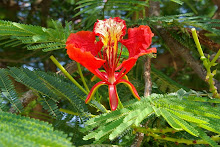
2. A red hibiscus flower (Pic courtesy: Wikipedia).

Sunday, October 25, 2009

Life and times of the 'Bengal Dakats'... (Part - I)


Bengal is rich is all kinds of stories... some of which are quite well known, some little known and several of them... unknown/undocumented and no history books have recorded them for posterity. Unfortunately! But somehow they have managed to survive via folklore, legends... i.e., by word-of-mouth. The very mention of Bengal conjures up many (familiar) images... fish (esp. the hilsa), sweets (e.g., the delicious rosogolla), the Royal Bengal tiger (I refer to the four-legged one here), Rabindranath Tagore, Durga Puja, Kali Puja, the passion for football, the Eden gardens, the Howrah bridge, the trams (video), the hand-pulled rickshaws (video), the underground metro rail, the 'Prince of Kolkata' Sourav Ganguly aka 'Dada'... even Mithun Chakraborty aka Mithunda... and so on. Mind you... I am deliberately undergoing a bout of 'selective amnesia' regarding Bappida *wink* Bengal is also noted for its revolutionary history (the Indian struggle for independence and beyond), intellectuals and being at the fore front of social reform.

However, one aspect that has been overlooked and/or ignored... are the legendary 'dakats' or dacoits hailing from this 'land of plenty'. Perhaps 'dacoits' are more associated with the desolate landscape, littered with ravines, valleys and criscrossing streams. Forbidding and haunting... much like the dreaded Chambal Valley... India's very own Wild West frontier, a name that spelt terror during the 70's (and still do). All that... courtesy the "Bandit Queen" Phoolan Devi, her paramour Vikram Mallah and "The Terror of Kings" Man Singh aka Daku Maan Singh or his side-kick Roopa. The original bandit queen... 'Daku Rani' Putli Bai, and even the now reformed dacoit/daku Malkan Singh. Or the densely forested and hilly terrains of the Biligirirangana Betta and Male Mahadeshwara Betta (Hills) and the Sathyamangalam and Gundiyal forests... due to the notorious forest brigand Veerappan. And not the lush green fertile soil of the riverine state of Bengal. Nothing can be more misleading. 

Incidentally, Chambal is associated with Kunti, the mother of the Pandavas. About 3000 years ago the "Nag" kings had established their capitals in this place and potteries and coins of that era are still found here. The "Nag" kings established their capitals in Mathura, Kantipuri (Kuntibhoj) and Padmavati. In the Age of the Mahabharat (around 5400 BC... in the Dwapar Yuga), Chambal was famous by the name of 'Kuntibhoj' - named after King Kuntibhoj - the adoptive father of Kunti. There were even some 'Centers of Learning' here... in the past - now buried deep down in the grave of time. More HERE. (Note: Kuntibhoj was actually the cousin of Kunti's [who was then called Pritha/Pŗtha and Parshni] biological father Sura/Śũrasena - King of the Surasenas, of the Yadav clan... whose capital was Mathura on the Yamuna. She was thus the sister of Vasudeva, father of Shri Krishna... and was given in adoption to the childless King Kuntibhoja, who rechristened her as Kunti. After her arrival, King Kuntibhoja was blessed with children. He considered her his lucky charm and took care of her until her marriage.) 

Bengali or Bangla literature has an abundance of the tales of exploits of these 'dakats' ('dakat' is bangla for 'dacoit'/'dakait' or 'daku'.) But, perhaps many bengalis and most people who do not speak this language are unaware of these fascinating stories. I am making a humble effort through this blog to spread a few of these stories... beyond the shores of Bengal. There is the legendary and much dreaded Raghu Dakat and his son Madhu, his contemporary... the much feared Gaurey Bedey and the equally legendary but unusual and philanthropically-inclined brigand Hiru Dakat.  

The very wise and widely respected, knowledgeable but shrewd Brahmin Bhabani Pathak, and his able disciple... the teenaged Prafulla - beautiful and unlettered, the daughter of a poor Brahmin widow. Due to a twist of fate, she had become the (neglected) daughter-in-law of a rich, greedy zamindar (landlord). But under her mentor Bhabani Pathak's guidance, the same Prafulla transformed into the feared by the British and the greedy and tyrant zamindars alike, but loved by the poor and the oppressed... the very cultured and accomplished, the legendary Devi Chaudharani. Along with her mentor, she was one of the early nationalists and played an inspirational role in the famous 'Sanyasi Movement' (1763-1800)... in 19th century Bengal. A 'sanyasi' is an ascetic/monk. The Britishers had first come to India via the Bay of Bengal... under the banner of the "East India Company"... as traders and merchants. Undivided Bengal then was the nerve-centre of everything... with respect to (undivided) India. 

In those days, it was not unusual for a daredevil brigand with several 'exploits' to his name to surrender and became the chief of the 'lathials'/'lethels' (private army) of a zamindar's estate/zamindari. I will bring forth each of their tales... in this blog... by and by. 

They were not the standard 'Tilak' (long red 'tika' on the forehead) sporting, dhoti wearing, turbaned dacoit, living in a den and worshipping the Ma Durga or Ma Kali idol. Nor were they dressed in army fatigues, with the cartridges drapped across them, stubbled and young... like the ones portrayed in the many ubiquitous Bollywood 'Dakait' movies... or the type(s) you read about in novels. Even their hideout was not any kind of den, with 'moshals' or 'fire torches', or an open space, hidden by the hills around. And most of them were not nomads, escaping the cops/the long arm of the law/the lathials of the zamindars. Nor were they anything like the immortalised-on-screen and on whom much ink has been spent... the very manifestation of pure evil - the belt wielding, maniacal yet iconic 'Gabbar Singh' (from the 1975 cult movie Sholay). Yes, he of the psychotic expressions, evil laugh, bad teeth and memorable dialogues like: "Arre O Sambha, kitne aadmi thhe" or "Yeh haath humko de de Thakur" or "Bahut nainsafi". The one who frequently subjected his men to a twisted version of Russian Roulette.

The Bengal dakats wore the unassuming dhoti - 'malkocha mere'... so that it did not fall below the knee - pretty much the way Marathi ladies wear their sarees or 'fisherwomen' are depicted wearing them (their sarees, that is) in typical Bollywood 'masala' movies. Only the dhotis were not colourful... just plain white and were made of thick cloth. They applied generous amounts of oil on their bodies and hair, for obvious reasons (to make it impossible for anyone to catch them.) And as a 'haather paanch' or 'double insurance' too [a la George Bush Sr aka Dubyaman's père... choosing Dan Quayle of all people as his 'Veep' or deputy in 1988... a sureshot 'insurance against impeachment']... in order to make it more than impossible for anyone to hold on to them, if caught. These dakats appeared and looked harmless enough. Most even indulged in farming, pottery, cattle herding, worked as ironsmiths, etc. Infact, many were such scrawny persons... no one could believe them to be dacoits. But after swallowing a jug or two of 'taadi' (fermented palm juice) they turned into terrible dacoits and then their nature was no longer timid.  

Lathi/Shurki/Bollom: They were usually not the gun totting types... though guns and even dynamites have been used in some cases. These dakats weilded the 'lathi' (a well oiled, long, thin bamboo stick), knives, swords (torowal) and shields (dhal), axe, spears (bollom) and sickles (used for cutting grass). Besides spears with curved blades, these people used a type of brass or bell-metal plate with serrated edges. These are spun and thrown with such force that they could slice off any person's head from afar. Talk about a distant 'cousin' of the sudarshan chakra... !!! Placing pebbles in loops of string and whirling them about, they threw them in such a way that, speeding like bullets, they succeeded in killing people. Besides... they also wore a type of mask. Some of them applied bitumen in such a way all over their faces that none could recognize them.  

'Dhenki' and code words/'gupto bhasha': The dakats had even 'discovered' a 'fool proof' method of breaking down any door... however strong. The innocuous-looking 'dhenki' (paddy-husking pedal) was used for this purpose. This 'dhenki' is usually made of strong wood and is nothing but a simple implement to husk paddy... and can be seen in the houses of all classes of people - both rich and poor - in villages. These dakats would rob a 'dhenki' from a poor farmer's house and suspend it a little above the ground from three bamboo posts. The instrument thus made was called the 'dhenki kol'. In earlier times, European soldiers also used a similar instrument for breaking down the walls of forts. This was called a 'battering ram'.  

Bringing this 'dhenki' suspended on poles to their target's door - usually a rich man house - by means of a rope... the suspended 'pedal' was drawn back and then released at a high velocity to hit the door. By such repeated violent blows of this 'pedal', any door or brick wall would collapse. At the time of their operations or while returning from one... these dakats signaled their positions to one another by imitating the call of jackals/hyenas (or even birds). From the code words they used during arrival, return and travel, it could be easily understood that they were the mercenaries of old. As an example... two such code words are reproduced here: "Bro" i.e., "go" (quick march) and "Baybro" i.e., "go fast" (double march). Besides this, the system of finger or hand signals was also prevalent.  

'Shinge': We are referring to an era before the advent of the sophisticated telecommunication system (telephone, telegraph, wireless, etc). These bandits used musical instruments (e.g., the drum, bhepu) or even resorted to whistling... to pass signals to each other. The 'shinge' ('animal horn' and later maybe even hunting horn) was extensively used. The waves emanating from the 'shinge' spread across the sky... making the sound bright and clear. btw... 'shinge phonka' or 'shinge phukeche' is also akin to the English phrase: "kicking the bucket." 

Communication 'skills': These dakats preyed on the "Runners" (messengers and postmen carrying letters and more importantly cash and 'money orders' in a sack on their shoulders.) The "runners" would cover great distances on foot... through uneven routes, forests, etc... by running (hence the name, "runner"). The dacoit bands would also attack groups of common people/petty businessmen/farmers... while they returned after selling their goods/articles/crops at the city/town/village "haat" (the weekly village bazar/market). Their leaders used to issue commands through Sanskrit words... or through words with a 'double entendre' (a word or phrase having a double meaning).  

Sample this. A band of these brigands were once waiting to waylay a group of farmers/businessmen returning from the "haat"... some of whom were travelling on their bullock carts while others walked. It was a forest area, meaning, the path/road passed through a forest... with no sight of any other people/villagers/habitation around. The bandits were disguised as "sadhus" (holy men) wearing orange/saffron coloured robes and displaying long matted hair. A few of them were keeping a lookout for the intended 'victims'.  

As soon as they spotted them... their leader enquired: "Keshub! Keshub!" ("Keshub" is another name for Lord Krishna... and also means "Who are they?"). 

His "chelas" (disciples/band members) responded: "Gopal! Gopal!" ("Gopal" too is yet another name for Lord Krishna... and also indicates "a bunch of cattle".) Now "cattle" here is an euphemistic reference to the 'simple minded villagers/farmers'. (Echoes of the "cattle class" row... that was created courtesy a certain twitter-minister... ?!!)

Thereafter, the "chelas" cried out: "Hari!" Hari!" ("Hari" refers to Lord Vishnu/Lord Krishna... and also means: "Shall we rob them?") 

The gang leader responded (with apparent humility): "Hara! Hara!" ("Hara" refers to Lord Shiva... and is also a subtle indication of the 'granting' of the required permission: "Yes, please go ahead [and rob them]") 

Clever... isn't it... ??? Their ingenuity is amazing to say the least. These chaps had 'developed' and 'perfected' an entire vocubulary of their own... apart from a truly unique form (and means) of communication and logistics.

(More later...) 

P.S. My earlier post on the 'dakats', titled: "Tales of Dacoits and one unique story... dating back three centuries!" can be read: HERE.

Note: 

Some info gathered, courtesy: Wikipedia.

The role of 'Gabbar', the dreaded Chambal dacoit, remains Amjad Khan's most powerful and memorable performance. 

Hunting Horns' - It is also the traditional French musical instruments that were used during hunting. Hunting horns were evolved from animal horns that served as means of communication in the past. It was inducted in the orchestra in 1680 when it was played during the royal displays at the 'Maison de France' in the reign of the 'Sun King' (French: le Roi Soleil), Louis XIV. During the era of Louis XV the hunting-horn was introduced in hunting. At that time his subjects posted themselves at sensitive points to inform the public about the fate of the prey and the hunting dogs. 

More info on Phoolan Devi can be found: HERE and HERE.

More on Man Singh aka Daku Maan Singh: HERE.

The three dreaded dacoits Malkhan Singh, Maan Singh and Mohar Singh, who once terrorized villagers in north and central India... have surrendered several years ago and have since dabbled in politics... with the later meeting a violent end. 

Additional info on the reformed dacoit/daku Malkan Singh can be read: HERE. While info on Mohar Singh can be found: HERE

In the 50's, it was Daku Man Singh before Putli Bai struck terror in the 60's. Malkhan Singh and Mohar Singh came in the late 70's. Then it was Phoolan's turn in the eighties. Nirbhay Gujjar ruled the terrain for the last 20 years but, unlike Phoolan, failed to make a transition to politics... and met a violent end. Here is an article on the Chambal 'dakus' (link) and one on 'female dacoits' (link).

Harkishan Mehta's three books about dacoits in the Chambal, "Chambal taro Ajampo" are worth a mention. They are thrilling stories of the life and times of dacoits in Chambal such as Mansingh and Daku Rani Putli and Rupa which can make your hair stand on end. They are adventure stories in the best tradition with larger than life dacoits and some may say they romanticise dacoits.

The late Taroon Coomar Bhaduri was a legendary Special Representative of 'The Statesman'. His book 'Chambal: The Valley of Terror' bore proof of his prodigious narrative skill. All-time dreadful dacoits Man Singh and Madho Singh and the mother of banditry Putli Bai came alive on the pages of his book. Here's a Telegraph link that touches on 'woman-dacoit phenomenon'. 

Photograph: 

The Howrah Bridge (popularly known as the Rabindra Setu) - a rare photo of the bridge under construction... from the archives of the Ananda Bazar Patrika (Pic courtesy: link.) This bridge is one of the four on the Hooghly River and is the definitive icon of Kolkata and West Bengal from 1943 onwards.

Wednesday, October 21, 2009

Tales of Dacoits and one unique story... dating back three centuries!


I came across an interesting article on the net. It is a story steeped in history... or rather in a historically-heightened folkloric feel that will start to draw you in. It is a heady combination of legend, folklore, a dream, of faith, of a chilling end and an unique tradition... all dating back to over three centuries. Let me share it with you here.

Kali's wrath and a stone: On Saturday (17th Oct) the twin cities of Kolkata (nee Calcutta) and Howrah were dotted with small and big images of Kali for her annual puja on the amavasya after Durga puja. But a small village in Bagnan, Saharah, had none of that, although not because the villagers are staunch non-believers. The village resonated with the sound of the 'dhak' and 'conch shell' on Saturday midnight. But instead of the fierce image of Kali, Saharah residents worshipped a black stone covered with a thick layer of vermilion.

Legend has it that anyone in the village who worships an image of Kali will incur her wrath. And so for over 300 years, the village has steered clear of the Goddess' image.

Sukumar Sarkar, 75, one of the two 'sebayets' (kind of hereditary priests... usually belonging to the family who owned the temple property) of the Kali temple in which resides the black stone, said: "Kali appeared in a dream to the Maharaja of Burdwan, the erstwhile zamindar of Saharah. She told him that he must retrieve her from the south-west corner of 'Kali pukur' (a pond) and place her in a temple near the pond. After scouting the spot, villagers found a black stone with the image of Kali engraved on it. Since then everybody in our village has worshipped the stone."

Another story on the origin of the stone worship does the rounds too. Some say one Chandrasekhar Mullick, a resident of Saharah, established a Kali temple and placed the stone there after it was retrieved from 'Kali pukur'.

Despite the disputed origin of the temple, the villagers worship the stone as Kali and take great pride in their unique tradition. Bidesh Das, a student of ancient history, said: "I am proud of our old legends. The puja is performed according to the scriptures in keeping with the tradition. We do not regret missing out on pandals and idols."

Yogendranath Chakraborty, a resident of Saharah and author of 'Sankhipta Pallichitra', a book on the history of his neighbouring villages, told the chilling tale of a villager who dared to worship a Kali image. Kamal Lochan Chakraborty made an image of the Goddess and worshipped it. He was killed by a tiger, said Chakraborty. According to him, the area around the Kali temple was covered in dense foliage and was home to a number of tigers. The village even has a pond called 'bagh pukur' (tiger pond) that was once supposed to be a watering hole for the big cats.

According to legend, Goddess Kali kept night vigil in the village on a tiger. Some villagers claim to have seen the Devi near the temple sitting on her majestic mount. The temple has its own legend. Set amid a dark forest, it was visited by dacoits (an armed gang of bandits) at night, who worshipped the fierce goddess and sacrificed animals to appease her.

Today, the temple is looked after by two 'sebayets'. The expenses are met from farming on a small plot donated by the Maharaja of Burdwan, said Sukumar Sarkar, a descendant of one of the 'sebayets' appointed by the zamindar. On Kali puja day, the temple and the adjacent 'aatchala' (meaning 'eight-roofed') are decorated with lights and 'dhak' beats reverberate in the tranquil ambience of the village of the "stone goddess". Note: 'Aatchala' means 'eight-roofed'. 'Chala' refers to the sloping roofs of huts. Thus a roof can be 'dochala' - with two segments or 'charchala' - with four segments. The 'aatchala' temple doesn't have terracotta work but that is compensated by the colourful paintings on both the outer and inner walls.

Is it only 'blind' faith/belief... or 'something' more... that 'something' which cannot be described in mere words... ???


Tales of Dacoits: The history of northern, central and easten India is studded with the names of notorious and outlawed dacoits who roamed the hills in the name of Kali, robbing the rich, comforting the poor, and in general spreading terror and rough justice. It is said that the dacoits of yore... were extremely devoted to Goddess Kali, and before leaving for any 'mission', they would worship Kali. Some of these gangs even offered 'human sacrifice'. According to some, this 'human sacrifice' originated from the practice of sacrificing prisoners-of-war (PoW). Here is a compilation of 20 stories, "Bengal Dacoits and Tigers" by the Maharanee Sunity Devee, C.I. of Cooch Behar. It is a full text free book... and even contains a story of the legendary 18th century dacoit/brigand, Raghu Dakat ('dakat' is bangla for 'dacoit' or 'daku'). You can read them all: HERE. The download link: HERE.

However... I will narrate one of these stories (from among the 20) over here.

'Girl as Kali-Ma': A large and well-to-do family lived happily in a country place in Bengal. One day their peace was disturbed by an anonymous letter. The writer warned them to expect a "dacoity" (burglary). These Indian outlaws always make it a point of honour to inform their intended victims, and always come with drums, torch-light and a sort of war-cry. There was much valuable jewellery in the house and the family, thinking discretion the better part of valour, gathered all together, packed it securely and, taking it with them, left their home about sunset for safe quarters.

Somehow one of the younger ladies with a tiny infant was left behind. Unaware of the warning letter or desertion of the family, she slept peacefully through the early hours of the night. But later, she was awakened by the sound of drums and loud cries, which she recognised as the signal of the dacoits. Rushing out of her chamber she discovered that the burglars were already in the house and that none of the family were to be found. From room to room she fled, finding none to protect her, and realised that she was alone and helpless. Even her husband was gone! She was a high-spirited and resourceful girl. She knew her life and the baby's as well were in danger and she determined to outwit the burglars.

She had a swarthy complexion like Kali, the dacoits' divinity. Often had her mother bemoaned its darkness! Now it should serve her. But was she black enough? To make assurance doubly sure, she caught up a bottle of ink, which she knew where to find, and hastily smeared her face and limbs with it. Then, hiding her baby in a safe corner, she uncoiled her heavy hair and let its luxuriant black tresses fall about her like a cloak. Her preparations complete, she placed herself in a large niche at the head of the stairs. The dacoits found nothing below worth attention and trooped upstairs. The flickering glare of their torches fell upon a life-like image of Kali the Terrible. With protruding scarlet tongue and fixed staring eyes, the girl stood immovable and breathless, silently invoking all her family gods to come to her aid in her bold design.

With an awe-struck cry of "Mercy! Mercy! Kali-Ma!", the thieves fell prostrate at her feet. The girl held her breath. Was it possible that her plan had succeeded? The slow seconds passed. The Chief arose. "Come, brothers, we touch nothing where Mother Kali is worshipped." With hasty and reverent steps they descended the stairs and left the house. Long after the dacoits had gone the girl stood there. Then the strain snapped and she relapsed to her normal self. Fear swept over her and she rushed out of the house. But her trembling limbs could not carry her far. She fell in a dead faint on the pathway. The neighbours, who had heard the dacoits enter the house and seen them go away silent and empty-handed, came to learn the mystery and found her there. When the family returned next morning, the neighbours abused them soundly for leaving the girl and her babe behind. The girl herselfwas so hurt by the neglect that she had scarcely strength enough to relate the strange happenings of the night.

Her husband found it difficult to make his peace; he said that he believed her to be with the ladies of the family. In zenana families even the most devoted husband has little voice in his wife's movements, as all arrangements are left in the hands of the mother-in-law. There were several ladies and children in the family and the mother-in-law had thought the girl was with some of them. Friendship was however finally restored. All generously admired her ingenuity and realised her bravery. From the white-haired old father to the smallest child, everyone was grateful then and always after for her presence of mind on that memorable night.

You can read the story titled, "The Terror of Kings" (published in the Time magazine on July 19, 1954 HERE.


There is this 1960 film - "Devi" (The Goddess) - directed by one of the greatest auteurs of 20th century cinema - Satyajit Ray - where the teen-aged Sharmila Tagore turned in an outstanding performance in the title role. Based on the story "Devi" by Prabhat Kumar Mukherjee, the film is 93 minutes long and is shot in black and white. The music is by Ustad Ali Akbar Khan.

The Plot: Kalikinkar Roy (Chhabi Biswas, who also appeared in 'Jalshaghar') has a revelation that his daughter-in-law, Doyamoyee (Sharmila Tagore), is the incarnation of the goddess Kali. When his son Umaprasad (Soumitra Chatterjee, introduced in 'Apur Sansar' , the final film of 'The Apu Trilogy') returns from university in Calcutta, he is appalled to find that his wife has been made a virtual prisoner of his father's obsession. Doyamoyee is decorated as a living goddess and forced to sit all day in the temple where people come to offer her prayers.

When an impoverished man brings his only son to this reluctant goddess and he is cured, everyone believes that she has performed a miracle. Then her beloved nephew Khoka gets sick. Will another miracle happen? Or is simply believing not enough? Dark and brooding, this is another powerful human portrait by the Svengali of Bengali filmmaking. Ray exposes the underbelly of twisted human desire and the overwhelming compulsion to rob others of the right to control their own destiny. How all this plays out leads to a conclusion that is open to interpretation. A lot of the film is in shadows, but there is always light on the whites of the characters' eyes. This is a story about changing values and about faith and the whole production is wrapped in this kind of aura. There is always a background of sitar music, which adds to the atmosphere.


Author's note: You can read my previous post on Ma Kali, titled, "For this Kali, 'bhog' is noodles and chopsuey... !!!": HERE.

The legend of Ma Kali and the mythology behind it can be read: HERE. Some more info on the devi along with the Kali Mantra can be found HERE.


Note:

Some info gathered, Courtesy: Wikipedia.

Link courtesy, The Telegraph newspaper, dated: Oct., 18th 2009 (here)

Photographs: 1. The cover page of a book on 'Raghu Dakat' (courtesy: link). 2. The black stone worshipped as Ma Kali in Bagnan village.

3. The 'Kali pukur' - the pond where the stone was found according to legend.

4. A poster of the film - 'Devi' - designed by Satyajit Ray (Pic courtesy: link)