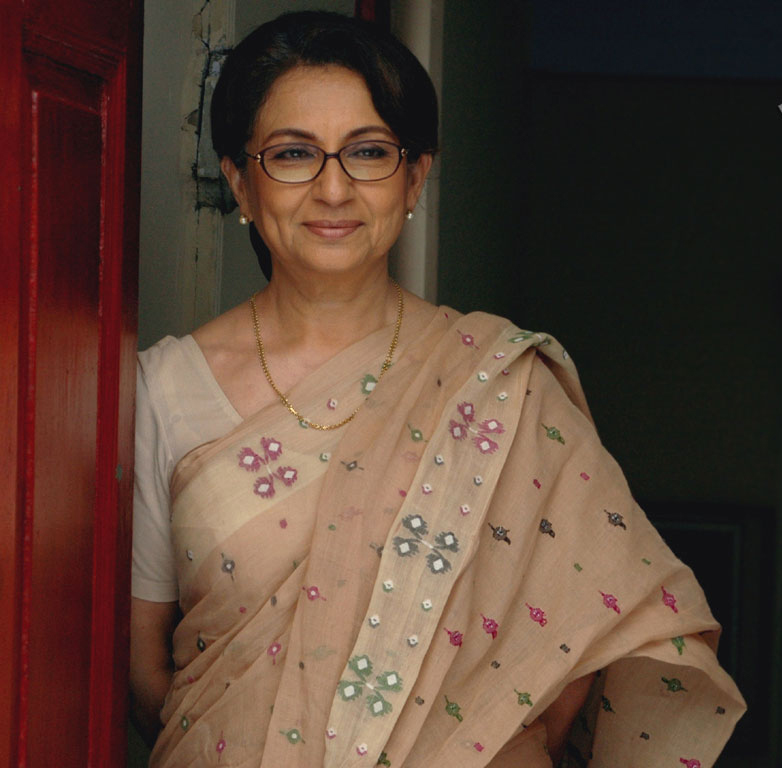
Begum Ayesha Sultana born Shormila Thakur (on 8th December 1946), known by her stage name Sharmila Tagore (Bengali: শর্মিলা ঠাকুর) is an Indian film actress few have unheard of. Born in a Hindu Bengali family in Hyderabad, Andhra Pradesh, to Gitindranath Tagore who was then Dy. General Manager of the British India Company and owner of Elgin Mills, she attended St. John's Diocesan Girls' Higher Secondary School and Loreto Convent, Asansol. She is the great-grandniece of the great poet laureate Gurudeb Rabindranath Tagore (Robindronath Thakur).
In fact she is more closely related to the great Tagore from her mother's side. Her maternal grandmother Latika Tagore was the granddaughter of Rabindranath Tagore's brother Dijendranath. Sharmila has never met Rabindranth Tagore (7 May 1861 – 7 August 1941), but he taught her mother when she went to Shantiniketan. Apparently her mother had received wonderful collections from Tagore like little couplets, drawings, et cetera in her book. But she would never give those to her.
Reason: She had lent Sharmila Gora (a novel) autographed by Tagore himself when she was 12, and she wanting to show off took it to school and lost it! Her mother did not speak to her for months after that. Not surprising, if you were to ask me.
To cut to the chase, I found this piece while trawling the net ...and decided to re-post it here. It makes for an interesting read.
The good news is the famous dimples are still intact.
But if you loved that sweeping bouffant, alas, that’s gone. But Sharmila Tagore doesn’t mind. “I thought I looked nice so I just did it,” she says with a laugh. “But now my children say, ‘Amma, you were very pretty. But that hair ...’”
The bouffant might have bit the dust but Sharmila Tagore is still going strong. Though she hasn’t appeared in too many Hindi films, she had leading roles in two recent Bengali films. In an industry where actresses have notoriously-short shelf lives that’s not a bad innings given that she entered the industry in 1959. She was 13 then. Her director was Satyajit Ray. The film: Apur Sansar.
Tagore cannot even remember clearly how it all came about. “I think someone saw me in front of some school and then Manik-da (Ray) called my father and asked if he had any objections,” she says. “I remember I was wearing a frock at the photo shoot and Manik-da asked if I could wear a sari.”
Ray was already a household name, thanks to Pather Panchali. His newly-discovered hero, Soumitra Chatterjee, was playing Apu. The role of Aparna, Apu’s young bride in Apur Sansar was one any young actress would covet. “But I was quite blase,” confesses Tagore who went on to act in four other Ray films. “I just did whatever everyone told me to do. There was no special enjoyment, no special tension.” She smiles and says what she cherished most was meeting the crew, many of whom became regulars in Ray films. “Durga-da, who did the sound, Bansi-da (Chandragupta), Subrata-kaku,” she ticks them off. “I don’t know why some were ’da (brothers) and some kaku (uncles). They became my pals. Can you imagine they are all gone?”
Ray knew that it would be hard to convince his audience that this sophisticated young Calcutta schoolgirl was the shy village bride Aparna. Tagore remembers she had a scene where she is supposed to hit her co-star Soumitra Chatterjee. “It had a lot of dialog. I said it all, and Manik-da said, ‘Excellent.’ Then he said, ‘Rinku (Tagore’s nickname), ekta kaaj koro. Kichhu bolar dorkar nei. Thappor merey choley jao. (Do something, Rinku. You don’t need to say anything. Just smack him and go.)’ He just cut it all out.”
But Apur Sansar was nothing compared to her next role in Ray’s Devi, where she played the daughter-in-law of an obsessed zamindar who thinks she is a goddess incarnate. Tagore readily says that it was a role she didn’t even fully comprehend while shooting. “I understood the romance of Apur Sansar, but the complications of a woman’s body in Devi were so much more tragic. I had no idea what I was doing till I was in my 30s,” she says. “The face of that girl still haunts me. You know, that film was just close-up after close-up.”
She went on to act in Aranyer Din Ratri, Nayak, and Seemabaddha and got to see Ray evolve as a filmmaker. “I think he peaked with Charulata, Mahanagar, and Aranyer Din Ratri,” she says, though she adds he never lost a certain innocence and simplicity in telling a story.
But did she ever feel comfortable enough to contradict him? She chuckles and says, “Well, in Nayak my character was supposed to wear glasses and I asked, is she long-sighted or short-sighted. He was very pleased. He told someone, ‘You know, Rinku is thinking about her roles now.’”
But her thinking person’s actress image suffered a severe jolt when the girl from the Tagore household left Calcutta to try her luck in Bombay. “My naak-unchoo (snooty) friends were disappointed, but I needed to stand on my own feet. Working with Manik-da was wonderful, but there was no money in it. If you wanted economic independence you had to do other things,” she says frankly. There was also a Bengali connection in Bombay— filmmakers like Shakti Samanta and Sachin Bhaumik who took her under their wings. At that time leading man Shammi Kapoor was being paired with new faces. That’s how she ended up in Kashmir ki Kali.
It wasn’t the smoothest of landings. “My Hindi was bad—Bengali accented—and I was like a piece of cardboard,” she admits. “And I had to learn all these jhatkas.” She remembers being in tears when she watched her first rushes. “There was some song. I thought I was awful. I hated everything from the eye makeup to the song. I didn’t feel like that at all about Aparna in Apur Sansar.” She smiles and then without missing a beat recites the dialog from Apur Sansar. “Tomaar chokhey ki acchey bolo. (What’s in your eyes, tell me.) Kajol. (Kajal) To my wife. Wife maaney jaani (I know the meaning of wife),” she shakes her head. “Beautiful.”
Though after Kashmir ki Kali she was almost ready to pack her bags and go home, she stuck it out and soon became the glamour doll of Bombay. That’s when the Sharmila Tagore of the bouffant and butterfly-knot blouse was created. She says she had no idea she was setting trends. “I was impulsive. I was ready for a new flavor. I guess I had a guardian angel because somehow I landed on my feet.”
Well, almost. When Sharmila Tagore suddenly appeared in a bikini, Calcutta’s intelligentsia choked over their tea. “I was foolish. I didn’t understand the Indian mind,” she says. “Usually the photographer tries to trap you. But in this case he tried to tell me it might not be a good idea. But I said, let’s do it. You know, I was just growing up and making mistakes, but they were my mistakes.” But now, decades later, she says she didn’t realize how much appearances counted not just for her but for her family. “Then heroines wore white saris and hid their whiskeys with coke. I drank whiskey. I smoked cigarettes. But I did everything openly. I lived alone in a hotel. So I was a social suspect.”
But her headstrong attitudes didn’t just raise eyebrows. The glamorous girl-about-town image also trapped Sharmila Tagore the actress. She remembers how in Anupama, the director Hrishikesh Mukherjee tried to de-glamorize her. “He said, ‘Rinku, this is a motherless child. You are very pretty and we’ll give you a backlight. We don’t need the hair.’ But I wouldn’t listen to him. I don’t know why he didn’t sack me on the spot.” She says her looks probably got in the way of any roles in art films as well. “Perhaps I looked too refined. At that time parallel cinema was all about Harijans in Chakra,” she shrugs.
Eventually, there came a point when she almost quit films. “It was those huge posters of An Evening in Paris,” she says. “You could see my arms and legs and it looked like I wasn’t wearing any clothes. My mother-in-law was coming to town. And the driver had to go and remove all the posters.” That was the point when she decided she needed an image makeover. After that she took on films like Aradhana, Safar, and Amar Prem and with Rajesh Khanna became quite the romantic couple.
As an actress she played opposite most of the leading men of her time - Shashi Kapoor, Dharmendra, Sanjeev Kumar, even Amitabh Bachchan. She has fond memories of them all but if she had to pick her leading men, they would be Paul Newman, Soumitra Chatterjee, and Shashi Kapoor. “And some of Dilip Kumar’s performances are fantastic - he is not good-looking but charismatic. He is a complete natural. Like Naseeruddin or Balraj Sahni. Shahrukh is not. Amitabh plays to the gallery but there is a coldness somewhere.”
Though she got along well with her men, it was sometimes a little dicier with the leading ladies. Rumor has it Mala Sinha once slapped her. She says the incident probably happened when she suggested some dance step. “She said I was trying to teach her and was humiliated. I tried to apologize but she screamed, ‘Who does she think she is?’ But I don’t think she slapped me,” says Tagore. “Maybe I was out of turn.” Then there was a time during the making of Daag that her co-star Raakhee stopped talking to her. Tagore admits that happened but says she has no idea why. “God knows who said what. She’d been to my house many times. I went to her wedding. And she stopped talking suddenly.”
But the two returned together a couple of years ago to star in Rituparno Ghosh’s Shubho Muhurat. In fact, Tagore’s latest, most successful forays have been in Bengali films, including Abar Aranye—a sort of sequel to Aranyer Din Ratri, but this time made by Gautam Ghosh. “I signed that film only to reunite with all those people,” she says happily. “We all shared a bungalow and it was so much fun. Soumitra would read poems he was writing on scraps of paper for his granddaughter. Subhendu (Chatterjee) would tell stories. And Samit (Bhanja) was of course very sick at that time but he was with us throwing a fit about bad food. There was such a bond between all of us.” She remembers how Samit Bhanja couldn’t come to the premiere because by then his cancer had spread. They all called him instead. Within a month he was dead. “But he is so alive in the film,” she says. “It was about generosity and heart, not about getting paid. It’s the kind of giving that characterizes us as actors.”
In Bombay she soon found that kind of enjoyment in her roles was harder and harder to come by. “Especially after Amitabh, it became all about the iconic mother, the absent father, and the rebel son. Women’s roles became more and more regressive,” she says. “Now if you see television everything is about puja and the bindis are covering the entire forehead. Even villains have to be men because that’s a decision-making role. Women have to beautiful and good and cry and dance.” And they have to be young too. “In Hindi cinema life stops at 30 whether you are Sharmila or Raakhee or Madhuri,” she says. “But in Bengali an Aparna Sen name still has marquee value.”
Tagore returned to the Bollywood big screen once more for Aamir Khan’s Mann. “But I was disappointed. He showed me something and he made me do something else,” she says without rancor. “It was such a lovely role but from the first day he said ‘moist eyes, moist eyes’ and I just gave up.”
But she has no regrets. Not even for the roles that got away - like Khilona, which made Mumtaz a star, or Haathi Mere Saathi.
Apart from the occasional film role, whether it’s Bengali or English (Mississippi Masala), she dabbles in television and happily spends her time gardening, reading, listening to music, watching television. “And I love to loaf. I can do nothing for days. I am very content,” says Tagore. Son Saif Ali Khan is a bona fide star now, one daughter designs jewelry, the other, after working at Ford Foundation, is venturing into films.
Her marriage to cricketer Mansour Ali Khan of Pataudi was a glamorous inter-religious marriage that people said would never work. But it did, though at one point she remembers she awoke to find the government had sent a bodyguard because of death threats. Now she says it’s mostly just a tangle of names. “I was Mrs. Khan in the kids’ school. I am Ayesha Begum of Pataudi. I am Sharmila Tagore. I am Rinku.” Then she chuckles, “When I wanted to print a card we had huge debates.” But in the end she decided, “Ultimately I am just Sharmila Tagore.”



 Posts
Posts